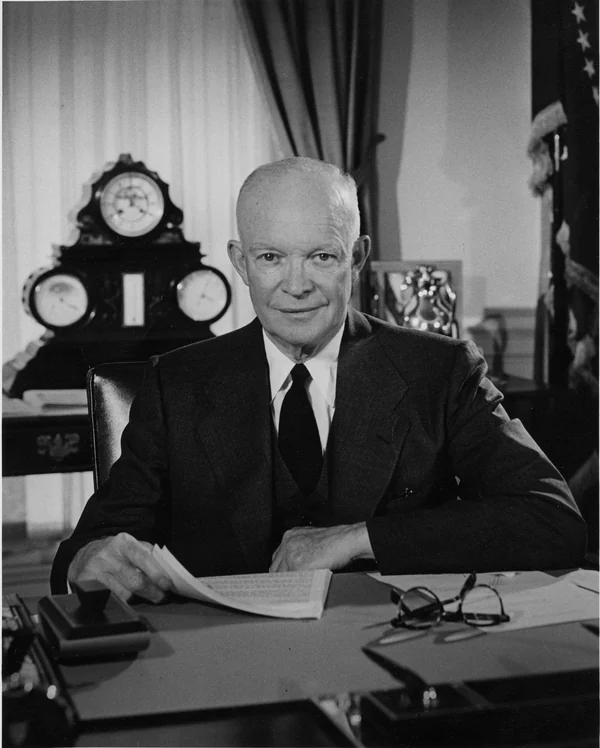
Dwight D. Eisenhower’s presidency began while fighting continued in Korea. His presidential library describes efforts to end hostilities through diplomacy and military pressure, alongside a broader military buildup and European defense commitments. That setting helps explain a record concerned with national-security employment, protected information, and military conduct. Context is not proof that a particular event caused every order: the individual directives supplied specific rules for managing personnel, information, or enforcement. Their legal reach depended on their text and authority, not simply on the administration’s concern about the Cold War. Primary record
His record also includes civilian equality policy. EO 10590 established a President’s Committee on Government Employment Policy and affirmed nondiscrimination based on race, color, religion, or national origin. Agency heads retained responsibility for civilian personnel practices, while employment-policy officers and a presidential committee reviewed complaints and offered advice. This belongs beside the security orders, because both concerned federal employees but performed different functions. A government can announce equality standards and maintain intrusive security screening at the same time; understanding Eisenhower’s record requires reading those mechanisms separately. Primary record
Security screening and its judicial limits
Cole v. Young (1956) imposed an important statutory limit on the program. The Court examined the dismissal of a federal employee under the 1950 security-removal law as extended by EO 10450. It held that the law’s exceptional dismissal powers were limited to positions affecting national security. The agency had not established that connection for the employee’s job. The ruling did not eliminate every investigation or invalidate the entire order, but it rejected use of the statutory shortcut without the required relationship to national security. It illustrates judicial review of implementation, rather than a blanket endorsement of all executive security claims. Primary record
Classification and military conduct
EO 10501 replaced Truman’s information-classification order. Signed in November 1953 and effective that December, it used Top Secret, Secret, and Confidential categories for defense information. It allocated classification responsibilities, controlled transmission and access, and provided procedures for downgrading or declassification. It also required review to prevent improper withholding and assigned continuing oversight within departments and the National Security Council. These provisions show classification as an administrative system with both protective and review functions, rather than a general permission to label all inconvenient information secret. Primary record
Contracting policy and later presidents
EO 10479 established the Government Contract Committee in 1953 to address compliance with nondiscrimination provisions in federal contracts. It coordinated agency attention to contract practices and replaced Truman’s earlier contract-compliance committee. This was distinct from EO 10590’s focus on the government’s own workforce. Federal procurement and direct federal employment created different administrative relationships, so the committee structures should not be collapsed into a single order. The contracting directive demonstrates Eisenhower’s use of executive instructions to oversee how existing federal purchasing policies operated. Primary record
Activity across the term
Dwight D. Eisenhower’s dated executive-order records are grouped by signing calendar year. Transition years include only this president’s orders.
Executive Order 10730 responded to obstruction of school desegregation in Little Rock in September 1957. Arkansas Governor Orval Faubus had used the state National Guard to prevent Black students from entering Central High School. After the guard withdrew, violence and disorder again obstructed attendance. Eisenhower’s order authorized federal military action, including federal control of Arkansas National Guard units, to enforce the district court’s orders and remove obstruction of justice. The intervention protected the Little Rock Nine’s access to the school; it was a concrete enforcement measure rather than an order that itself decided the constitutional question of segregated education. Primary record
EO 10450 replaced Truman’s loyalty program in 1953 with an employment-security system. It made agency heads responsible for ensuring that civilian employment was consistent with national security and required investigations of applicants. Its criteria extended beyond disloyalty to conduct and vulnerabilities considered security risks. The original order also included discriminatory language concerning sexuality. That language must be understood as a feature of the historical policy, not repeated as an acceptable modern standard. The directive’s breadth affected who could enter or remain in federal service and gave personnel decisions a national-security framework. Primary record
Executive Order 10631 prescribed a six-article Code of Conduct for members of the armed forces in August 1955. The code addressed resistance to surrender, behavior after capture, duties to fellow prisoners, and limits on information given to captors. The original order also directed instruction for personnel vulnerable to capture. Its instrument was a statement of military responsibilities supported by training, not a new civilian criminal statute. Readers should distinguish the expectations expressed in the code from the separate laws and military regulations governing disciplinary proceedings. Primary record
Little Rock: enforcing court-ordered desegregation
The legal relationship ran from court judgment to executive enforcement. In Cooper v. Aaron (1958), the Supreme Court rejected an effort to delay the Little Rock desegregation plan because of the disorder. The opinion recounted the resistance and federal military intervention and reaffirmed the binding effect of the Court’s constitutional interpretation in Brown. Cooper was not a decision striking down EO 10730. It concerned school officials’ obligations and state resistance. Calling it a lawsuit invalidating Eisenhower’s military order would reverse the relationship between the order and the courts in this episode. Primary record
Classification and military conduct
The National Archives codified version shows how this military directive survived through amendment. Reagan’s EO 12633 changed the training paragraph and Articles I and II in 1988. Earlier and later amendments also adjusted departmental responsibilities, including changes involving the Coast Guard. This is a useful example of continuity: later presidents did not have to discard the code to revise wording or responsibility. Because codification incorporates amendments, its current-looking text should not be mistaken for every word Eisenhower signed in 1955. Primary record
Contracting policy and later presidents
The classification system was revised by successors before being replaced. Kennedy’s EO 10964 amended EO 10501, including arrangements for classification and declassification review. Nixon’s EO 11652 then superseded Eisenhower’s order as amended, with the replacement taking effect June 1, 1972. The development is a chain of administrative revision, not evidence that Eisenhower’s precise rules remained permanent. EO 10730, by contrast, addressed a particular enforcement crisis; its significance lies in that intervention, rather than a continuing nationwide school-management program. Primary record
Nixon’s replacement expressly identified EO 10501 and the intervening amendments. That express provision lets readers establish the change in governing instructions without assuming that a later president’s silence preserved every older classification rule. Primary record
Four Eisenhower evidence guides appear in the curated historic collection. They highlight enforcement, security, classification, and military conduct, while the administration’s total of 484 orders covers a much wider administrative record.