EO-centered presidential profile

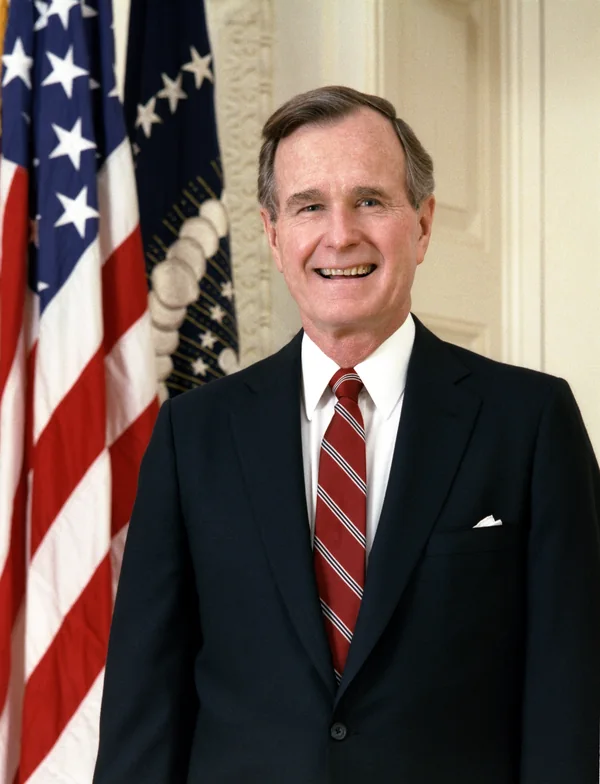
George H. W. Bush

Bush used executive orders for international sanctions, maritime immigration enforcement and the internal standards of the federal government. His Iraq measures demonstrate how a declared emergency could become detailed restrictions administered across agencies. Read the primary record.

41st president1989–1993 · Years in office
166 ordersHistorical executive-order total
EO 12668–12833Numbered EO range

How this president used executive orders

  • Iraq, sanctions and weapons proliferation

    EO 12735 of November 16, 1990, addressed chemical and biological weapons proliferation as a national emergency. It directed coordinated export controls and provided for sanctions against foreign persons contributing to proliferation and foreign countries engaged in specified unlawful activities. State and Commerce had distinct responsibilities, with other departments involved in implementation and decisions about restrictions. This was broader than sanctions against a single government: it sought to regulate transactions and assistance capable of supporting weapons programs. The order’s stated international-cooperation objective placed export licensing and economic restrictions within a wider nonproliferation policy. Primary source.

  • Haitian migration and maritime interdiction

    In Sale v. Haitian Centers Council (1993), the Supreme Court considered challenges to this return policy. The majority held that the relevant Immigration and Nationality Act provision and Article 33 of the Refugee Convention, applicable through the protocol, did not prohibit the challenged high-seas returns. The case was decided after Clinton took office, but concerned the policy established by Bush and continued by his successor. Justice Blackmun dissented from the majority’s reading. The outcome should be stated precisely: the Court resolved the claimed extraterritorial statutory and treaty restrictions, rather than declaring all immigration enforcement immune from judicial review. Supreme Court opinion.

  • Ethics and the handling of classified information

    EO 12829 of January 6, 1993, created the National Industrial Security Program for federal classified information shared with contractors, licensees and grantees. It aimed to coordinate government requirements and reduce unnecessary burdens while protecting secrets. The order assigned policy oversight and operating responsibilities, including preparation of a program manual. Industrial security concerns the handling of information outside ordinary government offices, making common standards important across agencies and private firms. Clinton amended the order through EO 12885 in December 1993 to extend the deadline for issuing the operating manual; he did not simply discard the program. Primary source.

  • Civil justice and later presidential changes

    EO 12778, signed October 23, 1991, addressed costs and delays in civil litigation involving the federal government. It urged settlement efforts, streamlined discovery, appropriate expert testimony and better case management, and required attention to clarity in legislative and regulatory drafting. These were instructions to agencies and government litigation counsel, with the stated aim of providing an example for other litigants. The order did not rewrite every court’s procedural rules. Clinton revoked it with EO 12988 in 1996, replacing Bush’s instrument with a new civil-justice framework that likewise addressed government litigation and drafting. See Clinton’s replacement order. Primary source.

Activity across the term

George H. W. Bush’s dated executive-order records are grouped by signing calendar year. Transition years include only this president’s orders.

Executive orders by calendar year

1989–1993

  • 198931
  • 199043
  • 199146
  • 199240
  • 19936

Major events and executive response

Direct response

Iraq sanctions after the invasion of Kuwait

EO 12722, issued August 2, 1990, declared a national emergency and blocked property of Iraq’s government, agencies, controlled entities and central bank within US jurisdiction or the control of US persons. It also prohibited specified imports, exports, transport, commercial contracts and financial transactions. Treasury received authority to implement the measures in consultation with State, and agencies were directed to act within their existing authority. The restrictions included exceptions for publications and informational materials, and particular humanitarian exports. The order was an economic instrument, rather than the document authorizing the later military campaign. Primary source.

Direct response

Dangerous voyages from Haiti and maritime interdiction

EO 12807 of May 24, 1992, directed interdiction at sea and return of certain migrants traveling toward the United States. Its preamble described dangerous voyages from Haiti, unsafe vessels and loss of life. It authorized Coast Guard action outside US territorial waters and directed arrangements for returning vessels and passengers. The order revoked Reagan’s EO 12324. It also stated that the treaty prohibition on return to persecution did not apply outside US territory, making the treatment of refugee protection beyond US borders central to its legal controversy. The order was therefore more than a generic border-management instruction. Primary source.

Same policy response

Government-wide ethical standards

EO 12674 of April 12, 1989, established principles of ethical conduct for executive-branch officers and employees. It covered conflicting financial interests, misuse of nonpublic information, gifts, impartiality, public property and the appearance of improper conduct. The Office of Government Ethics was instructed to produce comprehensive standards, and agencies were assigned training and implementation responsibilities. This approach sought consistent expectations across departments rather than leaving each office to devise unrelated rules. Bush modified the framework through EO 12731 in October 1990, demonstrating that a government-wide standard could be refined during the same presidency. Primary source.
Iraq, sanctions and weapons proliferation

Bush’s Iraq sanctions responded to the invasion of Kuwait. In explaining the later termination of the original emergency, George W. Bush identified that invasion as the reason for EO 12722 and described the modification of sanctions through EO 12724 following United Nations Security Council Resolution 661. The distinction matters because the sanctions developed through successive orders and international decisions. Treating EO 12722 as a single, unchanging embargo obscures both its initial purpose and its later adjustment. It also separates the executive-order record from other diplomatic and military decisions during the Gulf crisis. Primary source.

Civil justice and later presidential changes

In 1994, Clinton’s EO 12938 revoked EO 12735 and established a broader weapons-of-mass-destruction framework encompassing nuclear, chemical and biological weapons and their means of delivery. It preserved specified administrative actions under earlier authorities rather than wiping every prior measure away. The Iraq emergency changed later: George W. Bush’s EO 13350 terminated the emergency declared in 1990 while continuing specified restrictions involving previously blocked property and shifting other measures to newer authorities, as recorded in EO 13350. These changes show why the historical phrase “Bush’s sanctions” cannot identify the legal basis for every later restriction. Primary source.

Maritime interdiction also outlasted Bush’s term through modification. Federal Register disposition information records EO 12807 as amended by George W. Bush’s EO 13286 in 2003. That amendment accompanied the transfer of responsibilities to Homeland Security. The later administrative change is different from the Supreme Court’s 1993 ruling, and neither should be confused with the text and agency structure originally issued in 1992. A June 30, 2025, memorandum on Cuba expressly stated that it did not affect EO 12807, preserving that order rather than replacing it. Primary source.

Use the historic guides

The curated historic collection includes detailed Bush guides for Iraq sanctions and Haitian maritime interdiction. It represents selected orders rather than the full 166-order presidency. Follow their evidence and subsequent changes before treating an original direction as a present-day rule.

Record sources

George H. W. Bush’s executive-order total and numbered range · Compare presidential records