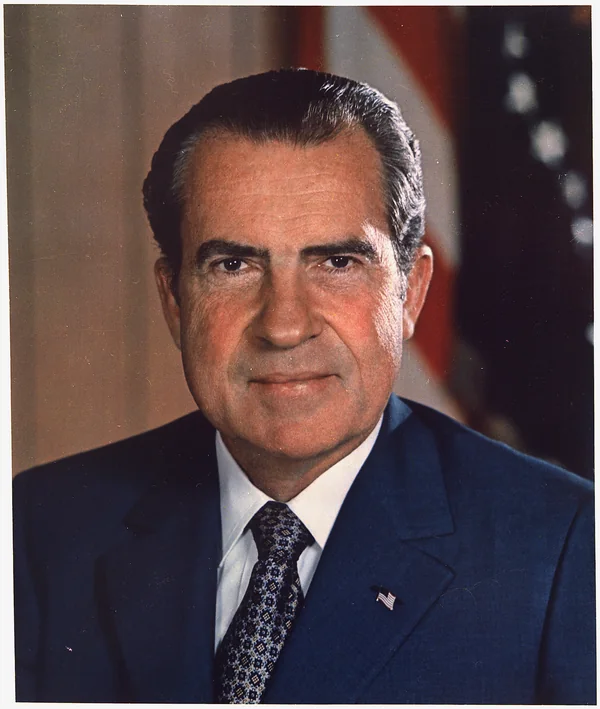
Nixon’s executive orders ranged from wage and price controls to federal employment equality, minority enterprise, environmental administration and management of classified information. The record includes both new arrangements and revisions to policies inherited from earlier presidents.
Inflation and the international position of the dollar supplied the context for Nixon’s broadest economic directive. The preamble to EO 11615 identified price stability, unemployment, world trade and purchasing power as reasons for action. Nixon relied on the Economic Stabilization Act of 1970, as amended, rather than claiming an unlimited constitutional power to set private wages. The order established a program and delegated its administration, illustrating how executive action could activate discretion Congress had already granted. Primary source.
Management, environment and national security
EO 11652 addressed classification and declassification of national security material in 1972. It assigned oversight to the National Security Council with an Interagency Classification Review Committee, required departmental procedures and training, and provided for systematic review of classified information. The Archivist also received authority concerning presidential papers in archival custody, subject to stated conditions. This was an administrative framework for both protection and eventual release of records; reading only its secrecy provisions misses the review duties. Carter’s EO 12065 later revoked this framework, as the National Archives codification records. Primary source.
Selected orders, not the complete presidency
Browse the curated historic-order collection for Nixon’s four selected guides. They explain particular directives and their later changes; the full presidential total is 346, as shown in the comparison table.
Activity across the term
Richard Nixon’s dated executive-order records are grouped by signing calendar year. Transition years include only this president’s orders.
EO 11615 imposed a 90-day stabilization period beginning August 15, 1971, for prices, rents, wages and salaries. The ceilings were tied to transaction levels in a specified preceding period, and raw agricultural products were excluded from the provisions stated in sections 1 and 2. The directive also created the Cost of Living Council and delegated stabilization powers to it. This was a temporary regulatory intervention with implementing machinery, not simply an appeal for voluntary restraint by employers and consumers. Primary source.
The 1970 reorganization of presidential management
EO 11541 delegated functions transferred under Reorganization Plan No. 2 of 1970 to the director of the Office of Management and Budget. It preserved existing Bureau of the Budget actions until amendment or revocation and assigned the Domestic Council work on national needs, priorities and policy advice. The order thus helped operate the reorganization while maintaining continuity in administration. The existence of a numbered executive order should not obscure the separate legal contribution of the reorganization plan on which it relied. Primary source.
Implementing the National Environmental Policy Act
EO 11514 directed agencies to protect environmental quality in furtherance of the National Environmental Policy Act. It called for monitoring the environmental consequences of government activity and procedures to obtain public information and views. The Council on Environmental Quality had a coordinating role. The directive should be understood alongside the statute it implemented: Nixon did not create the entire environmental review system solely by signing this order. Its contribution was to direct executive agencies’ conduct and organize responsibilities for putting national environmental policy into practice. Primary source.
EO 11478 established an affirmative equal-employment program for federal civilian workers in August 1969. Agency heads were responsible for recruitment, employee development, supervisory training and assessment of their programs. It superseded the federal employment portion of Johnson’s EO 11246, while contractor requirements remained a separate framework. The distinction is fundamental: the federal government was acting as employer under Nixon’s directive, rather than imposing the same personnel procedures on every private company throughout the United States. Primary source.
EO 11458 directed the commerce secretary to develop and coordinate a national minority-business effort in March 1969. The secretary could bring agencies and private-sector representatives together, recommend changes and maintain an information center. An advisory council supplied additional expertise. The order instructed agencies to cooperate but did not transfer all their legal functions to Commerce. That balance between coordinating responsibility and retained agency authority helps explain how the initiative was designed to work across an already complicated federal administration. Primary source.
Nixon replaced EO 11458 with EO 11625 in October 1971. The successor retained Commerce leadership, added reporting and information requirements, and expressly superseded the original directive. The policy continued through a replacement order rather than an untouched 1969 text. Successor order.
Economic intervention and a direct court challenge
The freeze was challenged in Amalgamated Meat Cutters and Butcher Workmen v. Connally. A union sought wage increases already negotiated in collective bargaining agreements, while employers argued that paying them would violate EO 11615. The three-judge court denied an injunction against the stabilization program and examined Congress’s delegation of authority, the temporary character of the measure and the legal standards governing administration. This case directly involved Nixon’s executive order; it is a more specific example of judicial review of his economic directives than litigation over presidential privilege. Court opinion.
The National Archives disposition table records that EO 11615 was amended by EO 11617 and then superseded by EO 11627 on October 15, 1971. That replacement came before the initial 90-day horizon. Further stabilization orders followed, so the original freeze should not be described as the complete wage-and-price regime or as a permanent rule. Its legal afterlife began with Nixon’s own revisions: the date of a signature tells only the start of a policy that later instructions could restructure. Primary source.
Inherited policies, courts and later presidents
Nixon’s Labor Department implemented the Philadelphia Plan under Johnson’s EO 11246. In Contractors Association of Eastern Pennsylvania v. Secretary of Labor, the Third Circuit upheld that implementation in 1971, grounding its discussion in federal procurement and assistance conditions. The plan was an administrative use of an inherited executive order, rather than a separate new Nixon numbered directive. This distinction makes the contractor litigation useful evidence of continuity across presidents without attributing Johnson’s original signature to Nixon. Court opinion.
Carter amended EO 11478 through EO 12106 in 1978, adding disability and age and changing enforcement responsibilities. Nixon’s framework continued through revision. Employment amendments. Trump’s EO 14173 later revoked Obama’s EO 13672, which had amended the federal and contractor orders. Later revocation.
The management framework also changed. The National Archives codification records Carter-era revisions transferring executive personnel functions and describes the abolition of the Domestic Council under EO 12045 in 1978, with functions transferred to the Domestic Policy Staff. OMB’s continuation is distinct from survival of Nixon’s particular Domestic Council design. Primary source.