Executive Order 12612: Federalism
President: Ronald Reagan · Government operations and workforce
Reagan directed executive agencies to assess how federal policies affect states and the division of governmental powers.
Research depth: Expanded historical analysis. About this collection
Status: Revoked — by EO 13083 in 1998.
- Signed
- October 26, 1987
- President
- Ronald Reagan
- Current position
- Revoked by EO 13083 in 1998; EO 13132 expressly revoked it again in 1999
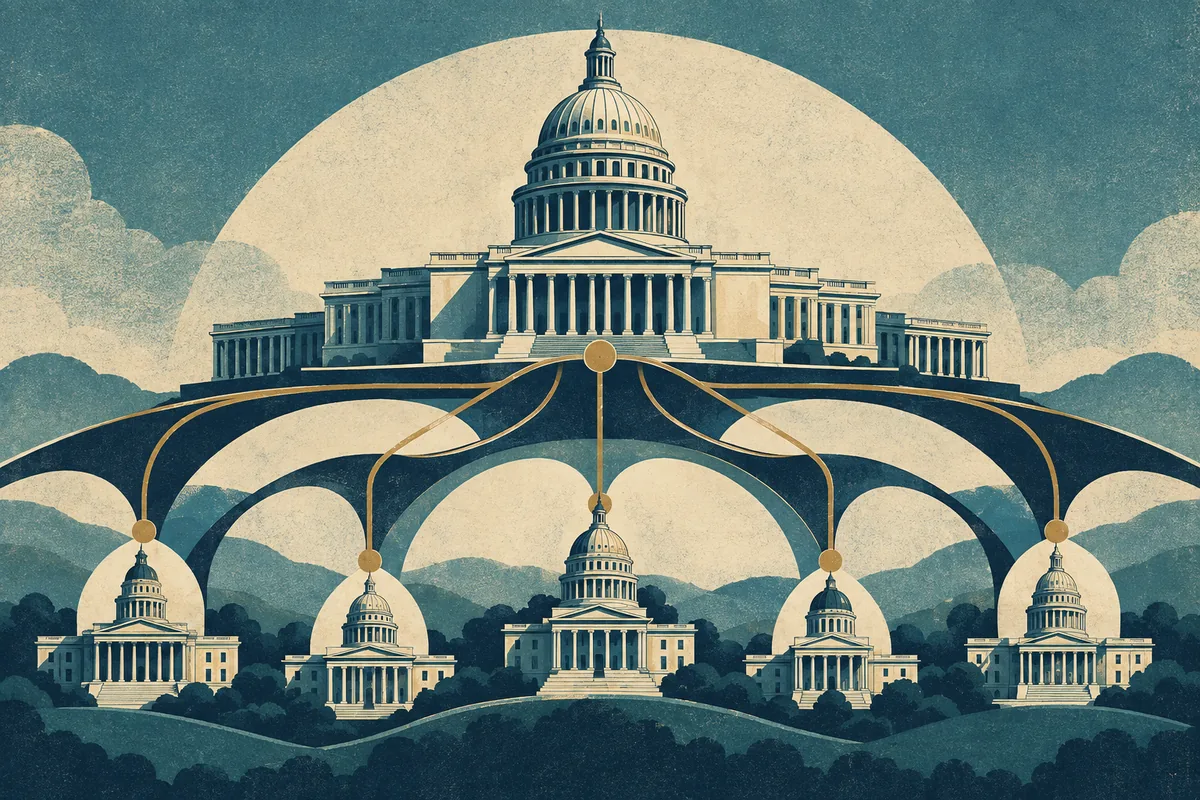
What the order directed
Agencies were to examine constitutional and statutory authority, avoid unnecessary limits on state policy discretion, and prepare federalism assessments for certain proposals. These were internal executive-branch policy instructions.
Why it was signed
President Reagan signed EO 12612 on October 26, 1987; the National Archives identifies its publication at 52 FR 41685. It was an instruction to executive departments and agencies on how to consider federalism in policy development. Its opening account of the Framers' intentions and state sovereignty expressed the administration's reasoning. The operative sections then defined covered policies and the duties of federal officials. The order neither amended the Constitution nor allowed an agency to disregard a statute or a controlling court ruling. Archived EO 12612 text.
The guide's earlier short status compressed a complicated succession into a single 1999 revocation. Official disposition tables show that EO 13083 revoked EO 12612 on May 14, 1998, then EO 13095 suspended the newer order on August 5, 1998. EO 13132, signed August 4, 1999, expressly revoked EO 12612 again alongside the intervening orders. This sequence needs to be recorded without asserting that the 1998 suspension automatically reinstated every provision of the 1987 order. National Archives 1998 disposition table; archived White House EO 13132, section 10.
What the text authorized
Section 1 defined policies with federalism implications by their substantial direct effects on states, the federal-state relationship, or the distribution of governmental powers. Section 2 stated principles for agency consideration; section 3 set policy criteria subject to existing law. Departments were to examine constitutional and statutory authority for actions limiting state discretion, consult states where practicable, and leave administrative flexibility where national programs were administered by states. These directions shaped agency process and interpretation rather than conferring an unconditional veto on state officials. EO 12612, sections 1–3.
The order's special preemption rules required agencies, to the extent permitted by law, to look for express statutory authorization, compelling evidence of congressional intent, or a direct conflict before construing federal law to displace state law. It urged consultation where a conflict was foreseen and limited regulatory preemption to what was necessary for a statute's objectives. This was an executive instruction about how agencies should approach federal statutes; it was not a presidential change to the meaning of every statute or an overruling of judicial preemption doctrine. EO 12612, section 4.
The text also called for federalism assessments for specified proposed policies and gave the Office of Management and Budget a role in reviewing compliance. Its scope and procedural limits matter: not every regulation necessarily needed a full assessment, and the order did not prove that a particular agency consulted the states or changed a final rule. Evidence about a named rule would require the agency's own proposed rule, preamble, assessment, and administrative record. A statement that the order generally directed assessments should not be recast as a finding that agencies always produced them. EO 12612, sections 5–8.
What happened in practice
EO 13083 was signed on May 14, 1998 and published on May 19. The National Archives disposition table expressly lists EO 12612 among the orders it revoked. Thus the first documented express revocation was in 1998, a year earlier than the old guide implied. The May order was itself suspended by EO 13095, signed August 5, 1998 and published August 7. Suspension of EO 13083 is a distinct event from revocation of EO 12612; the sources should not be flattened into a single uninterrupted policy. National Archives 1998 disposition table.
Clinton's EO 13132 set out a successor framework in August 1999, including consultation with state and local officials and federalism summary impact statements in specified cases. Its section 10(b) expressly revoked EO 12612, EO 12875, EO 13083, and EO 13095. The published order is later primary evidence for both the final revocation and the nature of the replacement. The intervening 1998 actions are still relevant to historical timing, even though the 1999 order closed the succession. Archived White House EO 13132; National Archives 1998 table.
A modern rule's federalism statement can be evidence that its agency evaluated EO 13132, but such a statement should not be presented as implementation of EO 12612 after the latter was revoked. Nor does a generic rule preamble prove that state consultations resolved every concern. This review establishes the presidential succession from official records; it does not audit every rule made under either administration. The narrower conclusion protects the distinction between a binding instruction for executive agencies at one time and later administrative practice under another order. EO 12612; EO 13132.
Reaction and legacy
EO 12612 is historically important as a federalism review framework, but its current legal status is revoked. The successor text of EO 13132, current statutes, and court decisions must be checked for present-day duties. The 1987 order's statement that agencies should avoid unnecessarily limiting state discretion is not itself a present-day rule conferring new authority on states. A reader comparing administrations should examine the actual criteria and preemption language of each order. EO 12612 text; archived EO 13132.
The policy history also illustrates a general caution with executive-order timelines. 'Revoked in 1999' is incomplete when an express revocation occurred in 1998 and the replacing order was suspended soon afterward. But 'revoked in 1998' alone omits the fresh, express revocation and successor framework in 1999. Recording all three stages explains why an agency citation from a particular year must be read against the directive that governed then. National Archives 1998 disposition table; EO 13132, section 10.
Federalism analysis as an executive rule
EO 12612 instructed federal agencies to consider federalism implications when developing policies and regulations. It was an internal executive decision process about the balance of national and state authority. It did not itself amend the Constitution, confer a state veto over every federal action or invalidate legislation enacted by Congress. NARA EO 12612.
The order’s criteria and consultation expectations should be read with its exceptions and definitions. A particular regulation’s legal authority still comes from the statute or constitutional source that empowers the agency. A federalism assessment can influence executive choices without replacing judicial review. EO 12612.
EO 13083 revoked EO 12612 in 1998, and EO 13132 later expressly revoked it again while installing a different federalism framework. The apparently redundant chronology is worth explaining rather than smoothing away. A current agency instruction is not simply Reagan’s 1987 order continuing unchanged. NARA 1998 disposition; Clinton federalism order.
To investigate compliance in its active period, examine an agency’s federalism assessment, consultation and rulemaking record. The order’s existence does not prove that every agency consulted every state or that any particular rule was revised in response. Those are document-specific questions. NARA EO 12612.
Federalism disputes often also involve preemption and Congress’s enumerated powers. EO 12612 was one presidential management response to those concerns, not the full legal test for them. A guide can explain its executive instructions while directing readers to the law and judicial decisions for a concrete dispute. EO 12612.
Its historical significance lies in formalizing a review lens and in the later replacement sequence. A claim that an order “protected states’ rights” as an outcome needs evidence of implementation; the signed text establishes a process and policy preference. NARA codification.
Federalism assessments in agency work
The order asked executive officials to consider how proposed federal actions affected state authority and responsibilities. It established principles for the administration’s own decisions. An assessment could inform a rule’s design, but was not a constitutional holding or a state government’s absolute veto. NARA EO 12612.
A regulation’s legal basis remains its authorizing statute. Even a strongly worded federalism principle in an order cannot override Congress’s valid command. The “to the extent permitted by law” structure and exceptions should be understood in that light. EO 12612.
State consultation is not the same as state consent. To assess one federal rule, find the consultation record, the agency’s explanation and any response from states. The order alone cannot establish that views were solicited or followed in a specific case. NARA order.
Federalism impacts can be fiscal, administrative or legal. A guide should say what a proposed policy actually required states to do, rather than call it “unfederal” merely because it had national effects. The 1987 order provides a lens for executive review, not a general verdict. EO 12612.
The unusual revocation sequence
EO 13083 revoked EO 12612 in 1998. Clinton’s EO 13132 later expressly listed the Reagan order among the revoked instruments while establishing a revised federalism policy. This two-step history should be given with dates instead of silently “corrected” into one revocation. NARA 1998 disposition; 1999 federalism order.
A present agency federalism analysis may be related in theme to EO 12612 without deriving its current legal force from that revoked text. Use the successor and later amendments for today’s process. EO 13132.
Congressional preemption and constitutional disputes are resolved through statutes and courts. An executive order can guide the administration’s interpretation and drafting, but it does not decide a state’s judicial challenge by itself. NARA EO 12612.
Its legacy is a traceable executive review framework. Claims that it changed outcomes in a named policy area need the agency record, not an inference from the order’s aspirational principles. EO 12612.
The successor’s different mechanism
EO 13132 in 1999 established a successor federalism policy with consultation provisions and specified federalism summary impact statements. These requirements belong to the successor text, not to EO 12612 after its revocation. Clinton archived order.
The first express revocation was EO 13083 in 1998, as NARA records. The later EO 13132 repeated the revocation while replacing the controversial interim framework. Both dates can appear in a careful chronology without being a contradiction. NARA 1998 table.
A modern regulation’s federalism statement can show compliance with a later order, but not implementation of the already revoked Reagan instrument. The policy theme may persist while the governing document changes. EO 13132.
For a historical rule from 1988, by contrast, EO 12612 may have been relevant. Always place an agency action against the framework in force on its date. NARA EO 12612.
One policy theme, three orders
Reagan’s EO 12612, Clinton’s EO 13083 and Clinton’s EO 13132 form a short but consequential succession. The first was revoked by the second; the third then established a new federalism approach and expressly listed the first again. A timeline prevents the later repeated reference from being mistaken for the first revocation. NARA 1998 table; EO 13132.
An agency consulting states in 2000 would be acting under the later framework, not the revoked 1987 text. An agency preparing a 1990 rule could have been under EO 12612. The action date selects the relevant source. NARA EO 12612.
Executive consultation cannot substitute for Congress’s statutory choice or a court’s preemption ruling. The order’s policy function is real but bounded. EO 12612.
Its legacy lies in the evolution of federalism review within executive agencies, not in a timeless constitutional rule stated by one president. EO 13132.
A rulemaking example
For a federal regulation drafted in 1989, one could inspect whether the agency identified federalism implications, consulted relevant state officials and explained its choice. The existence of EO 12612 establishes the executive review expectation, not proof that a particular docket met it. NARA EO 12612.
For a regulation drafted after the 1998 revocation, use the successor framework instead. A later federalism impact statement is not retroactive compliance with Reagan’s order. NARA 1998 table; EO 13132.
The two-step revocation history is unusual but documented. It should remain visible in the guide rather than being forced into a single date for convenience. NARA 1998 table.
A supersession caveat
The 1998 revocation is directly documented in NARA’s disposition table; the 1999 successor also listed EO 12612. A guide should report both events rather than erase one for a simpler date. NARA 1998 table; EO 13132.
Consultation and federalism-impact requirements in the successor order are not 1987 Reagan provisions. Dating them properly prevents a modern regulatory analysis from being attributed to a revoked historical instruction. EO 13132.
A useful way to test the historical policy is to compare an agency’s federalism assessment before and after consultation with state officials. The record may show a changed rule, a reasoned rejection of state objections or no documented consultation. The order establishes an executive expectation, but only a rulemaking file can show what happened in one case. NARA EO 12612.
Common questions
Did EO 12612 give states a veto over federal regulations?
No. It directed federal agencies to consider state interests, consult where practicable, and apply criteria within constitutional and statutory limits. It did not change federal statutes or grant a categorical state veto. Whether a particular rule complied with the relevant process requires its administrative record. EO 12612, sections 3–5.
Was it revoked in 1998 or 1999?
Both dates matter to the documentary sequence. EO 13083 expressly revoked EO 12612 in May 1998 and was suspended in August 1998. EO 13132 then expressly revoked the older order again in August 1999 while installing its own federalism framework. The suspension record does not by itself establish that all the older order's duties resumed. 1998 disposition table; EO 13132, section 10.
Does EO 12612 set agency policy today?
It has been expressly revoked. For a current question, examine the applicable successor presidential instructions, statutes, and court rulings; for a historical agency rule, identify which direction governed at that time. A contemporary rule that cites EO 13132 does not retroactively implement EO 12612. EO 13132.
What happened later
EO 13083 expressly revoked EO 12612 in May 1998, then EO 13095 suspended that replacement in August. EO 13132 expressly revoked the earlier order again in August 1999 and set a successor framework. The suspension alone does not establish that every 1987 provision was restored.
Evidence timeline
Why this order matters
The order formalized federalism review within agency policymaking and shows how presidential directives can shape the preparation of regulations.
Sources and historical records
- National Archives — EO 12612 text Official or archival record
- National Archives — EO 13083 and EO 13095 disposition Official or archival record
- Archived White House — EO 13132 successor Official or archival record
- Federal Register — EO 12612 record Official or archival record
Last recorded source review: September 28, 2026. Historical impact and current legal effect are distinct; follow the later sources for the current position.