Executive Order 14367: Designating Fentanyl as a Weapon of Mass Destruction
President: Donald J. Trump
Designated illicit fentanyl and core precursor chemicals as weapons of mass destruction for executive-branch coordination and directed enforcement, financial, intelligence and response actions.
Status: In effect.
Is Executive Order 14367 still in effect? Yes. The December 15, 2025 interagency directive is reflected in Treasury’s April 23, 2026 sanctions action and the May 4 drug strategy. The sanctions used separate authorities; the designation does not itself create a criminal offense. Official evidence checked October 17, 2026.
What does Executive Order 14367 do?
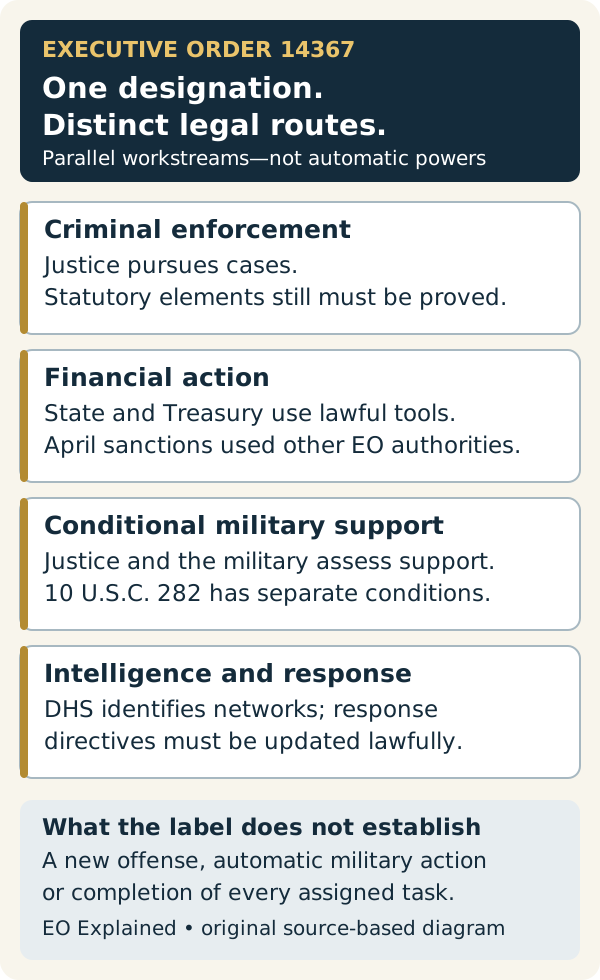
The order defines illicit fentanyl by reference to Controlled Substances Act violations and directs agencies to use existing authorities. The designation is an executive policy and coordination direction; it does not by itself create a new criminal offense, alter statutory drug schedules or automatically trigger every federal WMD statute.
Reading the operative provisions of Executive Order 14367
EO 14367 designates illicit fentanyl and specified precursor chemicals as weapons of mass destruction for federal coordination and directs enforcement, financial, intelligence and emergency-response actions. The Federal Register text limits the designation to illicit substances and related conduct described in the order; it does not treat legitimate medical fentanyl used under prescription as a weapon.
The designation changes executive-branch priorities and calls agencies to use existing tools. Criminal penalties, controlled-substance rules and sanctions still depend on statutes and regulations. A presidential order cannot by itself create a new criminal offense or remove statutory elements prosecutors must prove. Emergency response and intelligence agencies also retain their own legal limits and operational procedures.
Public-health responses remain important because illicit fentanyl causes overdose deaths and treatment needs. The designation does not replace prevention, naloxone access, addiction treatment or the work of local health systems. Agencies should distinguish illicit distribution networks from hospitals, pharmacies and patients using lawful medicine. To understand implementation, check the agency actions, prosecutions and public-health strategy cited on this page rather than infer that the label changes every fentanyl-related activity.
An implementation record supplies a useful distinction. On April 23, 2026, Treasury announced sanctions against 23 individuals and entities in a Sinaloa-linked procurement network. It explicitly said the action furthered EO 14367, but identified EO 14059 and EO 13224, as amended, as the designation authorities. The policy connection and the legal sanctions authority are not interchangeable. Treasury’s dated action and authority statement.
The National Drug Control Strategy released on May 4, 2026 connects EO 14367 to a whole-of-government approach and plans for improved inspections, analytics and task-force operations. Those passages document a strategy and planned activity. They do not show that every installation has received new equipment, every directive has been updated, or every contemplated investigation has resulted in a conviction. Dated release; Strategy, printed pages 6, 13 and 31–32.
Before and after
Before the order
Fentanyl trafficking was prosecuted under the Controlled Substances Act and related conspiracy, money-laundering and sanctions laws.
Federal chemical-incident and counter-WMD programs operated under their existing mandates.
After the order
Agencies were directed to coordinate investigations, prosecutions, financial disruption, intelligence and chemical-response planning around the designation.
The 2026 National Drug Control Strategy cites the order, showing continuing policy implementation.
Who had to do what
| Agency / office | Action | Timing / position |
|---|---|---|
| Attorney General / Department of Justice | Investigate and prosecute trafficking, seek appropriate sentencing treatment; jointly assess military support under section 2(c); pay publication costs under section 4(d). | Immediately for section 2(a); no numerical deadline for the joint assessment. |
| Secretary of State | Pursue lawful action against relevant assets and financial institutions. | Section 2(b); no numerical deadline. |
| Secretary of the Treasury | Pursue the section 2(b) financial action under applicable law. | No numerical deadline. |
| Secretary of War | Assess support jointly with the Attorney General; update homeland chemical-response directives in consultation with Homeland Security. | Sections 2(c)–(d); no numerical deadline. |
| Secretary of Homeland Security | Consult on response directives; identify smuggling networks using WMD/nonproliferation intelligence, coordinating with relevant agency heads. | Section 2(e); no numerical deadline. |
| Heads of relevant departments and agencies | Take appropriate implementation action within lawful authority. | Section 2 opening direction; no numerical deadline. |
Signed sections 2–4. These are assigned actions, not a finding that every action was completed. OMB is mentioned in a savings clause, not given a new substantive assignment.
What happened next
EO 14367 signed.
The signed order was published at 90 FR 59365; publication is distinct from the December 15 signing. Authenticated Federal Register pages.
Treasury announced the 23-person/entity sanctions action, expressly furthering EO 14367 while using EO 14059 and EO 13224, as amended, as legal authorities. Official implementation record.
ONDCP released its National Drug Control Strategy. Its EO 14367 references and future-tense action items show continuing policy use, not verified completion of every original assignment. Release date; Strategy’s specified passages.
No statutory amendment or court judgment converting the designation into a standalone offense was identified.
Court status
No court opinion, filing or docket is linked in this guide’s current source set.
Legal and source detail
How it works legally
Executive designation cannot expand the elements or penalties of a criminal statute. Investigations, sanctions, military support and intelligence activity must remain within separately granted legal authority and constitutional limits.
The military-support reference is conditional. Under 10 U.S.C. 282(a)–(b), assistance responds to an Attorney General request and a joint emergency determination; the Defense Secretary must also find no adverse effect on military preparedness. The emergency test includes a serious U.S. threat, unavailable civilian capabilities, necessary and critical military expertise, and serious impairment of enforcement of 18 U.S.C. 175, 229 or 2332a without assistance. The designation alone does not establish these findings. Section 282(a)–(b), printed pages 351–352.
Section 282(d) restricts direct arrest, search/seizure and intelligence participation by military personnel, with specified emergency-protection or specially authorized extraordinary-enforcement exceptions. It is not an unlimited domestic policing power. The record reviewed here does not establish a particular joint emergency determination or deployment under this provision. Section 282(d), printed page 352.
A WMD prosecution must independently meet the statute. The chemical-weapon branch of 18 U.S.C. 2332a(c)(2)(B) turns on a weapon designed or intended to cause death or serious injury through toxic or poisonous chemicals; section 2332a(a)–(b) also specifies prohibited conduct and jurisdiction. That is different from assuming every unlawful fentanyl transaction automatically proves a WMD offense. The EO’s illicit-fentanyl definition references the Controlled Substances Act; 21 U.S.C. 841(a) separately prohibits specified knowing or intentional conduct except as authorized. Statutory WMD elements and definition; Controlled-substance provision.
Sources by type
If a source is unavailable, first check the cited publisher or another official repository. The cited publisher remains the authority.
Primary and official sources
Orders, laws, court records and official implementation material.
- Signed EO 14367 — full operative text
- Treasury — April 23, 2026 sanctions and separate legal authorities
- White House — May 4, 2026 strategy release
- 10 U.S.C. 282 — conditional military support and limits
- 18 U.S.C. 2332a — statutory WMD elements
- 21 U.S.C. 841 — prohibited conduct and authorized exception
- Federal Register — 2025 Trump disposition entry
How we checked this
Last checked against the sources above on September 9, 2026. How we research →
Additional evidence review: October 17, 2026. Read the complete signed order and authenticated two-page publication, Treasury’s April 23 implementation release, the May 4 release, selected strategy passages on printed pages 6, 13 and 31–32, and the cited operative statutes. The disposition entry lists no later revocation; the positive implementation evidence supports the retained label. No exhaustive current docket search, every agency assignment, joint emergency finding, deployment, conviction or individual sanctions transaction is established by this review.