Executive Order 14251: Exclusions From Federal Labor-Management Relations Programs
President: Donald J. Trump
Invoked statutory national-security exclusions for numerous agencies and subdivisions, removing covered units from federal collective-bargaining regimes.
Status: Blocked by courts. Is Executive Order 14251 still in effect? Executive Order 14251 is blocked by court rulings. See Federal Register record.
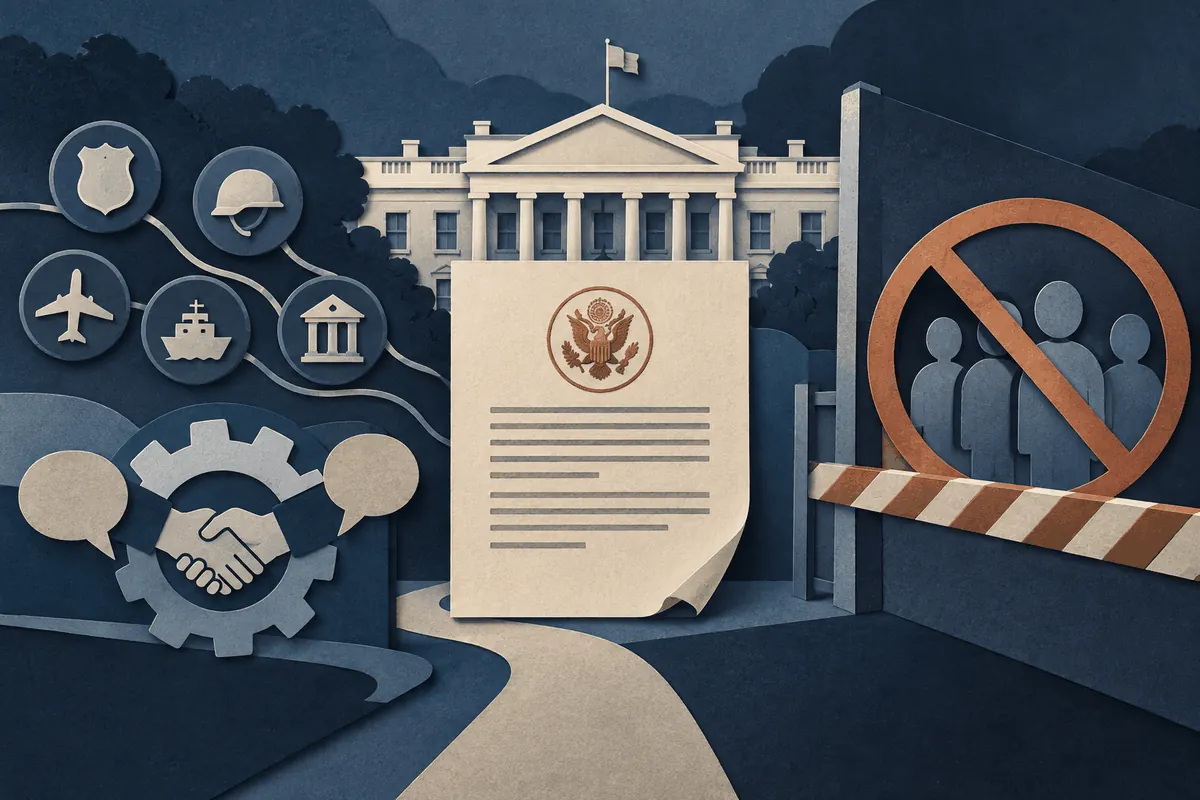
What does Executive Order 14251 do?
OPM provided implementation guidance and covered agencies had to determine which bargaining units met the statutory exclusion.
Reading the operative provisions of Executive Order 14251
EO 14251 invokes the national-security exclusion in federal labor law to remove specified agencies and subdivisions from the federal collective-bargaining framework. Its coverage is organizational: the order lists affected components and relies on the statutory authority that permits exclusions for national-security functions. The Federal Register text of EO 14251 identifies the units and the asserted basis. The order does not eliminate collective bargaining for every federal employee or change private-sector labor law.
For employees in a covered unit, the consequences can include changes to bargaining rights, grievance procedures and union representation under the federal-sector statute. Those consequences depend on the unit’s inclusion in the order and any operative court ruling. The order’s reliance on a national-security exception does not make every affected job classified or every employee personally engaged in sensitive work; the legal question concerns the agency or subdivision and the statute’s criteria.
Courts blocked the order’s operative provisions, so the listed exclusions should not be treated as currently enforceable where the injunction applies. Federal employees and agencies must look to the governing court order and subsequent appellate actions for the current labor-relations framework. A presidential text can state the executive branch’s rationale, but a judicial injunction constrains implementation. The distinction is important because employees’ rights may turn on the unit and the exact scope of the court’s relief, not just the order’s broad title.
Before and after
Before the order
Most covered employees previously bargained under title 5 or Foreign Service labor statutes and existing agreements.
After the order
OPM directed agencies to end recognition and related bargaining for covered units; later EO 14343 expanded exclusions, while litigation produced section- and party-specific restraints.
Who had to do what
| Agency / office | Action | Timing / position |
|---|---|---|
| OPM | Issue implementation guidance | March 27, 2025 |
| Covered agencies | Apply exclusions and address agreements | Ongoing |
| Agencies | Preserve bargaining where a unit is expressly excepted | Ongoing |
What happened next
EO 14251 signed.
OPM issued implementation guidance.
EO 14343 added further exclusions.
OPM updated detailed implementation FAQs.
Court status
No court opinion, filing or docket is linked in this guide’s current source set.
Legal and source detail
How it works legally
5 U.S.C. §7103(b)(1) and 22 U.S.C. §4103(b) authorize national-security exclusions, but statutory predicates, contract consequences and the scope of judicial relief remain contested.
Sources by type
If a source is unavailable, first check the cited publisher or another official repository. The cited publisher remains the authority.
Primary and official sources
Orders, laws, court records and official implementation material.
- OPM implementation guidance (opens in a new tab) Official record
- OPM updated FAQs (opens in a new tab) Official record
How we checked this
Last checked against the sources above on September 9, 2026. How we research →