Executive Order 14404: Imposing Sanctions on Those Responsible for Repression in Cuba and for Threats to United States National Security and Foreign Policy
President: Donald J. Trump
Authorized blocking, entry and correspondent-account sanctions against foreign persons and financial institutions meeting specified Cuba-related criteria.
Status: In effect.
Is Executive Order 14404 still in effect? Yes. The May 1, 2026 sanctions authority is being implemented through OFAC’s September 30, 2026 regulations and subsequent designations, including BICSA on October 15. Coverage, licensing conditions and other Cuba restrictions must be checked separately. Official record checked October 17, 2026.
What does Executive Order 14404 do?
The order directs executive officials within existing statutory authority; its practical effect therefore depends on the later agency, regulatory, diplomatic or presidential actions identified below.
Reading the operative provisions of Executive Order 14404
EO 14404 authorizes sanctions against foreign persons and financial institutions that meet specified criteria related to repression in Cuba or threats to U.S. national security and foreign policy. Measures can include blocking property, restricting entry to the United States and limiting correspondent accounts for certain financial institutions. The Federal Register text defines the criteria and agency roles; it does not impose identical restrictions on every Cuban person or business.
Treasury and State administer different parts of the sanctions framework. A blocking designation generally restricts property within U.S. jurisdiction and transactions by U.S. persons, while visa restrictions concern admission to the country. The order also targets foreign financial institutions under specified conditions. A designation must be made through agency action and can be subject to licensing or review mechanisms.
These targeted measures are distinct from broad trade and travel rules concerning Cuba. A person or company should check the current OFAC list, general licenses and transaction-specific regulations before acting. The order’s policy findings are not a substitute for determining whether a named person or transaction is covered. Implementation is shown by published designations, licenses and enforcement actions.
Sanctions can affect banks and aid organizations that handle lawful humanitarian transactions, so licenses and exceptions matter. A blocked-property rule may prohibit dealings by U.S. persons while leaving a path for authorized food, medicine or communications activity. Institutions should review current OFAC guidance and screen counterparties. The order’s targeted criteria should not be paraphrased as a ban on all remittances, travel or commerce with Cuba.
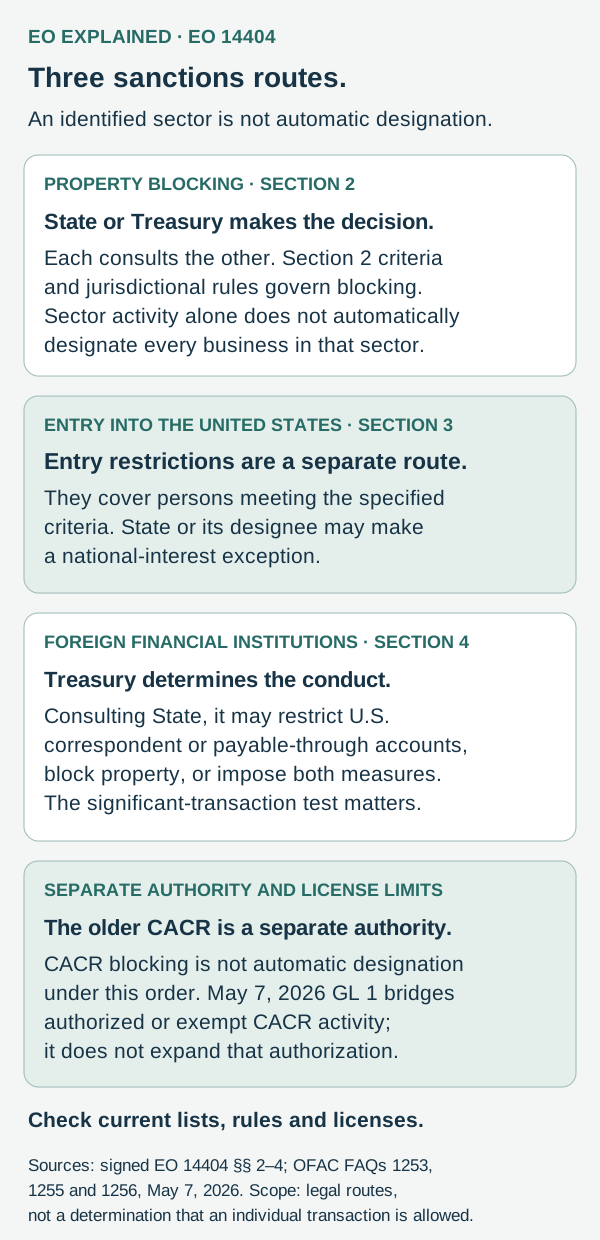
The decision point matters: the order identifies sanctionable conduct, while Treasury or State makes the required foreign-person determination. OFAC’s May 7 guidance says neither operating in a listed sector nor appearing under the older Cuban Assets Control Regulations automatically makes someone designated under EO 14404. Separate authorities may nevertheless restrict the same person. FAQ 1255; FAQ 1256.
A foreign financial institution faces a separate section 4 determination concerning significant transactions for or on behalf of a person blocked under this order. Treasury, consulting State, may impose U.S. correspondent/payable-through account restrictions, blocking sanctions, or both. This is not an automatic ban on every foreign bank dealing with Cuba. Section 3 separately concerns entry into the United States and permits a State national-interest exception. Sections 3–4.
OFAC actually issued General License 1 on May 7, 2026. It authorizes transactions prohibited by EO 14404 only to the extent they are authorized or exempt under the CACR; it does not expand the underlying authorization or override another prohibition in 31 CFR chapter V. The license is a conditional bridge between authorities, not permission for all food, travel, remittance or banking transactions. Full General License 1; Scope and conditions explained.
Implementation continued after the original guidance. OFAC added the Cuba Sanctions Regulations, 31 CFR part 516, effective September 30, 2026. Separately, it amended part 515 under the Cuba policy memorandum, also effective September 30. The earlier statement that EO 14404 left the CACR in place does not mean every May license or regulation remained unchanged afterward. Part 516 final-rule summary and effective date; Separate part 515 final-rule summary and effective date.
OFAC’s October 15 guidance identifies BICSA’s designation and a limited non-targeting posture for certain foreign-person divestment or wind-down activity through November 14, 2026. It expressly says that posture does not authorize transactions prohibited for persons subject to U.S. jurisdiction. A future wind-down date is not a general license, removal from a list or the order’s expiration. BICSA scope and limitations.
Before and after
Before the order
Existing statutes, regulations, programs and presidential actions supplied the prior legal baseline.
The order could direct executive discretion but could not amend an Act of Congress.
After the order
OFAC’s May 7, 2026 guidance described the new program as operating in parallel with the older Cuban Assets Control Regulations, not repealing them. Separate September 30 amendments later changed parts of the CACR; the two authorities and their current authorizations must be distinguished. Original parallel-authorities explanation; Later separate amendments.
Later measures have their own authority, effective date and review path.
Who had to do what
| Agency / office | Action | Timing / position |
|---|---|---|
| Secretary of the Treasury | Make section 2 determinations in consultation with State; determine additional sectors after consultation; make section 4 financial-institution determinations and choose authorized sanctions; implement under section 5; submit recurring/final reports in consultation with State under section 6. | Designation and implementation conditions, not a universal numerical deadline. Section 6 incorporates the separate statutory reporting clocks explained below. |
| Secretary of State | Make section 2 determinations in consultation with Treasury and provide the reciprocal consultations; decide section 3 national-interest entry exceptions personally or through a designee; implement under section 5, consult on section 6 reports, and bear section 8(d) publication costs. | As determinations, exceptions and lawful implementation require; no separate numerical decision deadline. |
| Heads of executive departments and agencies | Take appropriate implementation measures within existing authority; may redelegate consistently with law. | Section 5; no independent numerical deadline for every agency. |
Original sections 2–6 and 8. Consultation is distinguished from a separate decision power. General OMB savings language creates no new task. These directions do not establish that every determination, consultation or report has been completed.
What happened next
EO 14404 signed.
OFAC published implementation guidance in FAQs 1251 and 1252.
State’s GAESA designation under EO 14404 is documented in OFAC FAQ 1254. OFAC also issued General License 1; these are actual implementation records, not merely the original authorization. GAESA guidance; Dated license.
OFAC FAQ 1262 records State’s GECOMEX and GEMAR designations and a limited non-U.S.-person wind-down posture through August 12, not an authorization overriding CACR prohibitions. Dated guidance.
General License 4A replaced GL 4 for specified third-country diplomatic and consular activity; it does not authorize unblocking property. Full license and replacement clause.
Current position checked against the official implementation record.
OFAC issued an alert distinguishing EO 14404/part 516 from the separate CACR amendments taking effect the next day. Dated official alert.
The part 516 implementing final rule and separate part 515 amendments became effective. They are distinct legal instruments. Part 516; Part 515.
OFAC FAQ 1276 records State’s BICSA designation and limited foreign-person wind-down/divestment posture through November 14; it does not authorize otherwise-prohibited U.S.-jurisdiction transactions. Newer implementation record.
Legal and source detail
How it works legally
The order creates designation authority, not automatic blocking of every person in a listed sector. OFAC licenses and statutory exceptions continue to govern authorized transactions.
Section 6 incorporates different reporting clocks, not a new report every 180 days after this order. NEA section 401(c) requires expenditure reports within 90 days after each six-month period following the emergency declaration, and a final report within 90 days after termination. IEEPA section 204(c) requires follow-up at least once during each succeeding six-month period after the initial exercise-of-authority report. Treasury submits under the EO’s delegation with State consultation; the records reviewed here do not establish every submission. 50 U.S.C. 1641(c); 50 U.S.C. 1703(c)–(d).
The preamble invokes IEEPA, the NEA, INA section 212(f) and delegation authority. The order’s blocking and financial-institution prohibitions preserve specified CACR-license activity, and section 8 requires lawful implementation within available appropriations. General License 4A is a separate, limited diplomatic authorization and expressly does not unblock property. Preamble, sections 2(b), 4(c) and 8; License limits.
Sources by type
If a source is unavailable, first check the cited publisher or another official repository. The cited publisher remains the authority.
Primary and official sources
Orders, laws, court records and official implementation material.
- OFAC FAQ 1251 (opens in a new tab) Official record
- OFAC FAQ 1252 (opens in a new tab) Official record
- Signed EO 14404 — full operative text
- OFAC FAQ 1253 — conditional General License 1
- OFAC FAQ 1254 — May 7 GAESA designation and limited wind-down posture
- OFAC FAQ 1255 — separate determinations required
- OFAC FAQ 1256 — sector identification is not automatic blocking
- OFAC FAQ 1262 — July 13 designations and limited wind-down posture
- OFAC FAQ 1276 — October 15 BICSA designation and scope
- OFAC — full General License 1, May 7, 2026
- OFAC — full General License 4A, September 3, 2026
- OFAC — September 30, 2026 part 516 implementing final rule
- OFAC — September 30, 2026 separate part 515 amendments
- OFAC — September 29, 2026 expanded-sanctions alert
- 50 U.S.C. 1641(c) — NEA expenditure-report clocks
- 50 U.S.C. 1703(c)–(d) — separate IEEPA follow-up reports
How we checked this
Last checked against the sources above on September 9, 2026. How we research →
Additional evidence review: October 17, 2026. Read the full signed order, OFAC FAQs 1251–1256,1262 and1276, complete GL1/GL4A, the September29 alert and the cited reporting statutes. Read the September30 rules’ summaries/effective dates and selected opening provisions, not every regulatory provision. Actual public implementation is documented; every report, consultation, current designation, individual transaction and litigation outcome has not been exhaustively audited.