Executive Order 14340: Measures To End Cashless Bail and Enforce the Law in the District of Columbia
President: Donald J. Trump
EO 14340 remains in effect: review its D.C. bail directions, conditional agency funding actions, and the separate limit on temporary police control.
Status: In effect. Is Executive Order 14340 still in effect? Yes. Its federal charging and conditional agency-action directions have no stated sunset. The Federal Register’s disposition entry lists no amendment or revocation as checked on October 17, 2026. The separate limit on temporary MPD services under EO 14333, August 11, 2025 and Home Rule Act section 740 does not expire all of EO 14340. This does not establish that every contemplated funding action is lawful or has occurred.
What does Executive Order 14340 do?
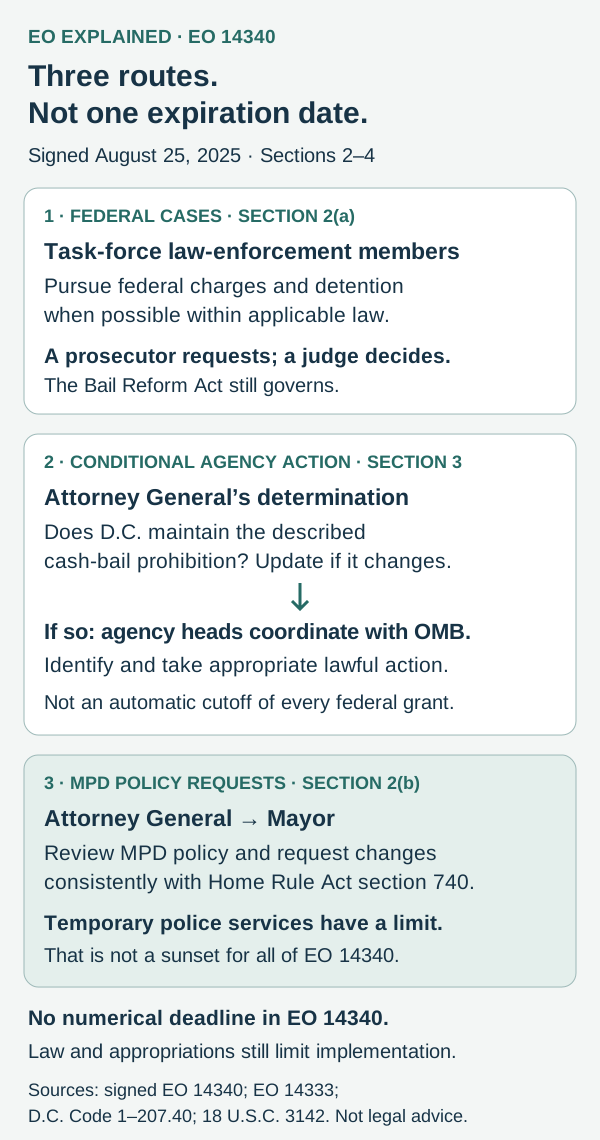
The action operated within the District’s Home Rule Act framework and existing agency authority; it did not itself amend the D.C. Code. Section 740 permits presidential direction of Metropolitan Police services for an emergency period of no more than 30 days unless Congress enacts a joint resolution extending it.
Reading the operative provisions of Executive Order 14340
Two different legal clocks. EO 14333, sections 2–3 made MPD services available for the maximum period allowed by section 740 and delegated presidential direction to the Attorney General. D.C. Code 1–207.40(b)–(d) limits those services, with a separate rule for a congressional adjournment sine die. That statutory limit is not a blanket sunset for every later federal prosecution or agency instruction. A request to change MPD policy still must respect the limits on the authority actually used.
EO 14340 directs relevant federal law-enforcement agencies and officials on the D.C. Safe and Beautiful Task Force to pursue lawful federal charges and pretrial detention, and directs the Attorney General to review MPD policies. Its signed sections 2–3 also create a distinct bail-policy determination and a conditional agency-action process. Unlike the temporary MPD-services direction in EO 14333, the charging and conditional agency-action provisions contain no stated expiration date.
Pretrial detention is governed by law and individualized findings, not simply by whether a person can pay money. Federal prosecutors must follow the Bail Reform Act and constitutional protections when asking a judge to detain a defendant. The President’s instruction could guide federal attorneys but could not order a judge to reach a particular result or create a new offense. District criminal procedure and the statutory framework remain important to local cases.
The order also asked for review of MPD policy. A review is not the same as a binding amendment to District law or department rules. The Mayor and District government retain responsibilities under the Home Rule Act, subject to the President’s limited emergency authority. To understand what happened, distinguish federal charging decisions, judicial detention rulings, local police policy and the expiration of the emergency directive.
The conditional funding mechanism. Under section 3(a), the Attorney General first determines whether D.C. continues to prohibit cash bail as a potential condition in the specified D.C. Superior Court cases, and must update that determination if the relevant policy changes. Section 3(b) then directs agency heads, coordinating with OMB, to identify appropriate pressure and undertake actions they deem appropriate within the law. It does not identify a fixed dollar amount, cancel every grant on signing, or prove that the condition was triggered. The OMB Director is the coordination partner, not the official assigned to make the Attorney General’s determination.
Before and after
Before the order
The elected District government administered MPD and local criminal-justice policy under the Home Rule Act and D.C. Code.
Federal law-enforcement agencies retained their own jurisdiction and authorities.
After the order
The order did not repeal the D.C. Council’s bail statutes; detention remains governed by applicable law and individualized judicial decisions.
Any lasting hiring, grant, deployment, prosecution or policy change depends on its own legal authority and implementation, not the emergency declaration alone.
Who had to do what
| Agency / office | Action | Timing / position |
|---|---|---|
| Relevant federal law-enforcement agencies and officials on the D.C. Safe and Beautiful Task Force | Work to hold D.C. arrestees in federal custody to the fullest lawful extent; pursue federal charges and pretrial detention whenever possible, consistently with applicable law. Section 2(a). | No numerical deadline; applies to relevant charging and detention decisions. |
| Attorney General — MPD review | Review MPD general orders, policies and practices concerning dangerous defendants’ pretrial release; request appropriate updates from the Mayor consistently with Home Rule Act section 740. Section 2(b). | No numerical deadline; any use of section 740 remains subject to that statute’s limits. |
| Attorney General — bail-policy determination | Determine whether D.C. maintains the cash-bail prohibition described in section 3(a), and update that determination if its policies or practices change. | No numerical deadline; update when the District changes the relevant policies or practices. |
| Heads of each executive department or agency, coordinating with the OMB Director | If the Attorney General makes the section 3(a) determination, identify appropriate pressure through funding, federal services, approvals or other described measures; undertake actions the agency head deems appropriate, consistently with law. Section 3(b). | Conditional on the Attorney General’s determination; no numerical deadline or automatic across-the-board funding cutoff. |
| Department of Justice | Bear the order’s publication costs. Section 4(d). | Publication-related; no numerical payment deadline. |
What happened next
EO 14340 signed.
EO 14340 was published at 90 FR 42125–42126. Publication followed signing on August 25; it did not supply a new 30-day sunset for the whole order.
The section 740 emergency-control period ran, absent a congressional extension.
Statutory duration and official implementation record rechecked.
The current disposition entry lists no amendment or revocation of EO 14340. Reading its complete signed text alongside the emergency police statute distinguishes the continuing federal directions from the separately limited MPD-services authority. This review did not verify a published section 3(a) determination, a particular funding cutoff, or the complete current litigation position.
Legal and source detail
How it works legally
Section 740 of the Home Rule Act authorizes temporary presidential direction of MPD services during special emergency conditions and limits use beyond 30 days unless Congress extends it by joint resolution. The orders do not themselves rewrite local bail law, create crimes or supply missing grant authority.
For federal criminal cases, 18 U.S.C. 3142(c)(2), (e) and (f) preserves the distinction between a prosecutor’s request and a judge’s detention decision. A financial condition cannot itself cause pretrial detention; detention under subsection (e) depends on judicial findings after the statutory hearing. Subsection (f) provides counsel and opportunities to present information, with clear and convincing evidence for the specified safety finding. EO 14340’s law-enforcement directions do not replace those procedures or make a person guilty before trial.
Section 4 preserves existing statutory authority, requires lawful implementation subject to available appropriations, and creates no privately enforceable right or benefit. A direction to consider funding or approvals is therefore not an independent grant of power to disregard the governing program statute. Whether a particular subsequent decision satisfies its legal limits requires that decision’s own record.
Sources by type
If a source is unavailable, first check the cited publisher or another official repository. The cited publisher remains the authority.
Primary and official sources
Orders, laws, court records and official implementation material.
- DOJ — Attorney General Order 6372-2025 (opens in a new tab) Official record
- White House — EO 14340 signed text (opens in a new tab) Official evidence
- Federal Register — 2025 disposition entry (opens in a new tab) Official evidence
- Authenticated EO 14333 — temporary MPD services (opens in a new tab) Official evidence
- 18 U.S.C. 3142 — judicial detention and release (opens in a new tab) Official evidence
How we checked this
Last checked against the sources above on September 9, 2026. How we research →