Executive Order 14396: Preserving America's Game
President: Donald J. Trump
Directed federal coordination to seek an exclusive broadcast window for the Army–Navy football game.
Status: In effect.
Is Executive Order 14396 still in effect? Yes. The March 20, 2026 order directs Commerce and the FCC chair to coordinate on an Army–Navy broadcast window, with no fixed sunset. It does not itself award exclusive rights; a completed new arrangement was not established in this review. Signed order.
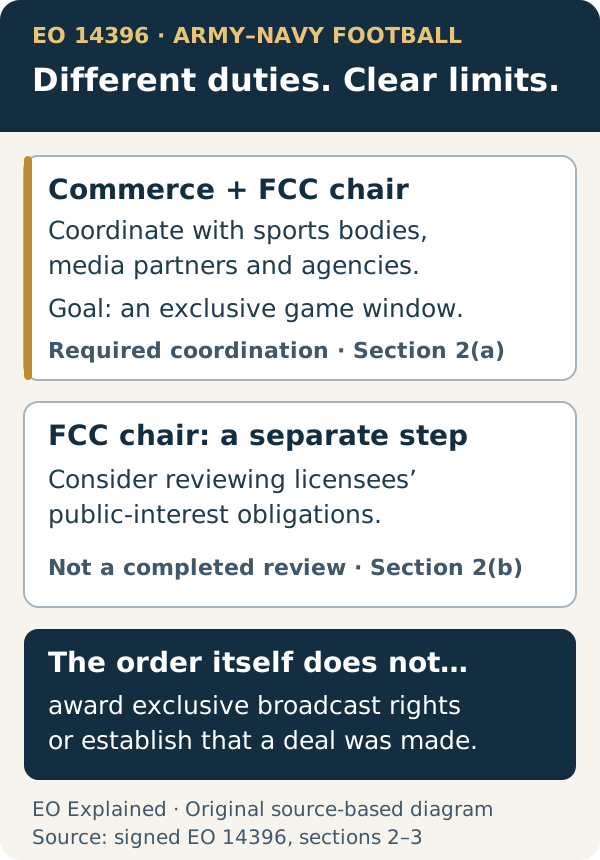
What does Executive Order 14396 do?
Commerce and the FCC chair were to work with the playoff committee, NCAA and broadcast partners. The FCC chair was also asked to consider licensees' public-interest obligations.
Later record checked September 26, 2026: The December 2026 Army–Navy game has not occurred; a subsequent broadcast arrangement expressly attributed to this order was not established in this pass.
Reading the operative provisions of Executive Order 14396
EO 14396 directs federal officials to coordinate with sports organizations and broadcasters to seek an exclusive broadcast window for the Army–Navy football game. It assigns Commerce and the Federal Communications Commission chair roles in discussions and asks the FCC to consider related broadcast issues. The Federal Register text is a coordination directive; it does not itself grant exclusive rights or force networks to carry the game.
The Army–Navy game is a college football event involving the service academies and commercial broadcast partners. Distribution rights are negotiated among the rights holders and networks, while the FCC regulates communications under the Communications Act. The order asks federal officials to facilitate a particular viewing arrangement, but any FCC rule or public-interest decision must follow the agency’s statutory procedures.
The Sports Broadcasting Act and antitrust law govern aspects of collective sports-media agreements. An executive order cannot create an antitrust exemption or amend broadcast law by itself. A requested exclusive window also does not guarantee that every viewer can access the game on a free or local channel. To determine what changed, examine the rights agreement, FCC action and actual broadcast schedule.
The FCC’s role under the order is to consider questions within its communications authority, not to choose the teams or dictate a private network’s programming. A change to broadcast licensing or access rules would need a separate notice, evidence and agency explanation. Any exclusive broadcast arrangement also needs to account for fans who rely on local television and viewers outside the main market. The actual impact can be checked in the final rights agreement and any FCC proceeding.
The operative verbs differ. Section 2(a) requires coordination by Commerce and the FCC chair; section 2(b) requires the chair to consider a review of broadcast licensees’ public-interest obligations. It does not state that a review, licensing change or agreement has already occurred. The order sets no numerical deadline. Sections 2–3.
As checked on October 17, 2026, Naval Academy Athletics lists the Army game for December 12, 2026, at 3:00 p.m., on CBS in East Rutherford, New Jersey. A scheduled telecast does not prove that other college broadcasts have been excluded or that the order produced a new rights agreement. Official 2026 schedule.
Before and after
Before the order
The Army–Navy game had existing scheduling and broadcasting arrangements before this coordination directive.
After the order
Commerce and the FCC chair were asked to work with sporting and broadcast partners. A subsequent broadcast change attributable to this order was not verified by the reviewed records.
Who had to do what
| Agency / office | Action | Timing / position |
|---|---|---|
| Secretary of Commerce | Coordinate with the FCC chair, College Football Playoff Committee, NCAA, related organizations, appropriate government agencies and playoff broadcast/media-rights partners toward an exclusive Army–Navy window. | Section 2(a); no fixed completion deadline. |
| Chairman of the Federal Communications Commission | Join that coordination and consider reviewing broadcast licensees’ public-interest obligations in relation to the game. A completed review is not required or established by the words “consider reviewing.” | Sections 2(a)–(b); no fixed review deadline. |
| Department of War | Bear the cost of publishing the order. This is not a separate broadcast-licensing assignment. | Section 3(d); no amount or numerical deadline specified. |
Signed assignments. The sports organizations and media partners are coordination counterparts, not separately ordered to transfer rights. General agency and OMB savings clauses preserve existing authority rather than create a new substantive task.
What happened next
Executive Order 14396 signed.
Order published in the Federal Register.
Official schedule checked: Army–Navy is listed for December 12, 2026, at 3:00 p.m. on CBS. This is a scheduled event, not proof of an exclusive-window agreement or completed FCC review. Naval Academy Athletics schedule.
Legal and source detail
How it works legally
The order’s section 3 preserves existing agency authority and requires implementation consistent with law and available appropriations. Its instruction to consider a review is not itself a new broadcast-license condition. Official compilation, sections 2–3.
The Sports Broadcasting Act’s section 1291 concerns a limited antitrust exemption for joint agreements involving listed professional team sports. Section 1293 restricts that exemption for certain professional football telecasts that conflict with college or high-school games. These are not a blanket college-football antitrust exemption or an automatic Army–Navy broadcast monopoly. 15 U.S.C. 1291–1294.
Sources by type
If a source is unavailable, first check the cited publisher or another official repository. The cited publisher remains the authority.
Primary and official sources
Orders, laws, court records and official implementation material.
How we checked this
Last checked against the sources above on September 26, 2026. How we research →
Additional evidence review: October 17, 2026. Read the full White House order and independent official presidential compilation, the cited Sports Broadcasting Act provisions and the Naval Academy Athletics schedule. Targeted official searches did not establish a completed new exclusive-window agreement or FCC review; the schedule alone is not evidence of either. No exhaustive current litigation clearance is claimed.