Executive Order 14347: Restoring the United States Department of War
President: Donald J. Trump
Authorized the Department of Defense to use Department of War as a secondary title in executive communications.
Status: In effect.
Is Executive Order 14347 still in effect? Yes. Active branding and legislative-proposal direction; statutory department name remains controlling.

What does Executive Order 14347 do?
The Defense Secretary and subordinate officials may use corresponding secondary titles in nonstatutory contexts. Statutory references to Defense remain controlling until Congress changes them.
Later official evidence reviewed September 26, 2026: The department adopted Department of War as a secondary title in its public branding. Its FY 2025 financial report still used Department of Defense for statutory reporting; the legal name was not changed by the order.
Reading the operative provisions of Executive Order 14347
EO 14347 authorizes the Defense Department to use “Department of War” as a secondary title in executive-branch communications. It allows the Secretary and subordinate officials to use corresponding secondary titles while preserving the statutory Department of Defense name. The Federal Register text changes usage within the executive branch; it does not rename the department in federal law.
Congress established the Department of Defense and controls its statutory name and structure. A President may direct how executive officials describe their work, but a secondary title does not amend the U.S. Code, change the chain of command or alter the department’s legal authorities. Official forms, contracts and statutory references may continue to use “Department of Defense.”
The order also does not create a separate military department or change the names of the Army, Navy, Air Force, Marine Corps or Space Force. Any use of alternate titles in public communications should be understood as a presidential naming policy. To assess broader legal effect, look for congressional action or formal amendments to statutes. Without those, the Department of Defense remains the legal entity established by Congress.
What happened after
Verified actions after the order
The department adopted Department of War as a secondary title in its public branding. Its FY 2025 financial report still used Department of Defense for statutory reporting; the legal name was not changed by the order.
Who had to do what
| Agency / office | Action | Timing / position |
|---|---|---|
| Secretary of Defense, authorized to use Secretary of War as a secondary title | May use the secondary title in official correspondence, public communications, ceremonies and nonstatutory executive-branch documents; submit the usage notification and permanent-renaming recommendation through the national security adviser. | Notification within 30 days of September 5, 2025; recommendation within 60 days. Section 2(a), (f)–(g). These are separate deliverables, not proof either was submitted on time. |
| Department of Defense and Office of the Secretary | May use Department/Office of War as secondary titles in the specified contexts; bear the order’s publication costs under the secondary designation. | Sections 2(b), 3(d); no separate numerical publication-cost deadline. |
| Subordinate Defense officials | May use corresponding secondary titles, such as Deputy Secretary of War or Under Secretary of War, as appropriate in the specified contexts. | Section 2(c); authorization, not a command to create new statutory offices. |
| All executive departments and agencies | Recognize and accommodate the secondary titles in communications, without confusion about legal, statutory or international obligations. | Section 2(d); continuing implementation, no new numerical clock for every agency. |
| Assistant to the President for National Security Affairs | Named submission channel from the Secretary to the President for both the notification and the recommendation. | Section 2(f)–(g); the Secretary’s 30/60-day deadlines, not a separately stated adviser deadline. |
| President | Recipient of the Secretary’s notification for transmittal to Congress and the recommendation for proposed legislative/executive action. | Section 2(f)–(g); no separate deadline imposed on the President or Congress to enact a permanent renaming. |
The table describes the signed directions, not verified completion of the submissions. The Office of the Federal Register’s publication role and the general OMB savings clause are not new substantive agency assignments. Statutory Defense references remain controlling under section 2(e). Exact implementation provisions.
What happened next
Executive Order 14347 signed.
Order published in the Federal Register.
CBO published conditional cost estimates for using the secondary title and for a possible statutory renaming. The scenarios are not an audited spending total or proof Congress changed the statutory name. CBO analysis.
The reporting duties behind the new title
Section 2(d) requires every executive department and agency to accommodate the secondary titles in communications, with a safeguard against confusion about legal, statutory or international obligations. The authorization extends to the Secretary's office and subordinate officials; the order gives Deputy Secretary of War and Under Secretary of War as examples. These provisions govern how officials identify themselves while section 2(e) preserves the controlling statutory names. Federal Register, section 2(a)–(e).
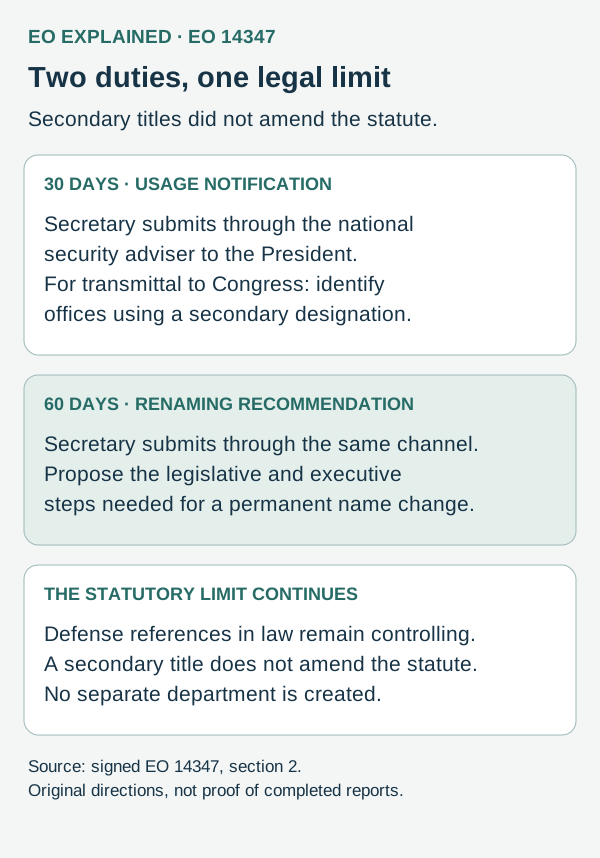
The order also assigns two separate submissions. Within 30 days, the Secretary must send the President, through the national security adviser, a notification for transmission to Congress identifying offices, components, commands or agencies adopting a secondary designation. Within 60 days, the Secretary must recommend the legislative and executive steps needed for a permanent renaming. A notification about usage and a recommendation for legislation are different deliverables; neither provision itself enacts a statutory name change. Federal Register, section 2(f)–(g).
Cost estimates and the request for legislation
On January 14, 2026, the Congressional Budget Office estimated that a modest implementation concentrated in the Office of the Secretary of Defense would cost about $10 million. It described these as opportunity costs likely covered from existing budgets by foregoing other activities. A minimal, phased approach would cost at least a few million dollars, while a broad, rapid rollout could reach $125 million. CBO cautioned that it lacked the department's implementation plans. These were conditional estimates, not an audited account of money already spent. CBO separately said a statutory renaming could cost hundreds of millions, depending on Congress's and the department's choices. CBO cost analysis.
Stars and Stripes reported on April 28, 2026, that the department had submitted a legislative proposal seeking to codify the new name and make roughly 7,600 conforming changes in federal law. The report attributed an approximately $50 million cost estimate to that proposal and said cost collection was continuing. That reported departmental estimate and CBO's earlier scenarios measure different things; the proposal was a request to Congress, not evidence that Congress had enacted it. Stars and Stripes report.
The financial objections were explicit. In a September 22, 2025, letter requesting CBO's assessment, Senator Jeff Merkley and nine other senators criticized the parallel designation as wasteful and potentially confusing. They asked for estimates covering personnel and administrative work, signs, procurement, interagency coordination and websites. Those were the senators' objections and requested categories of analysis, rather than judicial findings about the order's validity. Senators' letter and announcement.
Legal and source detail
Sources by type
If a source is unavailable, first check the cited publisher or another official repository. The cited publisher remains the authority.
Primary and official sources
Orders, laws, court records and official implementation material.
How we checked this
Last checked against the sources above on September 26, 2026. How we research →