Executive Order 14337: Revocation of Executive Order on Competition
President: Donald J. Trump
Revoked EO 14036's government-wide competition-policy framework; the Justice Department immediately stated how its Antitrust Division would proceed after the revocation.
Status: In effect. Is Executive Order 14337 still in effect? Yes. Section 1 continues to revoke EO 14036 in full; the Federal Register’s current disposition entry lists no amendment or revocation of EO 14337 as checked on October 17, 2026. The survival of separately authorized rules does not make this revoking order partly revoked. Signed sections 1–2.
What does Executive Order 14337 do?
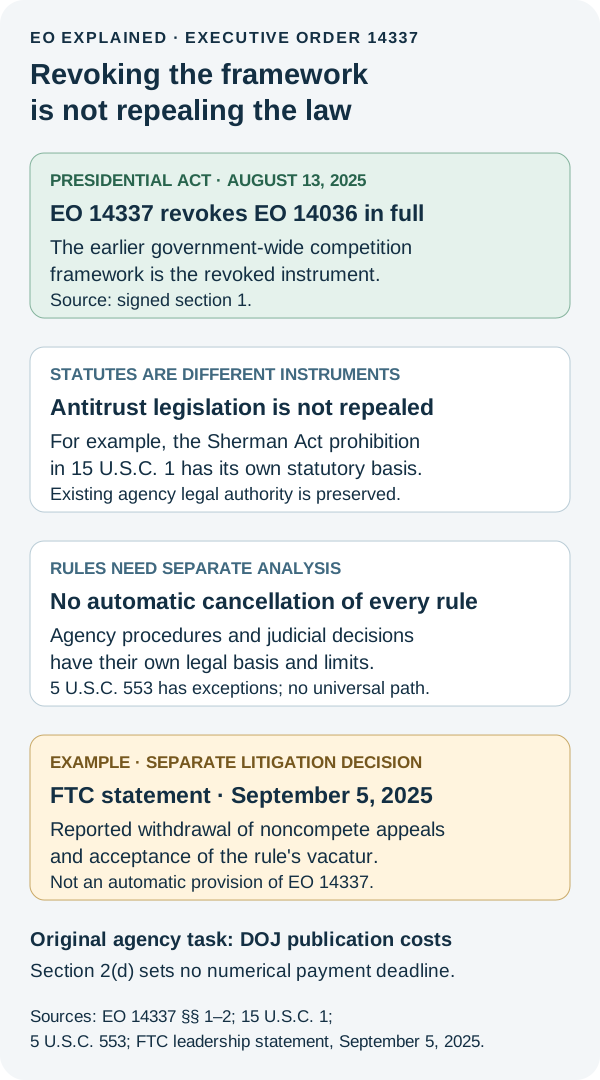
EO 14337 revoked EO 14036 in full but did not repeal the antitrust statutes, cancel completed rules or direct agencies to undo every earlier action. On the signing date, the Justice Department's Antitrust Division said it would recalibrate and modernize its approach, while continuing enforcement and using tailored executive directions. The statement was later updated in April 2026.
Later evidence reviewed September 27, 2026: DOJ's Antitrust Division publicly described the enforcement approach it would use after revocation; underlying antitrust law remains.
Reading the operative provisions of Executive Order 14337
EO 14337 revokes EO 14036, the prior administration’s government-wide competition-policy framework. It does not direct agencies to discontinue or revise every action previously associated with that framework. It concerns federal policy coordination and does not repeal antitrust statutes such as the Sherman Act or Clayton Act. The Federal Register text of EO 14337 contains the complete revocation and preserves existing statutory authority.
The Justice Department’s Antitrust Division and the Federal Trade Commission continue to enforce federal competition law under their statutes. Revoking a presidential framework can change policy priorities, interagency coordination or reporting requirements, but it does not remove agencies’ statutory powers. A merger review or enforcement case proceeds under the law and facts applicable to that matter, not solely under the prior executive order.
EO 14337 is the revoking instrument; EO 14036 is the order it revoked, as the Biden disposition entry confirms. The current record does not support describing EO 14337 itself as partly revoked. Revocation of EO 14036 also does not automatically undo final rules, contracts or agency decisions that were adopted under separate legal authority. Each downstream action needs its own review and, if necessary, formal amendment.
The only express departmental assignment in this short order is DOJ’s publication-cost obligation. Section 1 itself effects the revocation; there is no new government-wide review schedule, reporting requirement or instruction to cancel every action associated with EO 14036. Section 2 preserves statutory agency authority and OMB’s existing functions. Complete signed text.
The August 13 DOJ statement described the Division’s own enforcement policy, including its stated willingness to use early termination of eligible merger waiting periods and negotiated consent decrees. Those are agency descriptions, not additional commands in EO 14337, and the statement does not establish that each practice began because of the order. Its April 15, 2026 update stamp is a webpage record, not a newly signed executive order. DOJ’s dated statement.
A separate example is the FTC leadership’s September 5, 2025 statement reporting withdrawal of the appeals in Ryan, LLC v. FTC, No. 24-10951 in the Fifth Circuit, and Properties of the Villages, Inc. v. FTC, No. 24-13102 in the Eleventh Circuit. The statement says the Commission accepted the noncompete rule’s vacatur. This was a distinct agency litigation decision; it was not a provision of EO 14337 canceling that rule automatically. The statement’s evaluative claims are its authors’ positions, not new findings about EO 14337. FTC statement, page 1 and footnotes 1–2.
In prepared remarks dated October 15, 2026, Deputy Assistant Attorney General Stephanie Greco described continuing statutory investigations, settlements and litigation. That is a later agency account of its approach, not an amendment to EO 14337 or independent verification of every described case outcome. DOJ prepared remarks, “Core principles” and “When litigation becomes necessary”.
Before and after
Before the order
EO 14036 coordinated competition initiatives across agencies, while each agency acted under its own statutes.
After the order
EO 14337 ended the presidential coordination directive.
DOJ said it would continue antitrust enforcement with a different policy approach; independent rules, consent decrees and statutes remained separately effective unless changed lawfully.
Who had to do what
| Agency / office | Action | Timing / position |
|---|---|---|
| Department of Justice | Bear the costs of publishing the order, under section 2(d). | No numerical payment deadline. The Federal Register published the order on August 19, 2025. |
Signed section 2(d). The President’s revocation is the legal act in section 1, not a separate future agency task. DOJ’s policy announcement belongs in the implementation history, not this original-directions table.
What happened next
EO 14036 signed.
EO 14337 signed and DOJ issued its statement.
Published in the Federal Register.
FTC leadership reported the noncompete-rule appeal withdrawals and acceptance of vacatur, a separate litigation decision rather than an automatic effect of EO 14337. Dated FTC statement.
DOJ page records an update.
Order, DOJ implementation statement and continuing statutory limits reviewed.
Greco’s prepared remarks described the Antitrust Division’s continuing enforcement and settlement approach; they did not amend the order. Official remarks.
Legal and source detail
How it works legally
Revoking EO 14036 removed that executive coordination directive. It did not repeal the Sherman, Clayton or FTC Acts, vacate judicial orders or automatically rescind rules that have their own legal basis and procedures.
The distinction is between presidential direction and legislation: for example, 15 U.S.C. 1 supplies the Sherman Act prohibition on restraints of trade. A rule’s repeal may require separate agency procedures. 5 U.S.C. 553 addresses notice, participation and effective dates, but also contains scope exclusions, policy/interpretive-rule exceptions and a good-cause route. It should not be described as one mandatory procedure for every possible downstream action.
Sources by type
If a source is unavailable, first check the cited publisher or another official repository. The cited publisher remains the authority.
Primary and official sources
Orders, laws, court records and official implementation material.
- DOJ Antitrust Division (opens in a new tab) Official record
- White House — signed EO 14337
- Federal Register — 2025 disposition entry
- Federal Register — EO 14036 disposition
- DOJ — October 15, 2026 prepared remarks
- FTC leadership — September 5, 2025 appeal-withdrawal statement
- 15 U.S.C. 1 — Sherman Act prohibition
- 5 U.S.C. 553 — rulemaking procedures and exceptions
How we checked this
Last checked against the sources above on September 27, 2026. How we research →
Additional source review: October 17, 2026. The complete one-page order, White House text, both relevant disposition entries, DOJ’s original statement and later prepared remarks, the FTC leadership statement and the cited statutory provisions were checked. Agency statements about litigation are attributed; this is not an exhaustive audit of every rule, court docket or current appeal.