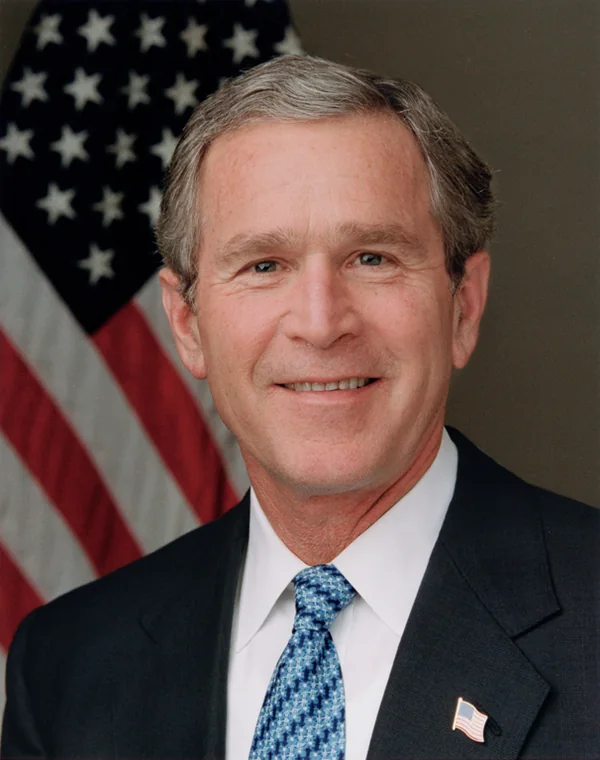
George W. Bush’s executive-order record was shaped most visibly by the post-9/11 security state, the wars in Afghanistan and Iraq and disaster recovery. It also includes substantial domestic management, faith-based initiatives, ethics, workforce and regulatory actions.
Bush’s cards cover distinct response mechanisms: terrorist-finance sanctions, White House coordination, information infrastructure protection, fraud enforcement and disaster recovery.
Counterterrorism finance, homeland security coordination, intelligence and protection of critical infrastructure after September 11, 2001.
Emergency powers and property-blocking orders used alongside military and diplomatic policy in Iraq and other national-security matters.
Federal management, contracting, regulatory policy and initiatives involving faith-based and community organizations.
Executive structures for crisis response and recovery, including the federal response to Hurricane Katrina.
Activity across the term
The 2001 and 2009 bars are partial years. Bush took office on January 20, 2001, and left on January 20, 2009; the archive assigns an order to its signer.
Executive orders by calendar year
2001–2009
200154
200231
200341
200445
200526
200627
200732
200830
20095
Major events and executive response
The September 11 examples separate asset blocking, homeland-security organization and cyber policy. EO 13390 later assigned a coordinator for Gulf Coast rebuilding after Katrina.
September 11–October 16, 2001Direct response
9/11 attacks and the homeland-security response
EO 13224 blocked property and prohibited transactions involving designated terrorists. EO 13228 created the Office of Homeland Security and Homeland Security Council, while EO 13231 addressed information-age infrastructure protection. Together they show financial, organizational and technical strands of the immediate executive response.
Enron, WorldCom and corporate-fraud investigations
Major accounting scandals damaged confidence in public companies and financial reporting. EO 13271 created a Corporate Fraud Task Force, directing senior justice and regulatory officials to coordinate investigation and prosecution.
A sequence of orders confiscated or blocked Iraqi state and former-regime property and protected the Development Fund for Iraq. The orders translated wartime and reconstruction policy into control over assets and transactions within US jurisdiction.
After Katrina caused catastrophic damage, EO 13390 established a coordinator of federal support for Gulf Coast rebuilding. The order focused on longer-term recovery coordination, distinct from immediate emergency response.
Following North Korea’s nuclear program and US decisions to alter Trading with the Enemy Act restrictions, EO 13466 continued selected controls under a newly declared national emergency. The order’s own findings identify proliferation risk as the basis.
Some post-9/11 institutions began through executive orders before Congress created or reorganized permanent departments and statutory authorities.
National emergencies and sanctions introduced in this period were repeatedly continued or amended by later administrations.
Later presidents altered several Bush-era management and contracting orders while retaining others as part of the executive branch’s operating framework.
Research boundary
EO 13271 coordinated investigation and prosecution by senior officials; it did not decide any defendant’s guilt. EO 13390 coordinated recovery support but did not provide reconstruction funding.
Security powers, legal boundaries and later reversals
The post-September 11 orders show the breadth of Bush’s response across finance, homeland security and critical infrastructure. EO 13224 blocked property and transactions connected to designated terrorist organizations and became a recurring sanctions authority. EO 13228 created the Office of Homeland Security and a Homeland Security Council in the White House while Congress considered a permanent departmental structure. EO 13231 focused on protecting information systems and critical infrastructure. Their different mechanisms—asset blocking, White House coordination and cyber policy—help explain why the administration’s “security” orders cannot be treated as interchangeable.
Congress then created the Department of Homeland Security by statute. That transition is a useful reminder that an executive order may organize presidential staff or coordinate existing authority, while a durable department and its legal powers require legislation. The order pages and the later statutory record should be read together: the text of EO 13228 established an immediate White House arrangement, not the cabinet department that followed.
Military detention and interrogation produced the clearest Supreme Court confrontation with the administration’s claimed powers. Hamdan v. Rumsfeld held that the military commission system before the Court lacked authorization under the governing statutes and violated the applicable law of war. Congress subsequently enacted the Military Commissions Act, so the episode involved both executive action and a legislative response. Later, Bush’s EO 13440 set the administration’s interpretation of Common Article 3 for a CIA detention and interrogation program. On his first week in office, President Obama’s EO 13491 expressly revoked EO 13440 and inconsistent CIA directives, and directed that interrogations comply with the Army Field Manual and applicable law. The signed order text in GovInfo makes the policy change explicit.
Not every major Bush order vanished with the administration. EO 13224 remained part of the government’s terrorism-related financial sanctions framework, although later orders adjusted and supplemented the list of designated persons and the authorities used to implement sanctions. In contrast, President Obama revoked EO 13233 on presidential records through EO 13489, returning the review process to the statutory framework established by the Presidential Records Act. The difference between these outcomes is instructive: an order tied to an ongoing statutory sanctions program can be continued and amended, while a contested administrative procedure can be rescinded by a successor.
Disaster recovery, ethics and workforce management also ran through this presidency. After Hurricane Katrina, EO 13390 created a coordinator for federal recovery support in the Gulf Coast region. The initiative relied on agencies and congressional appropriations rather than the order supplying its own reconstruction budget. Across the term, the orders thus reveal a presidency using directives to coordinate officials and implement statutory authorities, with Congress and courts supplying consequential limits.