Executive Order 13961: Governance and Integration of Federal Mission Resilience
President: Donald J. Trump
Adopted a federal mission-resilience strategy and created an executive committee to coordinate continuity of essential government functions.
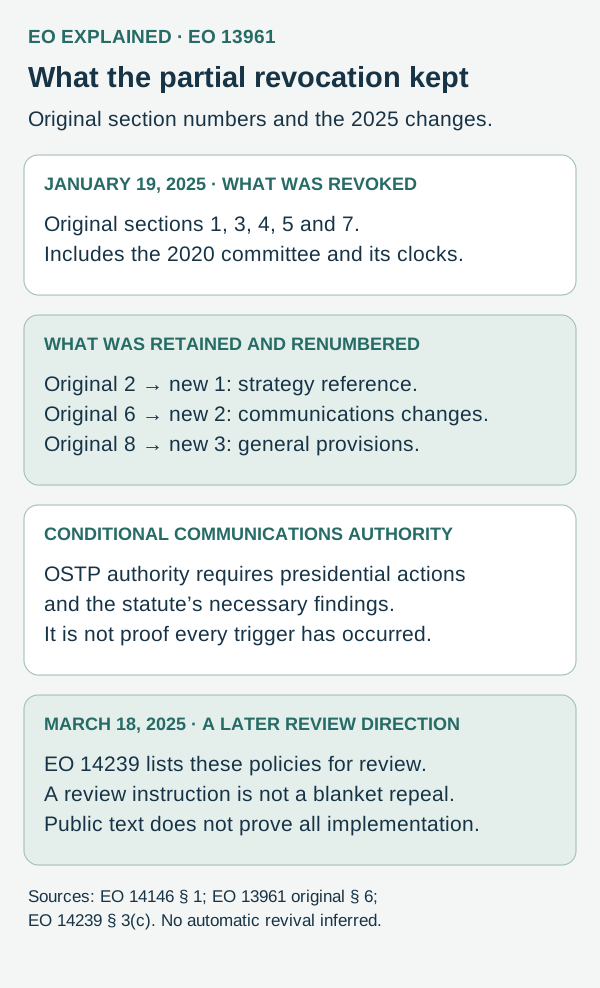
Status: Partly revoked. Is Executive Order 13961 still in effect? Partly. EO 14146, signed January 19, 2025, section 1, revoked original sections 1, 3, 4, 5 and 7, while retaining and renumbering original sections 2, 6 and 8 as sections 1, 2 and 3 and amending the transferred-responsibilities wording. The retained communications delegation remains conditional on the required presidential actions; EO 14239, March 18, 2025, section 3(c), later directed a policy review rather than itself revoking all of EO 13961.
What does Executive Order 13961 do?
EO 13961 directed agencies to assess and improve resilience of federal missions, facilities and continuity functions.
Later primary evidence reviewed September 24, 2026: EO 14146 expressly revoked in part this order. Official source. The cited steps do not establish every downstream effect.
The 2025 change was deliberately partial, not a whole-order repeal. EO 14146 removed the original general-policy section, the 2020 executive committee, its implementation deadlines, the PPD-40 coordinator amendment and the original program-support direction. It retained the strategy reference, communications amendments and general provisions, with new numbering. Its change to the transferred-responsibilities clause names the Restricted Principals Committee described in the January 19, 2025 National Continuity Policy memorandum. That is the public text’s stated successor, not a reason to assume the old committee or coordinator appointment silently returned. EO 14146, section 1.
The surviving communications provision should not be summarized as an unconditional power to shut down communications on an ordinary day. Original section 6(a) delegated specified Communications Act authorities to OSTP only if the President first took the actions required by that statute, including necessary proclamations and findings. The partial-revocation order kept that paragraph while amending the separate transfer of committee responsibilities. An authority’s delegation and the satisfaction of its legal triggering conditions are different questions. Original section 6(a)–(b); Renumbering and amendment.
In March 2025, EO 14239 specifically listed EO 13961, EO 14146, EO 13618 and National Security Memorandum 32 for continuity-policy review. It required the national security advisor, coordinating with relevant agencies, to recommend revisions, rescissions and replacements within 180 days. The text was a review direction, not an immediate deletion of every listed instrument. The Federal Register disposition entry likewise records EO 13961 as revoked in part by EO 14146 and cross-references EO 14239. Public text alone does not establish every later internal continuity arrangement or that all review recommendations were implemented. EO 14239, section 3(c); Disposition entry for EO 13961.
Before and after
Before the order
Federal agencies managed continuity and mission risks through existing policies and plans.
After the order
EO 14146 expressly revoked in part this order.
Who had to do what
| Agency / office | Action | Timing / position |
|---|---|---|
| Agency heads, including the Executive Office of the President | Originally integrate continuity and risk-management preparedness into daily operations to preserve National Essential Functions. | Original section 1: ongoing direction, no numerical deadline; this section was revoked January 19, 2025. |
| Federal Mission Resilience Executive Committee | Originally coordinate the implementation plan, continuity-policy execution, presidential advice, subordinate bodies and interagency risk framework. | Original sections 3–4: charter within 90 days, implementation plan within 90 days, policy-review recommendations within 120 days of December 7, 2020. Sections 3–4 were later revoked. |
| National Security Advisor / APNSA | Originally convene the committee with other members and serve, or designate a person to serve, as National Continuity Coordinator under the PPD-40 amendment. | Original sections 3(c), 5: convening as appropriate, no separate numerical deadline. Both provisions were revoked in 2025; do not present them as unchanged current appointments. |
| Defense Secretary, Homeland Security Secretary, DNI, EOP Deputy Chief of Staff for Operations and OMB Director | Originally serve with APNSA on the committee; OSTP joined when science/technology matters were on its agenda; others could be invited. | Original section 3(b): membership/collective governance, not a separate 90-day report from each member; section 3 was revoked in 2025. |
| President’s Chief of Staff | Originally receive/route the committee’s charter, plan and policy recommendations to the President. | Original sections 3(d), 4: recipient for committee deliverables, not an independent additional numerical deadline; those provisions were revoked. |
| OSTP Director | Exercise the delegated Communications Act section 706(a), (c)–(e) authorities only if the President takes the statutorily required actions, including necessary proclamations/findings. | Original section 6(a), now renumbered section 2(a): conditional delegation retained by EO 14146, not a finding that all invocation conditions have occurred. |
| Successor continuity body for transferred communications responsibilities | Original section 6(b) revoked EO 13618 section 3 and transferred its section 3.3 responsibilities. EO 14146 changed the named recipient to the Restricted Principals Committee described in the January 19, 2025 National Continuity Policy memorandum. | Original section 6(b), now section 2(b): retained with the amended recipient. Do not substitute the revoked 2020 committee name for the new wording. |
| National-security/emergency-preparedness Joint Program Office | Originally support the committee, implementation work and OSTP’s delegated activities. | Original section 7: no numerical deadline; EO 14146 revoked this support direction, not wording that by itself establishes every later staffing arrangement. |
The table uses original section numbers unless it explicitly states the new numbering. Its 90-day and 120-day directions describe the original 2020 committee framework, not fresh deadlines imposed on today’s agencies. Public directions to submit a plan also do not establish that a particular plan, charter or operational capability was completed. Original sections 3–7; EO 14146, section 1.
What happened next
Executive Order 13961 signed.
The Federal Register published the December 7 order. Original committee submissions used signing-based 90-day and 120-day clocks. Official source.
EO 14146 revoked original sections 1, 3, 4, 5 and 7; retained/renumbered original sections 2, 6 and 8; and amended the recipient of transferred communications responsibilities. Official source.
The Federal Register published EO 14146. The partial revocation was signed January 19, not on this publication date. Official source.
EO 14239 section 3(c) directed a 180-day continuity-policy review including EO 13961 and EO 14146. It did not itself revoke every policy on the review list. Official source.
Later primary evidence reviewed: EO 14146 expressly revoked in part this order.
Legal and source detail
Sources by type
If a source is unavailable, first check the cited publisher or another official repository. The cited publisher remains the authority.
Primary and official sources
Orders, laws, court records and official implementation material.
How we checked this
Last checked against the sources above on September 24, 2026. How we research →