Executive Order 6102: Forbidding the Hoarding of Gold Coin, Gold Bullion, and Gold Certificates
President: Franklin D. Roosevelt · Economy, finance and labor
Roosevelt ordered most privately held gold coin, bullion and gold certificates delivered to banks during the banking emergency, subject to stated exceptions.
Research depth: Expanded historical analysis. About this collection
Status: Revoked.
Is Executive Order 6102 still in effect? No. Executive Order 6260, signed August 28, 1933, expressly revoked Executive Order 6102 and replaced the earlier gold-hoarding rules. Its savings clause preserved liabilities and proceedings arising before revocation; revocation did not immediately end all gold restrictions.
- Signed
- April 5, 1933
- President
- Franklin D. Roosevelt
- Current position
- Revoked

What the order directed
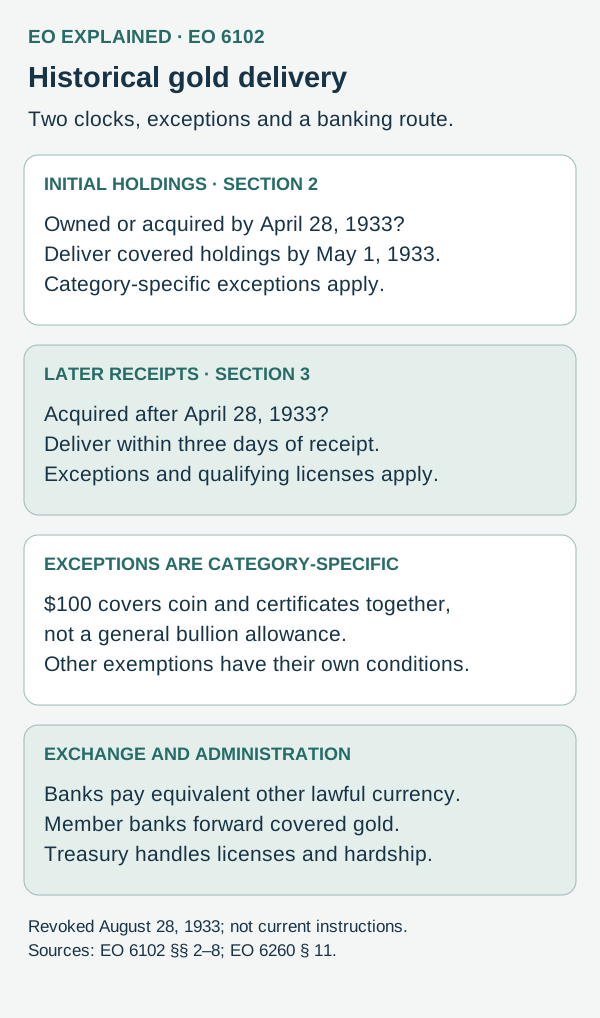
The order set a May 1933 delivery deadline and included exceptions for customary industrial and professional uses, limited personal holdings and rare coins. It invoked statutory emergency banking authority. Its provisions should be read with those exceptions, not as an unlimited seizure of every gold object.
| Actor | Direction in EO 6102 | Deadline and limits |
|---|---|---|
| Covered owners: individuals, partnerships, associations and corporations | Deliver covered gold coin, bullion and certificates to an authorized Reserve or member-bank receiving point, subject to the order’s category-specific exceptions. | Section 2: by May 1, 1933 for holdings owned or acquired on or before April 28. Section 3: within three days of receipt for acquisitions after April 28, subject to its exceptions and qualifying license/application provisions. |
| Federal Reserve Banks, branches/agencies and receiving member banks | Receive deliveries under the order; the receiving Reserve or member bank pays an equivalent amount of other lawful coin or currency. Reserve banks supply transport-cost voucher forms and receive sworn hardship applications addressed to Treasury. | Sections 2–4 and 6–7: payment upon receipt; applications follow the specified filing route. No universal Treasury decision deadline stated. |
| Federal Reserve System member banks | Deliver covered gold owned or received by them to their district’s Federal Reserve Bank, apart from section 2 exemptions, and receive credit or payment. | Section 5: onward-delivery duty, without a separate numerical deadline stated in this provision. |
| Treasury Secretary and designated licensing officers/agencies | Pay proper reasonable transport/insurance/protection costs on satisfactory evidence; consider extraordinary-hardship delivery extensions; issue implementing regulations and licenses through designated channels. | Sections 6–8: conditional reimbursement and discretionary extensions, not automatic compensation for every claimed cost or a blanket postponement. No fixed licensing/extension decision period stated. |
The $100 exception in section 2(b) applied to gold coin and gold certificates in the aggregate for one person; it was not a general $100 bullion allowance. Collector coins, customary industrial/professional/art uses, specified foreign holdings and licensed transactions had different wording and conditions. These are the terms of the historical 1933 instrument, not current gold-owner instructions. EO 6102, sections 2–3.
Why it was signed
The order was issued during a banking and monetary emergency. A Federal Reserve history explains that gold outflows continued despite earlier emergency measures and that Congress had amended the President's authority in March 1933. Roosevelt invoked that amended authority in the opening paragraph of EO 6102. It is therefore more accurate to read the April instruction as part of a sequence of emergency banking measures than as a timeless statement about private property. Federal Reserve history; EO 6102 transcription.
The administration's concern was gold being withheld from the monetary system during the crisis. Section 1 defined 'hoarding' in terms of withdrawal and withholding from customary trade channels. This definition, the specified categories of gold and the exceptions below all matter more than the shorthand claim that the government simply banned everyone from owning any gold. EO 6102, sections 1–2.
What the text authorized
Section 2 required delivery by May 1, 1933 to a Federal Reserve bank, branch or agency, or a member bank. It covered gold coin, gold bullion and gold certificates already owned or acquired by the specified April date. Section 3 addressed later acquisitions and set a shorter delivery period. The deadline and the form of gold should be stated together; a reader asking about jewelry or a rare coin should not be answered from an oversimplified slogan. EO 6102, sections 2–3.
The exceptions included gold reasonably needed for industry, a profession or art; a limited aggregate amount of coin and certificates per person; collector coins of recognized special value; certain foreign-government holdings; and licensed transactions. Section 4 required banks receiving gold to pay an equivalent amount in other lawful coin or currency. It was a compelled exchange under emergency rules, not a claim in the text that banks would receive the gold without payment. EO 6102, sections 2 and 4.
The order also directed member banks to pass on covered gold to Reserve banks, made provision for reasonable transport costs and allowed a written application for more time where timely delivery involved extraordinary hardship. These administrative details are important to a full account: the order was a set of instructions to people, banks and Treasury, with defined processes and exceptions. EO 6102, sections 5–7.
What happened in practice
EO 6260 later issued broader gold and foreign-exchange rules, including a licensing framework for certain uses and holdings. The 1934 Gold Reserve Act then transferred ownership of monetary gold to the Treasury and changed the monetary framework. Each instrument had a different date and legal form: executive directive, successor directive and statute. A guide should make those changes visible instead of treating the 1933 delivery order as the whole gold policy. EO 6260 text; Federal Reserve on the 1934 Act.
The Federal Reserve's historical essay gives a concrete example of a dental manufacturer seeking gold for its work in 1933. Such an example explains why the distinction between monetary hoarding and licensed industrial use mattered in practice. It does not establish that every applicant received a license, nor does it prove how frequently an exception was used across the country. A stronger quantitative section would need Federal Reserve or Treasury administrative records. Federal Reserve historical account.
Reaction and legacy
The original deadline has long passed, and later law changed the position on private gold ownership. The historical sequence matters to readers today because an image of the 1933 order sometimes circulates without its exceptions, its replacement rules or the later restoration of private ownership. The guide should answer a modern possession question with the current law, while presenting EO 6102 as evidence of the Depression-era policy. Federal Reserve account of later rules; EO 6102 text.
Congress later expressly provided that a person could purchase, hold, sell or otherwise deal with gold in the United States or abroad, with the relevant provision taking effect by December 31, 1974 unless an earlier presidential finding applied. This later enacted law is the proper answer to whether the 1933 restrictions still bar ordinary ownership. It does not erase the historical delivery requirement that applied at the time. Public Law 93-373, section 2.
The emergency and the claimed authority
EO 6102 was issued during the banking crisis, when gold withdrawals and outflows were a central concern of monetary officials. The Federal Reserve’s historical account places the order among March and April 1933 banking and gold measures. It was an intervention in a specific emergency, not a timeless description of what private Americans may own. Reading the April order alone obscures both the authority it invoked and the revisions that followed within months. The relevant questions are what the 1933 text compelled, how later measures changed it, and when Congress changed the statutory framework. Federal Reserve history; signed order.
The order cites the Trading with the Enemy Act as amended by the Emergency Banking Act. That attribution does not make every part of the later monetary program a clause of EO 6102. Congress supplied statutory authority, the executive issued instructions and Treasury and the Federal Reserve handled delivery and licensing. To judge a penalty or an individual transaction, one must check the applicable statute, executive text and regulations on the date involved. The emergency setting is a reason to be exact about that sequence, not a substitute for reading the actual clauses. Order text; Federal Reserve account.
The order’s title uses “hoarding,” but the operative rules had categories, exceptions and a delivery date. The word in the title should not be treated as an independent definition of unlawful conduct. A person looking at a family coin or a business inventory must start with what the instrument actually covered and excepted, then ask whether a later rule superseded it. A headline can convey the policy aim while still oversimplifying the legal mechanism. EO 6102.
The delivery requirement and its limits
The April text directed delivery of covered gold coin, bullion and certificates by May 1 to a Federal Reserve bank, branch or agency, or a member bank. It also addressed gold acquired after the relevant date. Delivery was therefore a rule with named assets, institutions and timing, rather than a generic confiscation of every object containing gold. The wording and its specific exceptions are necessary to understand who was covered. Primary order.
The listed exceptions included gold needed for legitimate and customary industrial, professional or artistic use, some coin and certificate holdings within a specified monetary ceiling, and recognized rare or unusual coins. Institutions holding gold for foreign governments or central banks were also treated under a separate exception. These categories do not mean every claimed collector or business purpose was automatically approved; they show why the claim “all gold was illegal” misstates the instrument. The precise text and later licensing rules controlled the actual case. Exceptions in EO 6102.
The order described payment on delivery and penalties for violations. That differs from saying every transfer occurred without compensation, while leaving open separate questions about valuation and economic loss during later changes to gold policy. A legal account should quote neither a nominal exchange amount nor a later gold price as proof of an individual claimant’s net outcome without transaction records. The Federal Reserve’s account explains the larger monetary sequence; the executive text specifies the contemporaneous duty. Signed order; Federal Reserve history.
Superseding rules and congressional change
Roosevelt’s later EO 6260 addressed gold, foreign exchange and related transactions under a more developed licensing framework. It should be read as a separate presidential act, not silently imported into the words of April 5. The quick succession of orders explains why a circulating scan of EO 6102 is an unreliable statement of the rules that applied months or years later. A dated legal timeline is essential: the first delivery requirement, later executive controls and the statutory monetary changes each occupied a different place. EO 6260; Federal Reserve chronology.
The Gold Reserve Act of 1934 shifted monetary gold to the Treasury and changed the legal structure within which the executive measures operated. The Federal Reserve history explains that change as part of the administration’s broader gold program. It would be inaccurate to say EO 6102 itself created every feature of the 1934 settlement, including the later alteration in the dollar’s gold value. The signed order, later orders and statute have different dates and legal effects. Federal Reserve on the 1934 act; EO 6102.
Congress changed the private ownership position decades later. The 1974 legislation is a key endpoint for evaluating claims that the 1933 possession controls remain generally operative against private citizens today. That later law did not erase the fact that people faced restrictions in the intervening period. A historically accurate status statement therefore says both that the 1933 deadline belongs to the past and that subsequent law removed the old general bar on private gold ownership. 1974 public law; Federal Reserve history.
Claims the record does and does not support
The text establishes a legal command and threatened penalties. It does not by itself count how many people complied, how many were prosecuted, or how much rare coin was retained. Those empirical questions require Treasury, banking and enforcement records. The Federal Reserve’s historical narrative supports the program’s monetary setting, but it is not a substitute for individual delivery receipts. Keeping the legal rule separate from measured enforcement avoids turning a dramatic order into an invented nationwide statistic. EO 6102 text; Federal Reserve history.
A second common shortcut attributes the later revaluation of monetary gold solely to the April delivery command. The order facilitated the administration’s policy, but changes in statutory ownership and valuation were separate steps. Evaluating whether a person suffered loss also requires a defined comparison date, the property held and the rules governing its exchange. This guide can state the legal sequence confidently while declining to assign a universal gain or loss to every holder. Federal Reserve, Gold Reserve Act; April order.
The historical relevance remains considerable. EO 6102 illustrates how emergency legislation, presidential instruction, central-bank channels and subsequent congressional action interacted in monetary policy. A reader asking what was required on April 5 needs the order’s clauses and exceptions; a reader asking what is legal now needs later law. Mixing those two questions creates the familiar but false impression that a deadline and prohibitions from 1933 still govern ordinary modern ownership. Primary text; 1974 statute.
How to check a claim about a gold holding
First establish what asset was held: coin, bullion, certificate or another item. The order did not use the word “gold” as an unlimited catch-all. Next identify the holder and purpose, because the exceptions were part of the operative rule. Finally establish the date, since EO 6260 and the 1934 act changed the framework. Without those three facts, a confident legal answer about a photograph of a coin or a historical transaction is likely to overreach. EO 6102; EO 6260.
The exception for rare and unusual coins is a reminder that an ordinary coin and a collector’s piece may have been treated differently. The order’s category does not prove that every seller’s claimed rarity was accepted by officials. For an individual dispute one would need the period’s classification, relevant license or enforcement file. It is more honest to state the exception’s existence than to announce an unsupported bright line for all numismatic items. Original order.
The payment provision also needs precise treatment. Delivery for payment was a legally specified mechanism; debate about whether the rate fairly compensated holders is a different economic question. A comparison with a later official gold price may illuminate policy but cannot replace records of what a specific person held or received. Avoiding an invented universal loss leaves room for serious analysis of the program’s distributional effects where evidence exists. EO 6102; Federal Reserve on 1934 change.
The banking emergency is also part of the causal setting, but it should not be conflated with the entire policy outcome. Federal Reserve history connects gold outflows, the emergency measures and later dollar policy. It does not say a single April signature solved every banking problem. The order was one instrument in a sequence that included congressional action and later presidential rules. Federal Reserve gold program.
The 1974 change to private ownership is decisive for the modern-status question, but it does not tell us whether a particular historical prosecution was valid or how a past claim was settled. Those questions depend on the law and facts at the time. The guide’s present-tense statement is limited to ordinary private ownership under later law. 1974 statute; 1933 order.
A source-led history can therefore say what officials demanded, what exceptions appeared in the instrument and how the legal regime evolved. It cannot produce compliance rates or individual losses from the order’s text. That limit is substantive: a rule’s scope and its lived enforcement are different kinds of evidence. Signed order; Federal Reserve account.
Separating prohibition from later monetary policy
The order’s delivery obligation operated through named banks and Federal Reserve facilities. This institutional channel matters: it identifies where the gold was to go and where a contemporaneous receipt or transaction record might be found. It also distinguishes the command from a claim that federal agents physically collected every item. Whether a particular holder complied is an evidentiary question. EO 6102.
The Federal Reserve’s narrative explains the monetary pressures and how policy developed after the order. It is a secondary institutional history, useful for chronology, while the signed order supplies the exact categories and exceptions in April. The 1934 act supplies later statutory changes. Using each for the question it can answer prevents a later explanation from silently amending the primary text. Federal Reserve history; Gold Reserve Act history.
Some accounts call the measure a general ban on possessing gold; others say the collector exceptions made it harmless. Both descriptions miss the balance of the text. It imposed a broad delivery duty on specified holdings, with specified exceptions and licensing, at a time of significant monetary change. The rules were consequential without being literally universal. Original order.
The legal landscape then continued changing through EO 6260, the 1934 act and the 1974 legislation. Present ownership cannot be determined by clipping the April 1933 order from that sequence. Historical enforcement, by contrast, must be assessed under the dated regime then applicable. These distinct inquiries are the reason the guide includes both the original exceptions and the later timeline. EO 6260; 1974 statute.
Common questions
Did the order require every gold object to be handed over?
No. It named gold coin, bullion and certificates and listed exceptions for certain industrial or professional uses, limited holdings, rare collector coins, foreign-government holdings and licensed transactions. The answer to any historical case depends on the category, date and terms of the exception. The text should be read before accepting a broad claim that every gold object was covered. EO 6102, section 2.
Were people paid when they delivered gold?
Section 4 said a receiving bank would pay an equivalent amount in another form of lawful coin or currency. That does not settle later arguments about the monetary value of gold after the 1934 law changed the official price. Those are separate policy stages and should be compared using their respective documents and dates. EO 6102, section 4; Federal Reserve history.
What if someone could not meet the deadline?
Section 7 allowed the Treasury Secretary, at his discretion, to extend the delivery time where it would involve extraordinary hardship or difficulty. The application had to be written under oath and filed through a Federal Reserve bank with details of the gold and the reason for an extension. That provision was not a blanket postponement for everyone. EO 6102, section 7.
Is EO 6102 a rule for gold owners today?
No. Its 1933 delivery direction belongs to a historical emergency program. EO 6260 and the Gold Reserve Act changed the scheme, and private ownership restrictions later changed again. A present-day legal question requires current law, not reliance on the old deadline or the historical dollar figures alone. This guide describes what Roosevelt ordered in 1933 and how that policy evolved. EO 6260 text; Federal Reserve history.
What happened later
EO 6260 replaced and developed the gold-control rules later in 1933; the Gold Reserve Act followed in 1934. Congress later restored private gold ownership from 1974. The original delivery order is a historical measure, not a current duty to surrender gold.
Evidence timeline
- April 5, 1933 EO 6102 required delivery of covered gold holdings, subject to exceptions. Source 1
- August 28, 1933 EO 6260 created a later and wider gold-control framework. Source 2
- 1934 Congress enacted the Gold Reserve Act. Source 3
- 1974 Private ownership of gold again became lawful. Source 3
- August 28, 1933 Executive Order 6260 expressly revokes Executive Order 6102 while preserving preexisting liabilities and proceedings. Official source
Why this order matters
EO 6102 was one step in a larger sequence of banking and monetary measures during the Depression. Distinguishing the April order, later presidential rules, the 1934 statute and the 1970s reversal prevents a misleading account of today’s law.
Sources and historical records
- FDR EO 6102 text — American Presidency Project Institutional text transcription
- FDR EO 6260 successor text — American Presidency Project Institutional text transcription
- Federal Reserve History — Gold Reserve Act and later ownership Official or archival record
Last recorded source review: September 28, 2026. Historical impact and current legal effect are distinct; follow the later sources for the current position.