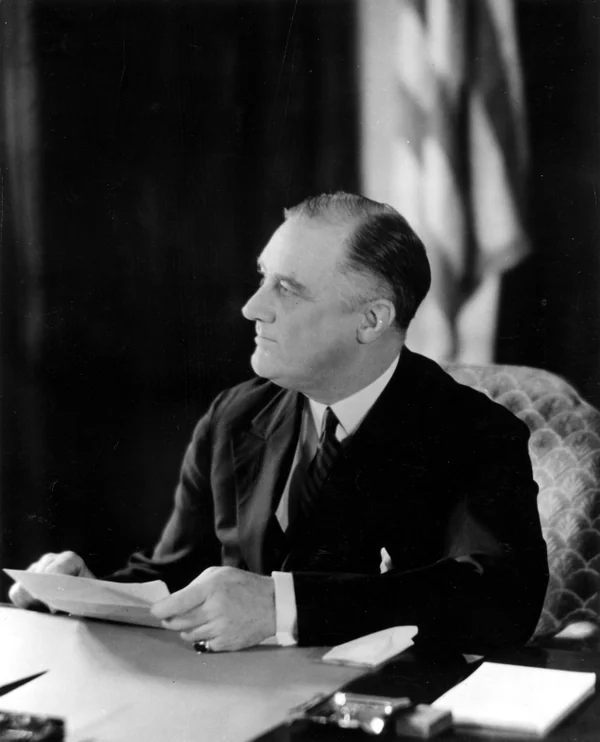
The banking emergency, 1933
EO 6102 expressly cited the continuing banking emergency and required delivery of covered gold holdings, with specified exceptions and payment in other currency.
Franklin D. Roosevelt's executive orders show two different faces of emergency government: organizing economic recovery and wartime production, and exercising powers that could gravely damage individual rights. His directives built administrative machinery, regulated gold, addressed employment discrimination, and authorized military exclusion. Reading these measures together avoids treating either the New Deal or World War II as a single executive action. Sources: American Presidency Project, source 1 · American Presidency Project, source 2 · National Archives, source 3
EO 6102 required most covered gold coin, bullion, and certificates to be delivered to banks, with payment in other lawful currency. It retained exemptions, including specified industrial uses and collectible coins. Treasury administered the rules; later orders changed the legal framework. Sources: American Presidency Project, source 1
EO 7034 established the Works Progress Administration and a process for reviewing projects and recommending funding allotments. Its administrative objective was to move people from relief into employment while coordinating progress reports, investigation, wages, and working conditions. Sources: American Presidency Project, source 1
EO 9024 created the War Production Board to direct procurement and production policy. Its chairman could coordinate purchasing, plant expansion, conversion, and priorities across agencies, which were required to follow the board's policies and supply information. Sources: American Presidency Project, source 1
EO 8802 addressed discrimination in defense employment, while EO 9066 enabled exclusion that led to Japanese American incarceration. These were distinct policies: expanding participation in wartime work did not prevent the government from denying other Americans liberty and property. Sources: National Archives, source 1 · National Archives, source 2
EO 6102 expressly cited the continuing banking emergency and required delivery of covered gold holdings, with specified exceptions and payment in other currency.
EO 7034 invoked the Emergency Relief Appropriation Act and created the WPA and the machinery for reviewing projects and recommending allotments.
The National Archives links the campaign against defense-job discrimination to EO 8802; Randolph called off the planned march after the order was issued.
EO 9024 referred to the declarations of war and established the War Production Board to direct war procurement, production, conversion, and priorities.
The National Archives documents how post-attack fears and anti-Japanese pressure preceded EO 9066 and its implementation through military exclusion and incarceration.
Signed on April 5, 1933, EO 6102 invoked the banking emergency and statutory authority Congress had recently amended. It set May 1 as the delivery deadline for covered gold holdings. It exempted up to $100 in gold coin and certificates per person, rare collectible coins, specified industrial and professional requirements, and other defined transactions. Banks paid an equivalent amount in other lawful coin or currency. Describing the order as a prohibition on every gold object would erase important limits in its actual text. Sources: American Presidency Project, source 1
Roosevelt did not leave that initial gold directive unchanged. EO 6260, signed on August 28, 1933, introduced a broader licensing and reporting framework for gold and foreign-exchange transactions. Section 11 explicitly revoked the April 5 gold order and the April 20 order covering foreign exchange and gold exports, while preserving liabilities already incurred. EO 6102 is therefore a landmark in a sequence of emergency measures, rather than the enduring legal text governing all later gold restrictions. Sources: American Presidency Project, source 1
EO 7034 followed the Emergency Relief Appropriation Act of 1935. It created a division to receive and review project applications, an advisory committee to recommend allotments to the president, and the Works Progress Administration to coordinate execution. The order assigned responsibilities for investigating progress and reporting employment, rather than merely announcing a wish to create jobs. It illustrates how Roosevelt used directives to put an enacted relief program into administrative operation. Sources: American Presidency Project, source 1
EO 8802, issued on June 25, 1941, prohibited discrimination based on race, creed, color, or national origin in defense employment and government. It required nondiscrimination provisions in defense contracts and established a committee to investigate complaints. The National Archives connects its adoption to A. Philip Randolph's threatened march on Washington. The order addressed jobs and training; it was not an order desegregating the armed forces. Sources: National Archives, source 1 · American Presidency Project, source 2
EO 9346 strengthened and reorganized that employment policy on May 27, 1943. It established a new Committee on Fair Employment Practice, required nondiscrimination terms in contracts and subcontracts, and authorized complaint investigations, hearings, findings, and steps to eliminate discrimination. It also called for nondiscriminatory vocational training. This was an institutional development within the wartime employment program, not a declaration that every segregated federal institution had been abolished. Sources: American Presidency Project, source 1
EO 9066, signed on February 19, 1942, authorized the secretary of war and designated commanders to establish military areas from which people could be excluded. Its wording did not name Japanese Americans, but its implementation targeted them for forced removal and confinement. Congress separately supplied criminal penalties, and military authorities issued implementing orders. These distinctions matter: the presidential directive enabled the machinery of exclusion, while later actions determined who had to leave and how the program operated. Sources: National Archives, source 1
In Korematsu v. United States in 1944, the Supreme Court upheld Fred Korematsu's conviction for violating the exclusion requirement. The National Archives records that his conviction was later vacated through a coram nobis proceeding in the 1980s. Ex parte Endo, also decided in 1944, reached a different question: the government could not detain a concededly loyal citizen without cause. Endo helped open the way to ending mass confinement; it should not be collapsed into Korematsu's ruling on exclusion. Sources: National Archives, source 1
After the war, Truman's EO 9638 transferred the War Production Board's functions to a Civilian Production Administration and terminated the board, effective at the close of business on November 3, 1945. Existing directives continued unless they conflicted with the new order or were later amended. The change combined administrative continuity with a stated goal of returning industry to peacetime production free from wartime controls; it did not simply cancel every production decision overnight. Sources: American Presidency Project, source 1
Roosevelt's fair-employment orders belong in the background to later civil-rights directives, but they must not be credited with Truman's military integration policy. Truman issued EO 9981 on July 26, 1948, establishing equality of treatment and opportunity in the armed services and a committee to recommend implementation. EO 8802 and EO 9346 addressed defense work and government employment. They were earlier uses of executive authority against discrimination, rather than orders that themselves desegregated military units. Sources: Presidential library, source 1 · American Presidency Project, source 2
Ford's EO 11825 revoked EO 6260 and specified related gold restrictions on December 31, 1974, preserving earlier liabilities and proceedings. In 1976, Ford addressed EO 9066 through Proclamation 4417, not a new executive order. That proclamation confirmed that the authority conferred by EO 9066 had terminated with the December 31, 1946 proclamation ending wartime hostilities. These later documents distinguish formal legal disposition from the continuing historical consequences of Roosevelt's actions. Sources: National Archives, source 1 · American Presidency Project, source 2
Roosevelt created the War Relocation Authority to administer the forced removal and incarceration of Japanese Americans during the Second World War.
Current position: War Relocation Authority abolished effective June 30, 1946
Roosevelt reorganized a wide range of executive functions, including transfer of national monuments, historic sites and military parks to the National Park Service.
Current position: Historical reorganization with continuing park-system lineage; many functions changed
Roosevelt created the Works Progress Administration and related machinery to distribute funds and run public employment under the Emergency Relief Appropriation Act of 1935.
Current position: Works Progress Administration abolished effective June 1943
Roosevelt combined domestic and overseas wartime information functions in the Office of War Information.
Current position: Office of War Information terminated in 1945
Roosevelt set wage and price stabilization machinery during the war and created an Office of Economic Stabilization.
Current position: Wartime stabilization order expressly revoked by EO 9801 in 1946; office changed before revocation
Roosevelt created the War Production Board to coordinate industrial output and allocation for the Second World War.
Current position: War Production Board terminated and functions transferred in 1945
Roosevelt organized the new Executive Office of the President into offices including the White House Office and Bureau of the Budget.
Current position: Executive Office continues; constituent offices and functions have changed
The order barred discrimination in defense employment by federal agencies and participating employers, and established a Fair Employment Practice Committee to receive complaints.
Current position: Historic wartime program; subsequently amended
Roosevelt established a Rural Electrification Administration under the 1935 relief appropriation to finance electric service in underserved rural areas.
Current position: 1935 agency succeeded by a statutory agency in 1936; modern rural utilities programs rest on later law
Roosevelt set up Emergency Conservation Work, the program later widely known as the Civilian Conservation Corps, to employ unemployed people on conservation projects.
Current position: Emergency Conservation Work program ended in 1942
Roosevelt established a War Refugee Board to pursue rescue and relief for people facing Nazi persecution.
Current position: War Refugee Board terminated in 1945
Roosevelt ordered most privately held gold coin, bullion and gold certificates delivered to banks during the banking emergency, subject to stated exceptions.
Current position: 1933 restrictions superseded; private gold ownership lawful since 1974
The order authorized military commanders to designate areas from which people could be excluded. Its implementation led to the forced removal and incarceration of Japanese Americans, although the order itself did not name them.
Current position: Authority ended in 1946; Proclamation 4417 confirmed termination in 1976
Roosevelt created the Office of Scientific Research and Development to coordinate scientific and medical research for national defense.
Current position: Wartime office terminated in 1947
Roosevelt extended the existing foreign-assets control framework to Japanese and Chinese property in the United States, requiring licenses for covered transactions.
Current position: Historical wartime amendment; broad current-transaction controls lifted in 1947; residual assets treated separately
The Roosevelt guides below cover selected New Deal programs, wartime organization, gold policy and military exclusion.
The site's historic collection is a curated selection, not a complete inventory of Roosevelt's directives. See the historic-order collection for the guides available here.