Executive Order 14167: Clarifying the Military's Role in Protecting the Territorial Integrity of the United States
President: Donald J. Trump
Assigned US Northern Command a border-related mission and directed revisions to the Unified Command Plan, planning and resource prioritization.
Status: In effect.
Is Executive Order 14167 still in effect? Yes. Active; military support framework implemented.
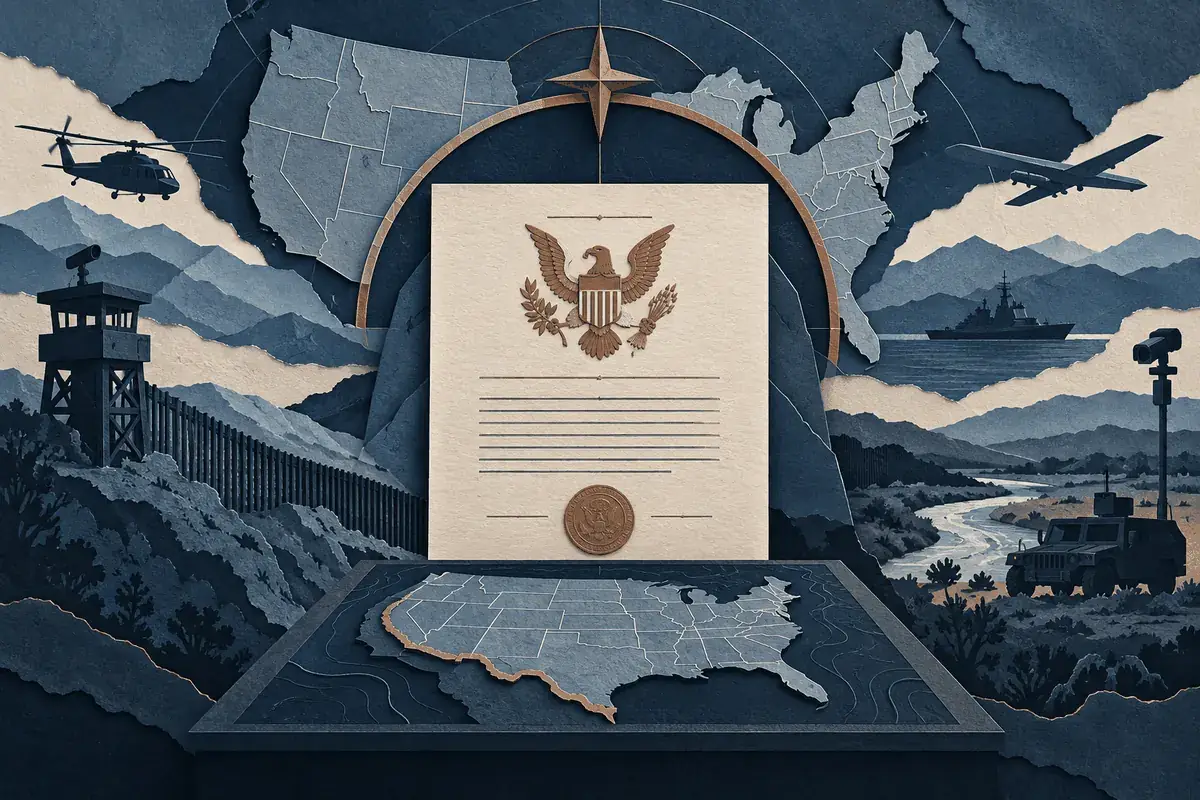
What does Executive Order 14167 do?
Civil immigration enforcement remained principally a Department of Homeland Security responsibility.
Later primary evidence reviewed September 24, 2026: A NASA land-transfer notice said the action complied with this order's military-border-support direction. Official source. The cited steps do not establish every downstream effect.
Reading the operative provisions of Executive Order 14167
The order assigned the Defense Secretary a planning deadline: revise the Unified Command Plan within 10 days so U.S. Northern Command could carry out the mission described in the order. It also called for military support to border operations in coordination with DHS. This is a command-and-coordination instrument within the executive branch; it does not transfer the entire civilian immigration system to the Department of Defense or make soldiers the final decision-makers in routine immigration cases.
The order’s support language must be read with statutory limits on military participation in domestic law enforcement. The type of support, location, and assigned personnel matter. A later land-transfer notice or military deployment can show one way agencies implemented the direction, but it does not establish that all military activities at the border have the same legal basis. DHS remains responsible for immigration enforcement, while Defense carries out the military planning and support functions assigned by the President and permitted by law. Review the cited order and agency records.
The Unified Command Plan is an internal Department of Defense planning document that assigns combatant-command responsibilities. Revising it was meant to organize military support, not to amend the Posse Comitatus Act or transfer DHS authorities. The actual military mission can vary by location, personnel, and task, so each deployment needs its own statutory analysis. The later NASA land-transfer notice cited by this page documents one agency action associated with the border mission; it is not a general grant of military law-enforcement power or proof that all support activities use the same authority.
Before and after
Before the order
DHS led civilian border enforcement while Defense provided support under existing authorities.
The Unified Command Plan did not contain the new mission wording directed by this order.
After the order
Defense was directed to make sealing the borders a military priority and add a Northern Command mission.
Later deployments and military-zone arrangements were made through separate orders and operational decisions.
A NASA land-transfer notice said the action complied with this order's military-border-support direction.
Who had to do what
| Agency / office | Action | Timing / position |
|---|---|---|
| Defense Secretary | Revise the Unified Command Plan | Within 10 days |
| US Northern Command | Plan and conduct assigned support mission | Ongoing |
| Defense and DHS | Coordinate personnel and resources | Ongoing |
What happened next
EO 14167 signed.
Ten-day planning deadline.
Later primary evidence reviewed: A NASA land-transfer notice said the action complied with this order's military-border-support direction.
Legal and source detail
How it works legally
The order does not erase the Posse Comitatus Act or transfer all immigration authority to the military. Each operational use requires its own legal authority and scope analysis.
Sources by type
If a source is unavailable, first check the cited publisher or another official repository. The cited publisher remains the authority.
Primary and official sources
Orders, laws, court records and official implementation material.
How we checked this
Last checked against the sources above on September 24, 2026. How we research →