Executive Order 14156: Declaring a National Energy Emergency
President: Donald J. Trump
Declared a national emergency concerning US energy and critical-mineral capacity and directed agencies to identify and use lawful emergency authorities to accelerate infrastructure, production and permitting.
Status: In effect.
Is Executive Order 14156 still in effect? Yes. The January 12, 2026 notice continued its national emergency for one year beyond January 20, 2026. EO 14391 later clarified the recommendation requirement in section 2(a). Continuing the emergency does not approve every project or settle the separate litigation over agency procedures. Continuation notice; March 13, 2026 clarification.
What does Executive Order 14156 do?
Declared a national emergency concerning US energy and critical-mineral capacity and directed agencies to identify and use lawful emergency authorities to accelerate infrastructure, production and permitting.
Later primary evidence reviewed September 24, 2026: A presidential notice continued the national energy emergency declared by this order. Official source. The cited steps do not establish every downstream effect.
What changed in actual agency practice?
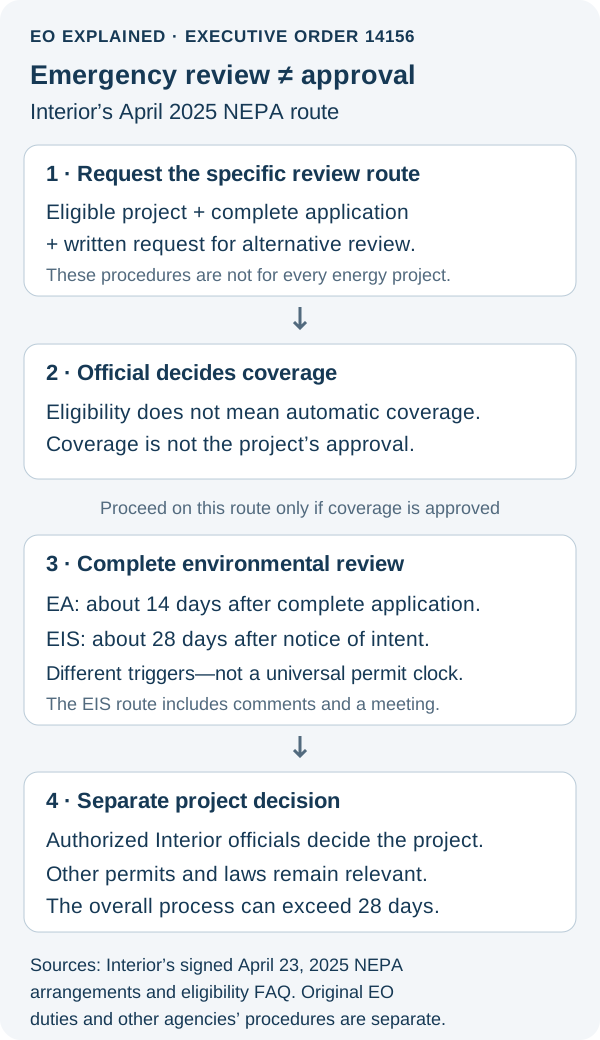
On April 23, 2025, Interior announced alternative procedures for environmental review, endangered-species consultation and historic-preservation compliance. The department’s announcement described approximately 14-day environmental assessments and roughly 28-day environmental impact statements. Those are Interior process descriptions, not deadlines written into EO 14156 for every federal permit. Dated agency announcement.
Interior’s FAQ makes coverage a separate decision: an applicant must request it and submit the relevant completed application; eligibility does not automatically confer coverage. Other federal, state and local requirements remain operative, and reviews by other agencies can push a project’s overall timetable beyond 28 days. The FAQ also excludes wind and solar projects from these particular procedures because those resources are not listed in the declaration. That is a limitation on this expedited process, not a nationwide prohibition on those projects. Eligibility, application process and limits.
EPA took a different kind of action on April 28, 2025: a temporary E15 fuel waiver effective May 1 through May 20, with further waivers contemplated if the supply conditions persisted. Its release expressly connects that action to the order. Despite the release’s year-round-sales heading, the instrument described there was time-limited; it was not permanent permission created by the executive order itself. EPA’s dates and statutory explanation.
A concrete permitting example followed on May 23, 2025, when Interior reported approval of the Velvet-Wood uranium-vanadium mine in Utah after completion of BLM’s environmental assessment under the accelerated process. That records an agency approval, not proof that mining had begun, production targets had been reached, or every project elsewhere received the same result. Approval announcement.
Reading the operative provisions of Executive Order 14156
A national-emergency declaration is a legal trigger, not a blanket waiver of every permitting rule. EO 14156 invokes the National Emergencies Act and directs agency heads to identify which emergency authorities may lawfully help address the stated energy and critical-minerals concern. The 30-day reporting task asks agencies to map available tools; the Secretaries of the Interior and Energy and other permitting officials then have separate operational roles. A later agency still must satisfy the conditions written into the statute it relies on.
The order’s focus spans production, leasing, transportation, refining, and generation, but a project does not become approved just because it falls within that policy. Emergency procedures may change timing or coordination where Congress authorized them, while environmental, safety, land, and appropriations requirements continue unless a specific law provides otherwise. EO 14241’s later mineral measures and the 2026 continuation notice are separate actions that help establish what remained in force. Read Executive Order 14156 in the Federal Register.
The declaration also requires agencies to identify which statutory tools are actually available. Different tools have different prerequisites: an emergency designation under the National Emergencies Act does not, by itself, waive environmental review, direct a utility to build a project, or give a private company a right to federal land. Interior, Energy, the Army Corps, and other offices must connect each step to the statute that authorizes it and to the facts of the project. The later continuation notice preserves the declared emergency for another period, but does not establish that every possible emergency authority has been invoked.
The President’s declaration also has a defined statutory role: it makes emergency authorities available only when the underlying statute’s requirements are met. The order directs preparation and coordination; its sections do not themselves decide which project receives a permit or whether a particular emergency procedure applies. A landowner, state, or company must still look to the agency’s final action and the statute it cites. The 2026 continuation notice renews the national-emergency declaration but does not retroactively approve earlier projects.
Before and after
Before the order
Energy projects proceeded through ordinary statutory permitting, environmental review and emergency authorities available under existing law.
No national emergency specific to the capacity described in EO 14156 was then in force.
After the order
Agencies were directed to catalog emergency powers, expedite priority projects and use lawful emergency procedures.
A January 2026 presidential notice continued the emergency for one year.
A presidential notice continued the national energy emergency declared by this order.
Who had to do what
| Agency / office | Action | Timing / position |
|---|---|---|
| Executive department and agency heads | Identify and use lawful energy authorities; expedite authorized, appropriated projects and facilitate West Coast, Northeast and Alaska supply, refining and transport. For needed eminent-domain or DPA action reserved to the President, recommend action through the National Security Advisor. Identify Corps/ESA emergency actions and report status. | Sections 2–5: initial reports within 30 days; status reports within 30 days after initial submission, then at least every 30 days during the emergency. |
| Secretary of the Army, through the Assistant Secretary for Civil Works | Identify Corps actions, report and consult promptly; submit recommended construction actions addressing defense-assessment vulnerabilities for presidential review. | Sections 4 and 7(b): initial 30 days; prompt consultation; construction authority only according to its terms. |
| EPA Administrator | Consider E15 emergency waivers with Energy’s concurrence; cooperate promptly on Corps permitting. | Sections 2(b), 4(d): consideration, not automatic issuance; no numerical waiver deadline. |
| Secretary of Energy | Consult and concur on fuel waivers; collaborate on Defense’s energy assessment. | Sections 2(b), 7(a): concurrence before waiver; assessment within 60 days. |
| Secretary of the Interior | Ensure FWS availability; chair and convene the ESA Committee; review exemption submissions; collaborate on Defense’s assessment. | Sections 5–7: prompt consultation; at least quarterly meetings; initial eligibility determination within 20 days of receipt and resolution within 140 days of eligibility, to the extent practicable under law. |
| Secretary of Commerce | Ensure NMFS’s fisheries official or representative is available for emergency consultation. | Section 5(d): promptly; no numerical deadline. |
| Fish and Wildlife Service Director or authorized representative | Consult with agencies on ESA emergency regulations and take appropriate action. | Section 5(d): promptly. |
| NMFS Assistant Administrator for Fisheries or authorized representative | Provide corresponding emergency consultation and appropriate action. | Section 5(d): promptly. |
| Secretary of Defense | Assess military energy acquisition/transport vulnerabilities with Interior and Energy; recommend authorities and resources; report to the National Security Advisor. | Section 7(a): within 60 days. |
| Endangered Species Act Committee | Consider lawful exemption applications; if none are pending, the Committee or its designees identify ESA/Marine Mammal Protection Act obstacles and procedural improvements. | Section 6: at least quarterly unless law requires otherwise; no automatic exemption. |
| OMB Director | Receive reports; may exempt agencies from the recurring ESA status-report requirement. | Section 5(c): discretionary exemption; not a blanket exemption from section 4 reporting. |
| Assistant to the President for Economic Policy | May request activity reports under the infrastructure-delivery section. | Section 3(c): as requested; no fixed reporting date. |
Original sections 2–7. The report-recipient lists differ: section 4 includes Army, OMB, economic-policy/NEC leadership and CEQ; section 5 includes Interior and Commerce instead of Army. Being a recipient does not create a separate project-approval assignment. The National Security Advisor is also the specified route for recommendations and receives the defense assessment. The presidential-recommendation row reflects EO 14391’s later clarification. These directions are not proof that every report or assessment was delivered.
What happened next
EO 14156 declared the emergency.
The signed order was published at 90 FR 8433–8437, separately from its January 20 signing. Authenticated publication.
Thirty-day agency-report deadline.
EO 14241 relied on the emergency for mineral-production measures.
Interior announced emergency NEPA, ESA and historic-preservation procedures. Agency announcement; signed NEPA arrangements.
EPA announced the temporary E15 waiver, effective May 1 through May 20. Further waivers required later action rather than following permanently from this announcement. Announcement and dates.
The states filed Washington v. Trump, No. 2:25-cv-00869, in the Western District of Washington, challenging the declaration and related agency procedures. A complaint is not an injunction. Official case tracker.
Interior reported approval of Velvet-Wood after BLM completed its environmental assessment. Agency approval report.
President continued the emergency beyond its anniversary.
The January 12 continuation notice was published at 91 FR 1667–1668, continuing the emergency for one year beyond January 20, 2026. Authenticated notice.
The states filed their first amended complaint adding Interior and challenging its procedures. These are litigants’ allegations, not findings that the order was struck down. Amended complaint.
EO 14391 clarified when section 2(a) requires a recommendation to the President: only where the authority rests in the President alone and has not been delegated. It was published on March 18. Signed section 3.
In the separate Lighthiser v. Trump appeal, No. 25-6714, the Ninth Circuit affirmed dismissal for lack of Article III standing and denial of leave to amend. It did not decide that every implementing agency action was lawful. Court’s unpublished memorandum.
Later primary evidence reviewed: A presidential notice continued the national energy emergency declared by this order.
Legal and source detail
How it works legally
Interior’s signed NEPA arrangements have distinct clock triggers. An environmental assessment should be prepared in approximately 14 days after receipt of a complete application. An environmental impact statement should be prepared in approximately 28 days after publication of a notice of intent. The latter route includes soliciting comments and announcing a public meeting. The document restricts who may approve coverage and the application itself and requires compliance with other applicable statutes. Paragraphs 1–5, including the actual timing triggers.
The ESA alternative procedures likewise do not erase consultation. They require agency coordination with FWS and provide for information and consultation after termination or expiration of the emergency as soon as practicable under the circumstances. This is a separate mechanism from the statutory exemption applications considered by the ESA Committee. Signed informal-consultation procedures, paragraphs 3–5.
EO 14391, section 3, March 13, 2026, clarifies that an agency already holding delegated authority need not recommend its own authorized action to the President under EO 14156 section 2(a). It is a clarification of that recommendation step, not a new universal permit waiver. Later, EO 14427, September 8, 2026, changed the separate EO 13603 delegations, including independent Interior and Energy authority for specified energy-related functions. Read the relevant delegation alongside the statute; neither document makes every energy project automatically approvable.
Two different lawsuits, different procedural positions
In Washington v. Trump, the states’ amended complaint challenges the use of the declaration and particular agency procedures. The federal defendants’ March 5, 2026 motion to dismiss, document 64, argues lack of standing, absence of final agency action and other threshold grounds. Those arguments are not a judicial ruling accepting them.
As checked on October 17, 2026, Oregon DOJ’s case tracker describes that motion as fully briefed, with oral argument scheduled for October 20, 2026. This is the official account of a plaintiff state, not a merits judgment or assurance that the hearing cannot change. It does not establish an order-wide injunction.
The separate June 2, 2026 Lighthiser memorandum affirms a standing dismissal, discusses traceability, redressability and the requested sweeping relief, and is unpublished and nonprecedential except as permitted by Ninth Circuit Rule 36-3. Its reasoning does not establish that each agency permit, regulation or project decision satisfies its own governing law. The historical disposition is not an exhaustive account of later rehearing or Supreme Court proceedings.
An emergency declaration activates only authorities supplied by statute; it does not waive every permitting or environmental law. Agency uses of emergency powers remain separately reviewable.
Sources by type
If a source is unavailable, first check the cited publisher or another official repository. The cited publisher remains the authority.
Primary and official sources
Orders, laws, court records and official implementation material.
- January 12, 2026 energy-emergency continuation notice
- Interior — April 23, 2025 emergency procedures announcement
- Interior — eligibility and permitting FAQ
- Interior — April 23, 2025 NEPA alternative arrangements
- Interior — April 23, 2025 ESA consultation procedures
- EPA — April 28, 2025 temporary E15 waiver announcement
- Interior — May 23, 2025 Velvet-Wood approval report
- EO 14391 — section 3 clarification of presidential recommendations
- EO 14427 — September 8, 2026 DPA delegations
- Oregon DOJ — Washington v. Trump current case tracker
- Washington v. Trump — first amended complaint
- Washington v. Trump — March 5, 2026 defendants’ motion, document 64
- Lighthiser v. Trump — Ninth Circuit June 2, 2026 memorandum
How we checked this
Additional primary-source review on October 17, 2026: the complete signed order, continuation and delegation instruments; Interior’s procedures and implementation reports; EPA’s dated waiver announcement; the cited pleadings and court memorandum; and Oregon DOJ’s current case tracker. Directions and reported approvals are not treated as proof that every agency deliverable was completed, and the continuing declaration is not a judicial clearance of all implementation.
Last checked against the sources above on September 24, 2026. How we research →