Executive Order 14155: Withdrawing the United States From the World Health Organization
President: Donald J. Trump
Directed the United States to withdraw from the World Health Organization, pause future federal support and personnel, and stop negotiations on specified WHO pandemic instruments.
Status: In effect. Is Executive Order 14155 still in effect? Yes. The U.S. withdrawal direction remains operative: HHS and State reported its implementation on January 22, 2026. This label describes the domestic directive, not a finding that every international membership or financial question is settled. Agency announcement; later WHO resolution.
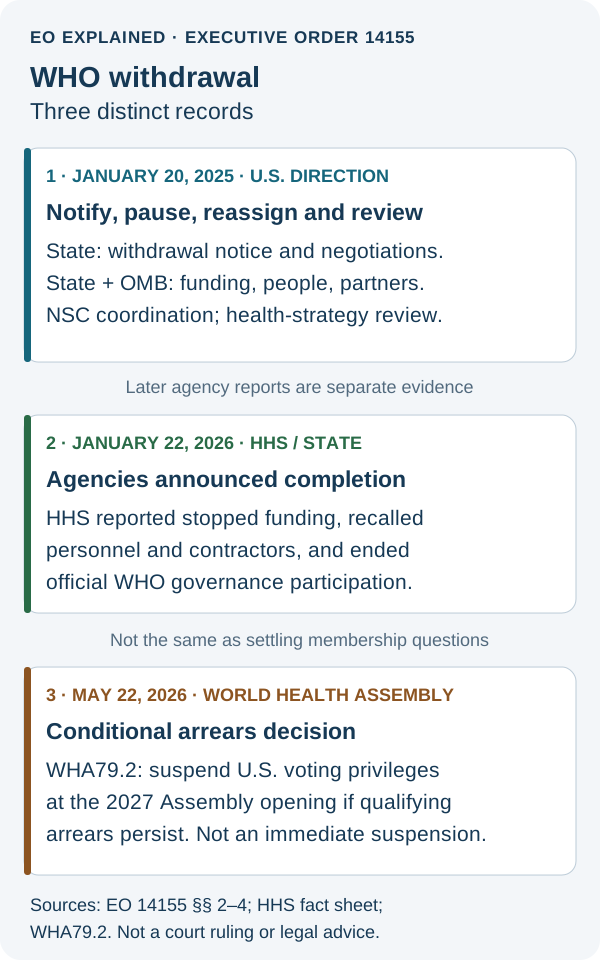
What does Executive Order 14155 do?
A one-year international notification process followed.
Later primary evidence reviewed September 24, 2026: WHO acknowledged the United States' withdrawal notification in January 2026 and said related questions would be considered by its governing bodies; this source does not settle the order's full legal effect. Official source. The cited steps do not establish every downstream effect.
What agencies reported carrying out
HHS and State announced on January 22, 2026 that the United States had completed withdrawal. Their release reported that funding had stopped, personnel had been withdrawn, and former WHO activities were being redirected toward bilateral engagements. These are the agencies’ implementation claims, rather than proof inferred solely from the order’s signing. Dated joint-agency announcement.
HHS’s accompanying fact sheet specifically reported recall of personnel and contractors from Geneva and other WHO offices, suspension or discontinuation of engagements, and the end of official participation in WHO committees, governance bodies and technical groups. It does not identify a completed replacement for every WHO function or publish the strategy-review deliverable assigned to the pandemic-policy office. Implementation fact sheet.
Reading the operative provisions of Executive Order 14155
The text lays out several actions for the withdrawal period, not only a notice to the World Health Organization. It revokes EO 13987 and the 2021 presidential letter that had withdrawn the earlier U.S. withdrawal notice; directs the National Security Council to establish public-health and biosecurity coordination; and tells State and OMB to pause future U.S. support, recall or reassign personnel, and identify replacement partners. It also assigns a review of the 2024 U.S. Global Health Security Strategy and directs State to stop negotiating the WHO Pandemic Agreement and International Health Regulations amendments while withdrawal proceeds.
These provisions affect different actors and have different proof of completion. The order’s notice, WHO’s response, domestic funding decisions, personnel changes, and any replacement partnerships should not be collapsed into a single status claim. The order also preserves agency authority and appropriations limits. Its policy criticisms of WHO are attributed to the administration; the legal and operational consequences must be checked against the governing withdrawal notice and later official records. Read Executive Order 14155 in the Federal Register.
Before and after
Before the order
President Biden had retracted the first Trump administration withdrawal notice in 2021 and restored US participation.
The United States participated in WHO governance, funding and technical cooperation.
After the order
The order reversed that policy, directed a withdrawal notification and halted specified support and negotiations.
WHO records a stated withdrawal date of January 22, 2026 while noting that related issues remained before its governing bodies.
WHO acknowledged the United States' withdrawal notification in January 2026 and said related questions would be considered by its governing bodies; this source does not settle the order's full legal effect.
Who had to do what
| Agency / office | Action | Timing / position |
|---|---|---|
| Secretary of State | Notify the UN Secretary-General, other applicable depositaries and WHO leadership; stop the specified WHO negotiations. Join OMB on funding, personnel and replacement partners. | Notification: immediately. Joint measures: with all practicable speed. Negotiations: while withdrawal proceeds. Sections 2(d), 3–4. |
| OMB Director | With State, pause future federal funds, support and resources; recall and reassign personnel or contractors; identify replacement partners. | With all practicable speed; no fixed number of days. Section 2(d). |
| National Security Advisor | Establish NSC directorates and coordinating mechanisms for public health and biosecurity as deemed necessary and appropriate. | No numerical deadline. Section 2(c). |
| White House pandemic-preparedness policy Director | Review, rescind and replace the 2024 U.S. Global Health Security Strategy. | As soon as practicable. Section 2(e). |
Signed sections 2–4. The full title of the fourth official is Director of the White House Office of Pandemic Preparedness and Response Policy. The table separates immediate notification from the other timing standards.
What happened next
EO 14155 signed.
US notification identified a one-year withdrawal period.
The Federal Register published the order at 90 FR 8361–8362. Authenticated publication.
A later presidential memorandum revoked PPD-6 on U.S. Global Development Policy, citing inconsistency with EO 14155 and other orders. It revoked PPD-6, not EO 14155; it was published on July 31. Signed memorandum.
Stated effective date in the notification.
HHS and State announced completion of withdrawal and reported the funding and personnel changes. Announcement; implementation details.
WHO said the notification raised issues for its governing bodies.
WHA79.2 included the United States among countries whose voting privileges would be suspended at the opening of the 2027 Health Assembly if qualifying arrears persisted. This was conditional, not an immediate suspension. Adopted resolution.
WHA79.7 addressed Argentina’s withdrawal communication. It did not decide the United States’ case. Resolution text.
Later primary evidence reviewed: WHO acknowledged the United States' withdrawal notification in January 2026 and said related questions would be considered by its governing bodies; this source does not settle the order's full legal effect.
Legal and source detail
How it works legally
The withdrawal reservation is codified at 22 U.S.C. 290c. It combines one year’s notice with payment in full of U.S. financial obligations for WHO’s current fiscal year. Ending future transfers and resolving existing obligations are therefore different questions; the executive order alone is not evidence that the statutory payment condition was satisfied.
WHO’s legal report, EB158/45, paragraphs 21–25, identifies the United States’ distinctive 1948 reservation and asks which fiscal year is relevant and whether payment is a condition precedent to withdrawal. The report recorded outstanding obligations as of its preparation and assigned interpretation of WHO’s constitution to the Health Assembly. This is WHO’s legal analysis, not a U.S. court ruling. Report and identified questions.
The later adopted resolution WHA79.2, May 22, 2026, continued to address U.S. arrears and conditional future voting consequences. Separately, WHA79.7, May 23, 2026, concerns Argentina, not the United States. Neither should be presented as an adjudication approving every U.S. withdrawal claim. The HHS announcement and these WHO records describe different institutional positions; this guide does not turn that disagreement into a definitive judicial settlement.
US membership was subject to the 1948 joint resolution and international notification process. Funding and outstanding financial obligations involve appropriations and the terms of that resolution, not the order alone.
Sources by type
If a source is unavailable, first check the cited publisher or another official repository. The cited publisher remains the authority.
Primary and official sources
Orders, laws, court records and official implementation material.
- Federal Register — EO 14155 disposition entry
- HHS and State — January 22, 2026 withdrawal announcement
- HHS — January 22, 2026 implementation fact sheet
- 22 U.S.C. 290c — notice and financial obligations
- WHO EB158/45 — legal questions, paragraphs 21–25
- WHA79.2 — May 22, 2026 assessed-contribution resolution
- WHA79.7 — May 23, 2026 resolution concerning Argentina
- July 15, 2025 memorandum revoking PPD-6
How we checked this
Additional primary-source review on October 17, 2026 covered the complete signed order, the January 2026 agency reports, the statutory withdrawal reservation, WHO’s legal report and its May 2026 adopted resolutions. Agency reports are attributed; international membership questions are not treated as a court judgment. The sources do not establish completion of every replacement partnership or the assigned strategy review.
Last checked against the sources above on September 24, 2026. How we research →