Executive Order 14315: Ending Market Distorting Subsidies for Unreliable, Foreign-Controlled Energy Sources
President: Donald J. Trump
EO 14315 remains in effect. Compare its two deadline clocks, Treasury tax-credit guidance and Interior reviews, with limits and documented agency steps.
Status: In effect.
Is Executive Order 14315 still in effect? Yes. The Federal Register disposition entry records no revocation, and Treasury and Interior issued implementing guidance and review procedures. That does not mean all credits were canceled, every report was submitted, or every project decision was upheld. Current disposition entry; IRS Notice 2025-42; Interior’s July 15, 2025 procedures.
What does Executive Order 14315 do?
The text directs Treasury to issue guidance on credit phase-out and foreign-entity restrictions, and Interior to review wind and solar policies and practices.
Later primary evidence reviewed September 24, 2026: The federal regulatory agenda listed a planned offshore-wind rule to support this order; a listed plan is not a final rule. Official source. The cited steps do not establish every downstream effect.
Reading the operative provisions of Executive Order 14315
EO 14315 directs Treasury and Interior to review how federal tax incentives and public-land policies apply to wind and solar projects that the administration considers dependent on foreign-controlled supply chains. It emphasizes statutory restrictions and seeks to prevent incentives from supporting entities that do not meet eligibility rules. The Federal Register text of EO 14315 assigns review and implementation duties; it does not by itself cancel every tax credit for renewable energy.
Tax credits are governed by statutes and detailed eligibility conditions. Treasury may issue regulations or guidance interpreting those provisions, but cannot rewrite the tax code. Project eligibility can depend on ownership, component sourcing, construction dates and other statutory tests. A policy label such as “foreign-controlled” must be matched to the definitions Congress enacted and the rule that applies to a particular project.
Interior’s public-land decisions are separate from Treasury’s tax administration. A land lease or permit may face review under land-management law, while a tax-credit claim is handled through the tax system. Changing one does not automatically decide the other. Project developers should consult the applicable statute, final IRS or Treasury rules and lease terms. The order’s policy goal is to reduce certain dependencies; its actual reach depends on agency actions and the legal criteria those actions establish.
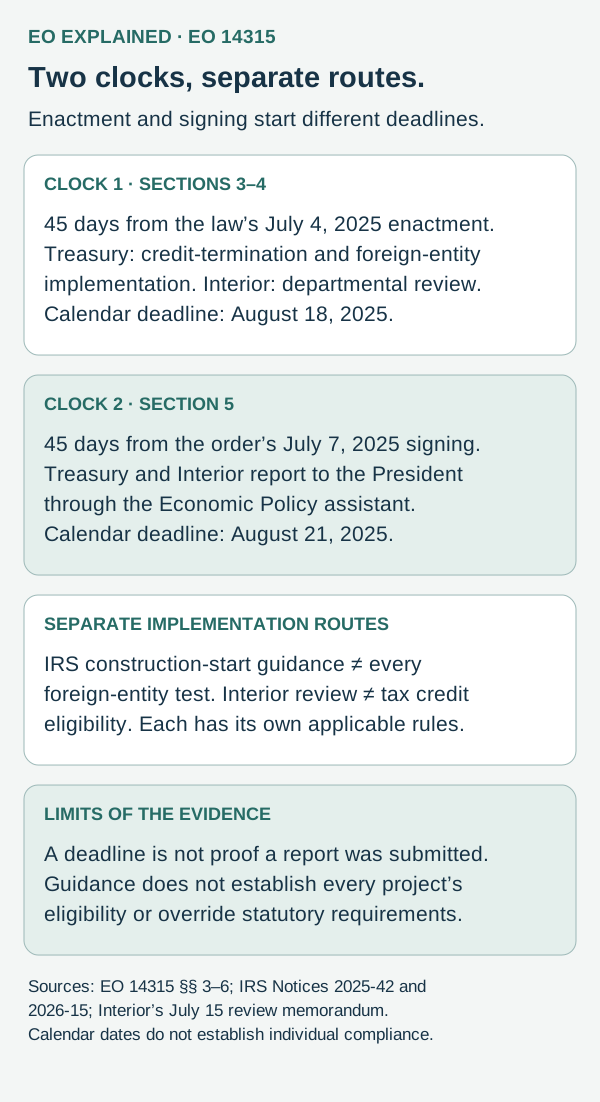
The implementation clocks begin on different dates. Sections 3 and 4 count 45 days after the July 4, 2025 enactment of Public Law 119-21; section 5 counts 45 days after this order’s July 7 signing. On an ordinary calendar-day count those dates are August 18 and August 21, respectively. The later revisions must still be appropriate and consistent with law. The records cited here do not establish delivery of both reports. Original timing and reporting provisions; IRS’s description of the enacted law.
IRS Notice 2025-42 supplies a concrete tax-administration step. It generally uses the Physical Work Test for the relevant wind and solar construction-start deadline, with a limited Five Percent Safe Harbor for low-output solar facilities of no more than 1.5 megawatts, measured as the notice specifies. Its section 7 applies the new guidance to facilities whose construction had not begun before September 2, 2025. These are conditions of that notice, not a blanket finding that every wind or solar project loses its credit. Notice 2025-42, sections 3, 6 and 7.
The foreign-entity restrictions are a different test. Notice 2025-42 expressly does not supply the construction-start rules for those restrictions. Notice 2026-15 later describes interim guidance on prohibited foreign entities, material-assistance calculations and safe harbors while anticipating more comprehensive proposed regulations. Its introduction is not a final determination about a particular supply chain or taxpayer. Notice 2026-15, purpose and footnote 11.
Interior’s July 15, 2025 memorandum established a separate review route: covered wind and solar undertakings go to the Executive Secretariat and Regulatory Affairs office, then the Deputy Secretary, then the Secretary for final review. Its list includes leases, rights-of-way, construction and operating plans, and consultations. Interior’s July 29 announcement also linked Secretary’s Order 3437 to this policy. A required review is distinct from a completed denial or a final offshore-wind regulation. Signed review memorandum; July 29 announcement.
Before and after
Before the order
The Inflation Reduction Act created technology and investment credits subject to statutory eligibility, phase-outs and later congressional amendments.
After the order
Agencies reviewed leasing and issued tax guidance, but executive policy cannot withdraw a credit Congress made available to an eligible taxpayer.
The federal regulatory agenda listed a planned offshore-wind rule to support this order; a listed plan is not a final rule.
Who had to do what
| Agency / office | Action | Timing / position |
|---|---|---|
| Treasury Secretary | Strictly enforce statutory sections 45Y and 48E termination provisions, including appropriate construction-start and anti-manipulation guidance. | Within 45 days following enactment on July 4, 2025: August 18, 2025; section 3(a). |
| Treasury Secretary | Take appropriate lawful action implementing enhanced Foreign Entity of Concern restrictions. | Same enactment-based 45-day clock; section 3(b). |
| Interior Secretary | Review departmental measures for wind and solar preferences; then revise identified measures appropriately and lawfully. | Review within 45 days following enactment: August 18, 2025. No separate numerical revision deadline; section 4. |
| Treasury and Interior Secretaries | Submit findings and actions taken or planned to the President through the Assistant to the President for Economic Policy. | Within 45 days of the July 7 order: August 21, 2025; section 5. |
| Department of the Treasury | Bear publication costs. | No numerical deadline; section 6(d). |
The Economic Policy assistant is the report-routing official; the order assigns no separate substantive report-writing task to that recipient. General OMB savings language is not a new enforcement assignment. The 45-day clocks are not an expiration date for the order, and elapsed deadlines do not prove that reports were delivered. Signed sections 3–6.
What happened next
EO 14315 signed.
Interior’s signed memorandum established elevated departmental review of covered wind and solar undertakings. Official source.
Interior announced Secretary’s Order 3437 and related policy measures; the announcement is not proof every recommended reform was completed. Official source.
IRS issued Notice 2025-42, as later recorded in Notice 2026-15 footnote 11. Official source.
Notice 2025-42’s section 7 applicability threshold concerns facilities whose construction had not begun before this date. Official source.
Internal Revenue Bulletin 2026-11 published Notice 2026-15’s separate interim prohibited-foreign-entity guidance. Official source.
Later primary evidence reviewed: The federal regulatory agenda listed a planned offshore-wind rule to support this order; a listed plan is not a final rule.
Legal and source detail
How it works legally
The Internal Revenue Code controls tax eligibility. Administrative Procedure Act requirements, leasing statutes, existing rights and judicial review limit agency changes.
Sources by type
If a source is unavailable, first check the cited publisher or another official repository. The cited publisher remains the authority.
Primary and official sources
Orders, laws, court records and official implementation material.
- IRS — Notice 2025-42, construction-start guidance
- IRS — Notice 2026-15, separate interim foreign-entity guidance
- Interior — signed July 15, 2025 review memorandum
- Interior — July 29, 2025 implementation announcement
- IRS — March 9, 2026 Internal Revenue Bulletin
- Federal Register — current EO 14315 disposition entry
How we checked this
Last checked against the sources above on September 24, 2026. How we research →
Additional evidence review: October 17, 2026. Original duties, selected IRS notice provisions and Interior implementation records were checked. Report delivery, each taxpayer’s eligibility, every later rule and the full current litigation or appeal position are not exhaustively established.