Executive Order 14300: Ordering the Reform of the Nuclear Regulatory Commission
President: Donald J. Trump
Directed NRC reform, faster licensing, fixed timelines and fees, organizational review and wholesale revision of regulations and guidance.
Status: In effect. Is Executive Order 14300 still in effect? Yes. Executive Order 14300 remains in effect. See Federal Register record.
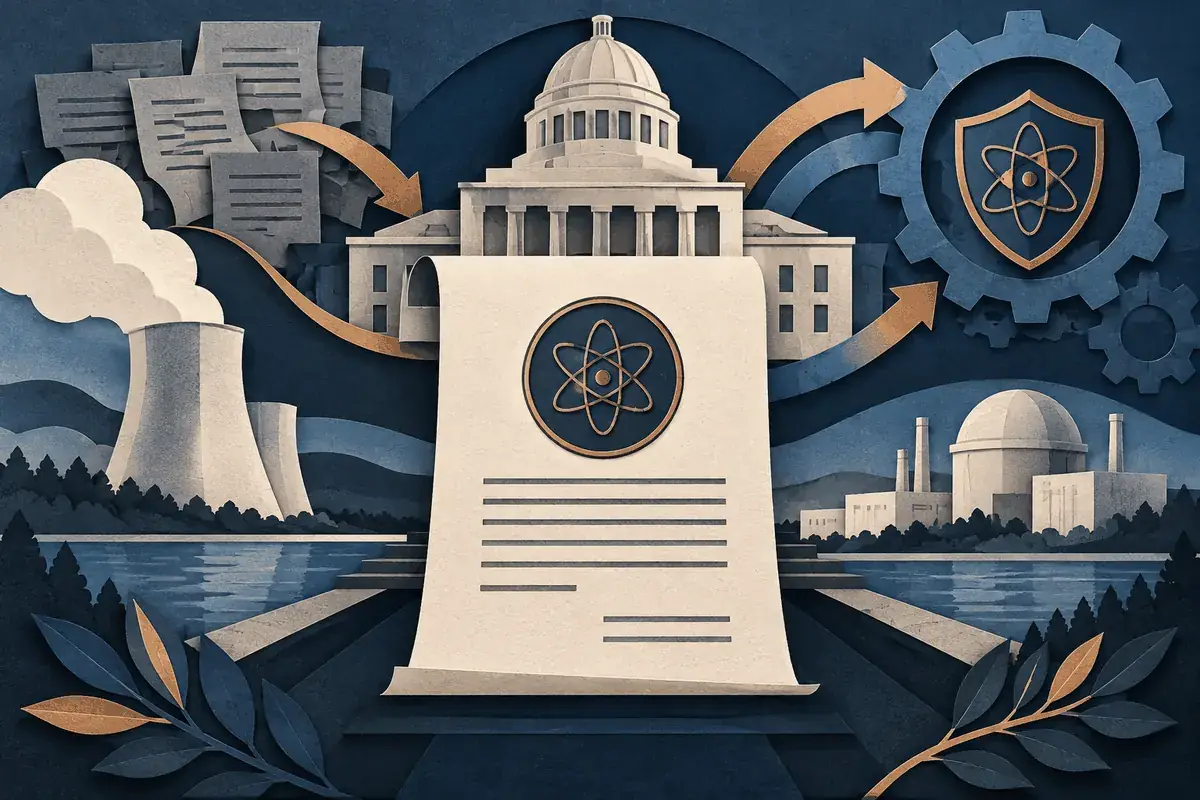
What does Executive Order 14300 do?
The text directs NRC to review and revise regulations and guidance, and NRC to set licensing timelines and fee caps.
Reading the operative provisions of Executive Order 14300
EO 14300 directs a major review of the Nuclear Regulatory Commission’s licensing, staffing, fee structure and regulations. It calls for faster review timelines and asks the NRC to revise rules that the administration considers unnecessarily burdensome. The order’s text appears in the Federal Register publication of EO 14300. The NRC remains an independent regulator with statutory duties; the order cannot authorize a reactor that fails safety requirements.
Nuclear licensing involves technical review of reactor design, site hazards, emergency planning, security and waste. Predictable timelines may help applicants and utilities plan, but shortening a schedule cannot replace the evidence needed to establish safety. The NRC must follow the Atomic Energy Act and other applicable laws, and it remains responsible for its licensing decisions. The President may set executive-branch priorities and propose changes, but Congress establishes the Commission’s authority and the framework under which it regulates.
The order’s implementation should be evaluated through NRC rulemakings, licensing guidance, fee schedules and staff performance data. A directive to revise a regulation is not itself a final rule, and a proposed deadline does not necessarily bind the Commission unless it adopts an appropriate legal instrument. The order also asks the agency to review its organizational structure and guidance. Those management steps should be distinguished from decisions on individual reactor applications, which require case-specific records and public processes.
Licensing timelines can improve only when applicants submit complete materials and agency reviewers have the resources to examine them. A faster target should identify how pauses for applicant responses, hearings or additional technical studies are counted. The public record should show not only the date a license was issued but also unresolved safety issues, inspection findings and any conditions imposed. Those measures make speed accountable to the NRC’s central safety mission.
Before and after
Before the order
NRC licensing and oversight operated under the Atomic Energy Act, NEPA and the 2024 ADVANCE Act.
After the order
NRC completed several rules, proposed many more and restructured processes through 2026; its public tracker shows the wholesale revision remains ongoing.
Who had to do what
| Agency / office | Action | Timing / position |
|---|---|---|
| NRC | Review and revise regulations and guidance | 9 and 18 months |
| NRC | Set licensing timelines and fee caps | Rulemaking |
| OMB and agencies | Support reorganization and coordination | Ongoing |
What happened next
EO 14300 signed.
First streamlining rule completed.
NRC completed the broad sunset rule.
Legal and source detail
How it works legally
The NRC must continue carrying out Atomic Energy Act safety duties and the ADVANCE Act. Independent adjudication, notice-and-comment and judicial review remain.
Sources by type
If a source is unavailable, first check the cited publisher or another official repository. The cited publisher remains the authority.
Primary and official sources
Orders, laws, court records and official implementation material.
- NRC EO 14300 rulemaking tracker (opens in a new tab) Official record
How we checked this
Last checked against the sources above on September 9, 2026. How we research →