Executive Order 14319: Preventing Woke AI in the Federal Government
President: Donald J. Trump
Told OMB to set procurement guidance for federal use of large language models based on the order’s truth-seeking and ideological-neutrality criteria.
Status: In effect.
Is Executive Order 14319 still in effect? Yes. Active federal procurement direction; constitutional and procurement constraints remain.
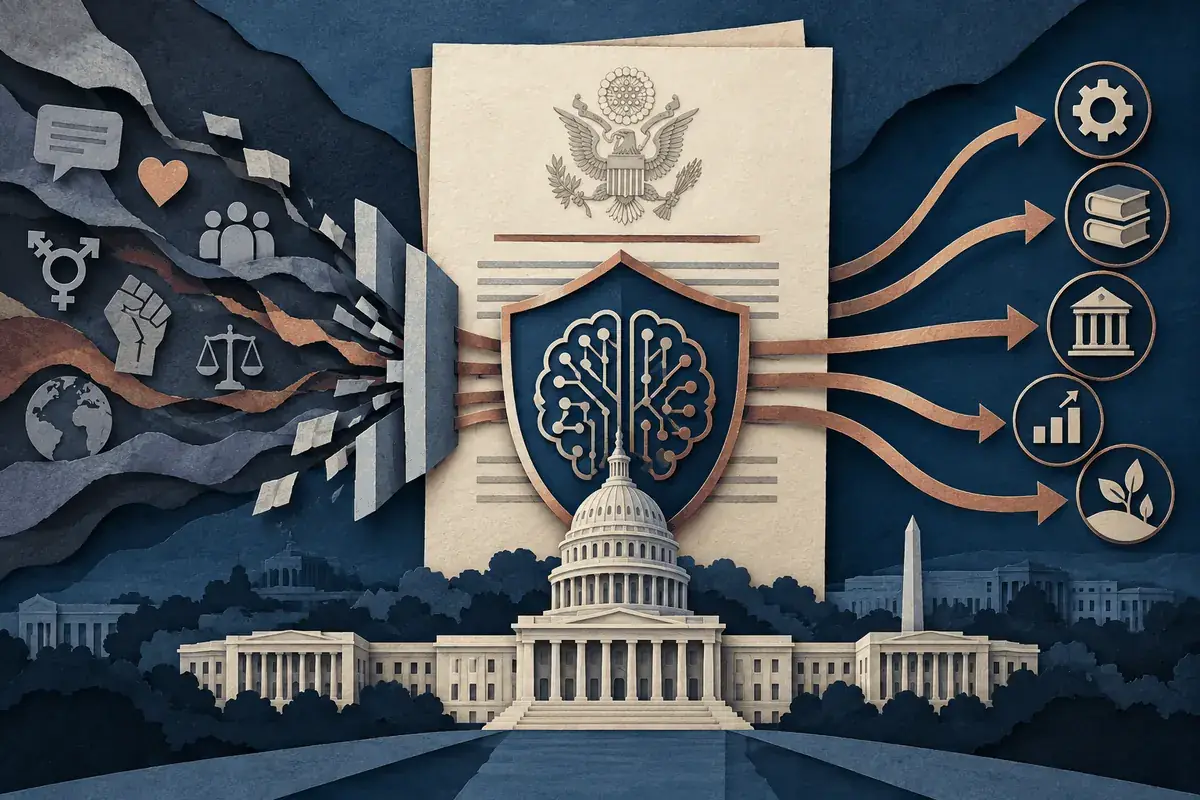
What does Executive Order 14319 do?
OMB was directed to issue guidance within 120 days. Agencies were then to incorporate compliant procurement terms and procedures, with national security exceptions.
Official records rechecked October 2, 2026: OMB issued M-26-04 on December 11, 2025. It requires specified contractual terms in new agency large-language-model procurements and tells agencies to update AI procurement policies by March 11, 2026. The memo establishes requirements and a deadline; it does not show which agencies completed them.
Reading the operative provisions of Executive Order 14319
EO 14319 directs the Office of Management and Budget to issue procurement guidance for federal agencies buying large language models. It sets criteria described by the administration as truth-seeking and ideologically neutral, and agencies are expected to incorporate compliant requirements into covered procurements. The Federal Register text of EO 14319 governs federal purchasing; it does not regulate every AI product sold to the public.
Procurement terms can affect which models agencies test or buy, but a vendor’s compliance is evaluated against the government’s contract requirements. The order does not establish that one model is objectively unbiased or that its preferred criteria guarantee factual accuracy. Agencies still need to test for hallucinations, security vulnerabilities, privacy risks, accessibility and performance on the intended task. A procurement preference cannot excuse a system that fails the agency’s legal or operational requirements.
OMB guidance and agency solicitations are the next steps that translate the order into practice. The federal government can set requirements for its own purchases within procurement law, while private users and state governments remain outside the order unless another law applies. Public-interest concerns include transparent evaluation methods and the risk that ideological-neutrality language could be applied inconsistently. To assess implementation, examine the final guidance, contract clauses, model evaluations and any appeals or vendor disputes.
Before and after
Before the order
Before EO 14319, EO 14179 stated a federal policy of advancing U.S. AI leadership, while EO 14148 revoked EO 14110. EO 14319 added federal procurement standards focused on truthfulness and ideological neutrality.
After the order
OMB issued M-26-04 on December 11, 2025. It requires specified contractual terms in new agency large-language-model procurements and tells agencies to update AI procurement policies by March 11, 2026. The memo establishes requirements and a deadline; it does not show which agencies completed them.
Who had to do what
| Agency / office | Action | Timing / position |
|---|---|---|
| President | Issued the executive order and stated the administration policy | July 23, 2025 |
| Named departments and officials | Carry out the directions, reviews and reports specified in the order | According to the deadlines in the primary text |
| Office of the Federal Register | Assigned the EO number and published the signed document | July 28, 2025 |
What happened next
Executive Order 14319 signed.
Order published in the Federal Register.
Legal and source detail
Sources by type
If a source is unavailable, first check the cited publisher or another official repository. The cited publisher remains the authority.
Primary and official sources
Orders, laws, court records and official implementation material.
How we checked this
Last checked against the sources above on October 2, 2026. How we research →