Executive Order 14243: Stopping Waste, Fraud, and Abuse by Eliminating Information Silos
President: Donald J. Trump
Directed agencies to give authorized federal officials prompt access to unclassified records and systems for fraud and waste work, while preserving statutory privacy and security restrictions.
Status: In effect.
Is Executive Order 14243 still in effect? Yes. Active; agency data-access implementation continues.
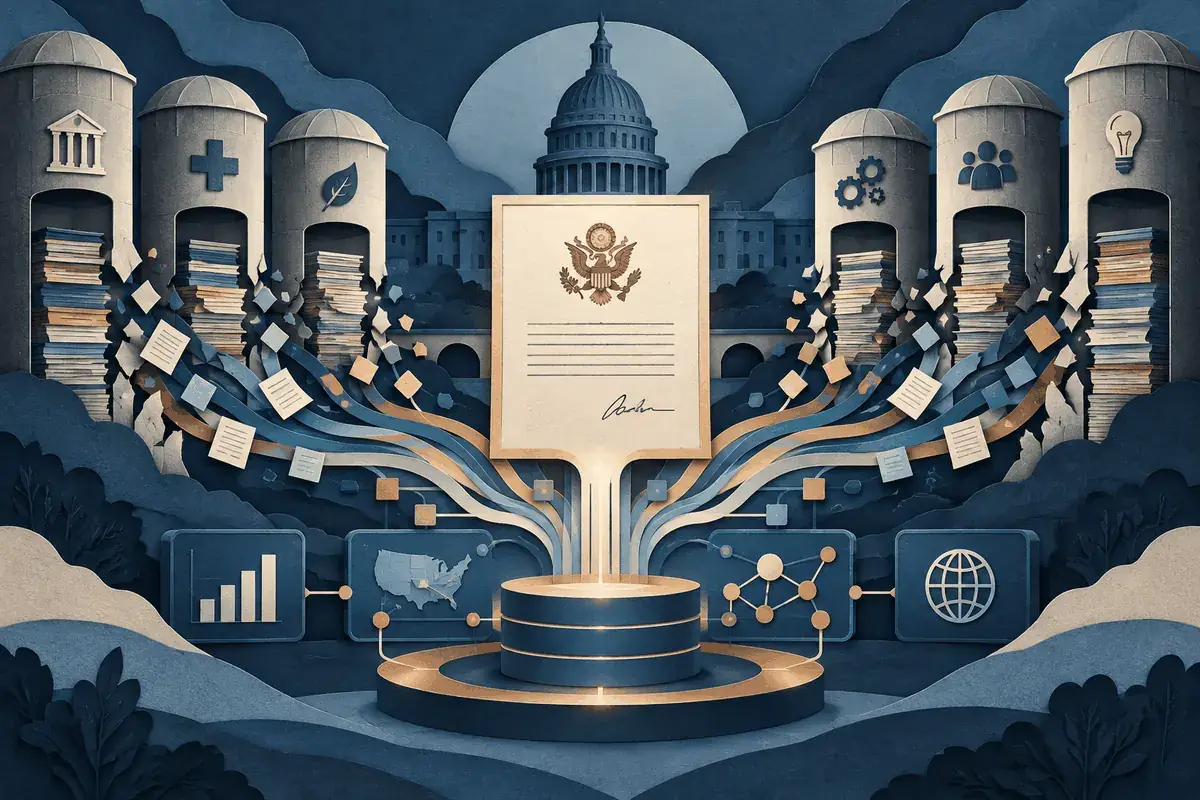
What does Executive Order 14243 do?
The order operates through existing statutory authority, so concrete effects depend on the agency actions and legal limits described below.
Reading the operative provisions of Executive Order 14243
EO 14243 directs agencies to make unclassified records and systems accessible to authorized federal officials conducting work to identify waste, fraud and abuse. It emphasizes interagency data access, but it does not create unrestricted public access or erase privacy protections. Agencies must still follow the Privacy Act, tax-confidentiality rules, health-information statutes, national-security restrictions and other laws governing specific records. The operative instructions appear in the Federal Register text of EO 14243.
Access and disclosure are separate questions. A federal employee may be authorized to use a record for a defined official purpose while remaining barred from redisclosing it or using it for an unrelated purpose. Agencies therefore need role-based access, logging, data minimization and rules for handling sensitive information. The order’s carve-outs and savings language matter because the executive branch cannot use an efficiency directive to override a confidentiality statute or a court order. The practical implementation question is not simply whether a database can be connected, but who can see which fields and under what legal authority.
Data matching can help identify duplicate payments or inconsistent records, but a possible match is not proof of fraud. People can share names, have outdated addresses or appear differently in separate systems. Any adverse action—such as suspending a benefit, demanding repayment or referring a person for investigation—requires the applicable program procedures and an opportunity to correct errors where the law provides one. Measures of success should include verified improper payments prevented, false positives corrected and protections against unauthorized access. This keeps the order’s anti-fraud purpose distinct from the rights that govern individual decisions.
Before and after
Before the order
Agency access and sharing were governed by program-specific statutes, the Privacy Act, tax law and security controls.
Existing statutes, regulations and constitutional limits continued to govern the subject.
After the order
Agencies were required to review internal barriers and facilitate lawful cross-agency access; OMB later reinforced technology oversight in Memorandum M-26-10.
Later rules, contracts, grants or enforcement decisions retain their own procedures and review paths.
Who had to do what
| Agency / office | Action | Timing / position |
|---|---|---|
| Agency heads | Provide authorized access and review restrictive guidance | Immediate / 30 days |
| Secretary of Labor | Obtain state unemployment and payment data consistent with law | Ongoing |
| OMB | Receive regulatory catalogs and coordinate implementation | 30 days and ongoing |
What happened next
EO 14243 signed.
The 30-day review and reporting deadline passed.
Current position, amendments, implementation and reported litigation rechecked.
Legal and source detail
How it works legally
The order repeatedly limits access to what law permits. The Privacy Act, tax-return confidentiality, benefit statutes, cybersecurity rules and appropriations law remain controlling; the order itself does not authorize public disclosure.
Sources by type
If a source is unavailable, first check the cited publisher or another official repository. The cited publisher remains the authority.
Primary and official sources
Orders, laws, court records and official implementation material.
- OMB Memorandum M-26-10 (opens in a new tab) Official record
How we checked this
Last checked against the sources above on September 9, 2026. How we research →