Executive Order 14342: Taking Steps To End Cashless Bail To Protect Americans
President: Donald J. Trump
Directed the Attorney General to identify jurisdictions described by the order as having substantially eliminated cash bail and to review federal funding options; later CBO analysis confirms the reporting direction but not publication of the list.
Status: In effect. Is Executive Order 14342 still in effect? Yes. Its section 2(a) requires list updates as necessary, and the initial 30-day submission deadline is not a sunset for the order. The Federal Register’s disposition entry lists no amendment or revocation as checked on October 17, 2026. This does not establish that the list was published, that a particular grant was lawfully cut, or that every implementation dispute has been resolved.
What does Executive Order 14342 do?
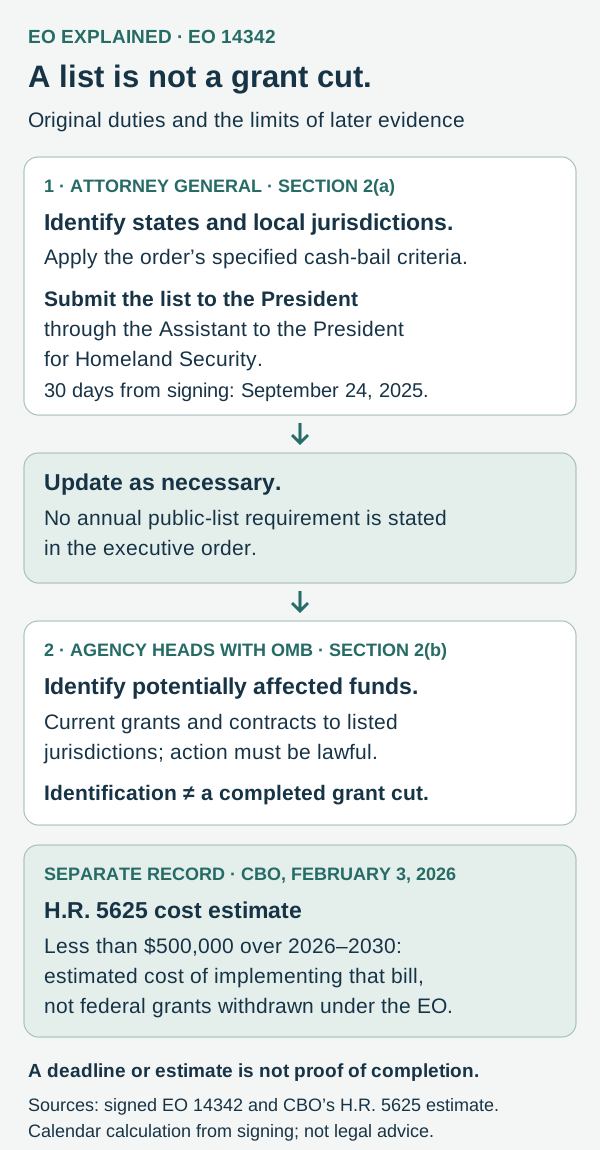
EO 14342 required the Attorney General to submit within 30 days a list of state and local jurisdictions that substantially eliminated cash bail for specified offenses and directed agencies to identify potentially suspendable or terminable funds, consistent with law. A February 2026 CBO estimate for proposed reporting legislation describes the EO's list requirement. The reviewed primary sources did not establish that the Attorney General's list was publicly released or that a specific grant was lawfully terminated under the order.
Later evidence reviewed September 27, 2026: CBO confirms the reporting direction. It does not establish public release of the list or implementation against a particular jurisdiction.
Reading the operative provisions of Executive Order 14342
Who is identified, and who receives the list? Section 2(a) uses the Attorney General’s opinion that cash bail has been substantially eliminated as a potential pretrial condition for the specified crimes, including violent, sexual or indecent acts, burglary, looting and vandalism. It is not a direction to list every jurisdiction that ever releases someone without money. The initial list goes to the President through the Assistant to the President for Homeland Security; that routing role is different from the Attorney General’s identification responsibility. Updates are required as necessary, without a stated annual publication requirement.
Which funds enter the review? Section 2(b) concerns federal funds currently provided to jurisdictions identified under section 2(a), expressly including grants and contracts. Department and agency heads identify funds that may lawfully be suspended or terminated, coordinating with OMB. The text specifies neither a dollar total nor an automatic suspension date. It does not direct courts to require cash bail or replace each jurisdiction’s pretrial-release statutes.
EO 14342 directs the Attorney General to identify jurisdictions the administration describes as having substantially eliminated cash bail and to identify potentially suspendable or terminable federal funds, including grants and contracts, provided to those jurisdictions. The Federal Register text assigns an identification and review process; it does not itself prohibit a state or locality from using nonfinancial release conditions.
Pretrial release systems can consider risk, court appearance, public safety and less restrictive conditions. Federal constitutional law does not make cash payment the only lawful way to manage those goals. A jurisdiction’s bail policy is created under its own law, while the federal government may influence practice through grants only when Congress has authorized the condition and recipients receive clear notice.
The order’s required list and funding review are separate from an actual grant restriction. A jurisdiction should not be described as having lost federal funds unless an agency has issued a specific decision under valid authority. The cited congressional analysis on this page confirms the reporting direction but does not establish that the list was published. Implementation should be tracked through DOJ records, grant notices and any court rulings, not assumed from the executive order alone.
What the CBO estimate measures. The complete February 3, 2026 estimate evaluates H.R. 5625 as ordered reported by the House Judiciary Committee on December 18, 2025. It contrasts the bill’s proposed annual public list with the EO’s submission to the President. Its estimate of less than $500,000 over 2026–2030 concerns the cost of implementing that bill, subject to appropriations—not federal grants withdrawn under EO 14342. A cost estimate is not evidence of the bill’s enactment, the EO list’s delivery or publication, or a completed funding sanction.
Before and after
Before the order
Pretrial release was governed primarily by federal, state and local statutes, constitutions and court rules.
After the order
The order launched a federal identification and funding review.
CBO later described the list direction while evaluating a separate bill that would require annual public reporting; that record does not prove the EO list was made public or that funds were withheld.
Who had to do what
| Agency / office | Action | Timing / position |
|---|---|---|
| Attorney General — initial list | Identify states and local jurisdictions that, in the Attorney General’s opinion, substantially eliminated cash bail for the specified categories of crimes. Submit the list to the President through the Assistant to the President for Homeland Security. Section 2(a). | Within 30 days of August 25, 2025: September 24, 2025, calculated from the signing date; the order states no business-day rule. |
| Attorney General — later updates | Update the jurisdiction list as necessary. Section 2(a). | As necessary; no annual cycle or numerical update deadline is specified. |
| Heads of each executive department and agency, coordinating with the OMB Director | Identify federal funds, including grants and contracts, currently provided to jurisdictions identified under section 2(a), which may appropriately and lawfully be suspended or terminated. Section 2(b). | No numerical deadline; tied to the identified jurisdictions. Identification is not itself a signed grant-termination decision. |
| Department of Justice | Bear the order’s publication costs. Section 3(d). | Publication-related; no numerical payment deadline. |
What happened next
EO 14342 signed.
Published in the Federal Register.
The 30-day period in section 2(a) reaches its calculated reporting deadline, measured from signing on August 25. This calendar milestone is not evidence that the list was submitted or made public.
CBO described the EO list requirement in its H.R. 5625 estimate.
The current disposition entry lists no amendment or revocation. The signed order and CBO’s estimate distinguish the original assignment from the proposed reporting bill. This review did not independently verify a published jurisdiction list, an individual funding-termination decision, or the complete current litigation and appeal position.
Legal and source detail
How it works legally
The executive branch cannot withhold funds contrary to an appropriation, statutory grant condition, constitutional limit or binding court order. Any funding action requires program-specific authority, process and review.
Section 3(a)–(c) preserves existing agency authority and OMB functions, requires implementation consistent with law and available appropriations, and creates no privately enforceable right or benefit. The order does not amend a named grant statute or award agreement. Identifying a funding stream therefore does not, by itself, establish authority to terminate a particular recipient’s award. The relevant agency decision, the governing program and any applicable court order require separate examination.
Sources by type
If a source is unavailable, first check the cited publisher or another official repository. The cited publisher remains the authority.
Primary and official sources
Orders, laws, court records and official implementation material.
- White House — EO 14342 signed text (opens in a new tab) Official evidence
- Federal Register — 2025 disposition entry (opens in a new tab) Official evidence
- CBO — complete one-page H.R. 5625 estimate (opens in a new tab) Official evidence
How we checked this
Last checked against the sources above on September 27, 2026. How we research →