Executive Order 13944: Combating Public Health Emergencies and Strengthening National Security by Ensuring Essential Medicines, Medical Countermeasures, and Critical Inputs Are Made in the United States
President: Donald J. Trump
Directed agencies to favor domestic sources when buying essential medicines and medical countermeasures, and ordered a review of supply-chain vulnerabilities.
Status: In effect. Sources: Federal Register: Executive Order 13944 · Federal Register 2020 executive order disposition table · Executive Order 14293, May 5, 2025 · Executive Order 14336, August 13, 2025.
Is Executive Order 13944 still in effect? Yes. Executive Order 13944, signed August 6, 2020, retains its essential-medicines and domestic-procurement framework. Executive Order 14293 of May 5, 2025, and Executive Order 14336 of August 13, 2025, refer to and build on that framework rather than revoke it.
What does Executive Order 13944 do?
EO 13944 directed agencies to use procurement and Defense Production Act tools to increase domestic production of essential medicines and medical countermeasures.
Later primary evidence reviewed September 24, 2026: A 2023 presidential determination limited a Defense Production Act project to essential medicines and related inputs identified under this order. Official source. The cited steps do not establish every downstream effect.
The immediate mechanism was federal purchasing and supply-chain planning, not an instruction that every patient buy only domestic medicine. FDA’s list identifies products for acute-care needs and public-health threats, including drugs, biologics and device countermeasures. FDA’s public resource links the list, selection criteria and public docket; inclusion is not by itself a new approval of a medicine or a personalized treatment recommendation. FDA’s list and explanation.
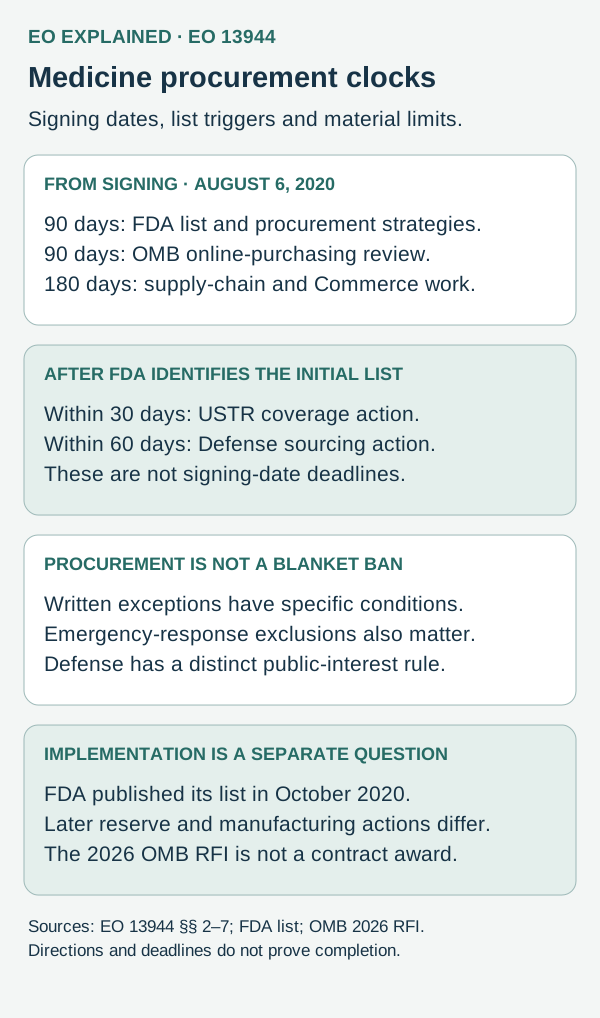
The domestic preference has material limits. Section 2(f) permits written, contract-specific determinations based on public interest, inadequate domestic quantity or quality, or a procurement-cost increase exceeding 25 percent unless a higher statutory percentage applies. It also excludes specified emergency-response procurements from subsections 2(a), 2(d) and 2(e). Defense’s section 2(e) direction expressly operates notwithstanding the public-interest exception; it is inaccurate to say every exception applies identically to every purchasing route. Section 7(i) addresses both U.S.-produced critical inputs and U.S. manufacture or processing of the finished product, not just the location of a seller’s headquarters. Signed sections 2(e)–(h) and 7(i).
Later actions used different legal tools. The December 27, 2023 presidential determination invoked Defense Production Act section 303 and limited its project scope to drug/biologic products and inputs identified under section 3(c) as of that determination’s date. That is distinct from EO 13944’s section 101 priorities and allocation direction. In 2025, EO 14293 directed regulatory and permitting work, while EO 14336 set separate API-reserve planning and acquisition directions. Their requirements are not proof that all manufacturing capacity or reserve inventory was delivered. Determination 2024–03, sections 1–2; EO 14293; EO 14336.
For a current, concrete participation route, OMB’s September 25, 2026 request asks about new or idle domestic and near-shore capacity for finished-dose forms, APIs and starting materials linked to the ASPR 86 list, with additional antibiotic questions. The notice sets October 26, 2026 as the response deadline and directs electronic submission through Regulations.gov. Participation is voluntary; the notice disclaims any government commitment, reimbursement obligation or binding project agreement. Its scope and eligibility terms should be read in the notice itself. This information request is not a final procurement award or evidence that a national supply target has been met. OMB notice, dates, instructions and disclaimer.
Before and after
Before the order
Federal medicine and countermeasure purchases used existing procurement law and public-health supply programs.
After the order
A 2023 presidential determination limited a Defense Production Act project to essential medicines and related inputs identified under this order.
Who had to do what
| Agency / office | Action | Timing / position |
|---|---|---|
| Heads of covered federal procurement agencies | Use lawful domestic-source procurement procedures and split requirements where appropriate; develop procurement strategies with FDA; document exceptions and procurement spending/sources/plans. | Sections 2(a), 2(c), 2(h), 6(a), 6(c): strategies within 90 days of August 6, 2020; exception reports annually; procurement reports by December 15, 2021 and annually thereafter, covering the preceding three fiscal years. Publish reports with lawful redactions. |
| OMB Director | Review authority to restrict online purchasing to qualifying platforms, consult agency heads and report to the President; consult on FDA/Defense supply-chain work and receive reports. | Sections 2(b), 3(a), 3(c)–(d), 6: online-procurement authority review/report within 90 days of signing; other consultation follows the relevant task’s clock. |
| United States Trade Representative | Take lawful action to exclude the listed products from relevant federal procurement coverage under trade agreements; adjust waivers after coverage changes take effect and notify the President through OMB. | Section 2(d): no later than 30 days after FDA identifies the initial section 3(c) list; later coverage updates as appropriate. This is not 30 days after signing. |
| Defense Secretary | Apply the specified defense domestic-source restriction where necessary for national defense; identify and mitigate military supply vulnerabilities and provide a defense-specific list to the named recipients. | Sections 2(e), 3(d): procurement action within 60 days after FDA identifies its initial list; supply-chain work within 180 days of signing; update the defense list periodically as appropriate. |
| HHS Secretary, acting through FDA Commissioner | Identify and mitigate supply-chain vulnerabilities, consider information-collection regulations/guidance, arrange lawful interagency disclosure, recommend legal changes and review regulatory barriers. | Section 3(a): within 180 days of signing, in consultation with OMB. Considering a proposal is not the same as issuing a final regulation. |
| HHS Secretary / FDA Commissioner | Accelerate appropriate domestic approvals/clearances, issue advanced-manufacturing guidance, pursue more foreign-site inspections and refuse affected imports when facilities refuse or unreasonably delay inspection, as appropriate. | Section 3(b): consistent with applicable law; no separate numerical deadline specified. |
| FDA Commissioner | Identify the essential-medicines, countermeasures and critical-inputs list with the specified federal consultation. | Section 3(c): within 90 days of signing; periodically update as appropriate. |
| ASPR, presidential economic-policy assistant and Office of Trade and Manufacturing Policy director | Consult with FDA and OMB on the essential-products list. The trade/manufacturing policy official also serves in specified report-routing and receipt roles. | Sections 3(c), 2(h), 3(d), 6: consultation partners/recipients, not a separate instruction that each independently publish a medicine list. |
| EPA Administrator | Identify requirements and guidance that can be streamlined for advanced-manufacturing facilities and expeditious domestic production, including siting/permitting. | Section 4: consistent with law; no numerical deadline specified. |
| HHS Secretary | Use delegated Defense Production Act section 101 priority/allocation authority for covered federal contracts, materials, services and facilities, as appropriate. | Section 5: under EO 13603’s delegation; no numerical deadline. This is a priorities/allocation mechanism, not a new appropriation. |
| Commerce Secretary | Report changes in the public-health industrial base and recommend strengthening initiatives to OMB, the national-security assistant, National Economic Council director and trade/manufacturing policy director. | Section 6(b): within 180 days of signing; section 6(c) requires publication to the extent lawful with protected information redacted. |
| DHS National Intellectual Property Rights Coordination Center; NSC, State, Defense and Veterans Affairs | The center is the evaluator contemplated by qualifying platforms’ agreement; the other bodies are named partners for appropriate FDA records-sharing agreements. | Sections 2(b)(i)(B), 3(a)(ii): conditional platform/records-sharing roles, not separate numerical deadlines or permission to disclose protected records without law. |
These are directions in the signed 2020 order, not a finding that every report, procurement or regulatory step was completed. FDA’s list-based triggers for USTR and Defense are different from the 90-day and 180-day signing-based clocks. The December 15, 2021 reporting date also must not be rewritten as a deadline beginning on each later review of this guide. EO 13944, sections 2–6.
What happened next
Executive Order 13944 signed.
The Federal Register published the order, eight days after signing. Its signing-based clocks do not begin on this publication date. Official source.
FDA published the essential-medicines, countermeasures and critical-inputs list, as recorded on FDA’s official list page. The product list is not a claim every covered item was already domestically produced. Official source.
Presidential Determination 2024–03 used DPA section 303 and tied its drug/biologic project scope to products and inputs identified under EO 13944 as of this date. It was published January 2, 2024. Official source.
EO 14293 cited EO 13944 and directed further domestic pharmaceutical regulatory/permitting work under its own deadlines. Official source.
Executive Order 14336 directed work on the strategic active pharmaceutical ingredients reserve using the essential-medicines framework established by Executive Order 13944. Official source
Later primary evidence reviewed: A 2023 presidential determination limited a Defense Production Act project to essential medicines and related inputs identified under this order.
OMB published a voluntary essential-medicines manufacturing information request, with responses accepted for consideration until October 26, 2026. This was market research, not a government purchase commitment. Official source.
Legal and source detail
Sources by type
If a source is unavailable, first check the cited publisher or another official repository. The cited publisher remains the authority.
Primary and official sources
Orders, laws, court records and official implementation material.
How we checked this
Last checked against the sources above on September 24, 2026. How we research →