Executive Order 13945: Fighting the Spread of COVID-19 by Providing Assistance to Renters and Homeowners
President: Donald J. Trump
Asked CDC to consider a temporary eviction halt and told Treasury and Housing officials to identify housing aid; the order itself did not impose a nationwide moratorium.
Status: Completed/expired. Sources: Federal Register: Executive Order 13945 · Federal Register 2020 executive order disposition table · Public Law 118-3, April 10, 2023 · Alabama Association of Realtors v. HHS, August 26, 2021.
Is Executive Order 13945 still in effect? No. Executive Order 13945 addressed evictions and foreclosures during the COVID-19 national emergency, which Public Law 118-3 terminated on April 10, 2023. The Supreme Court had already ended the CDC’s separate eviction moratorium in Alabama Association of Realtors v. HHS on August 26, 2021; that ruling did not strike down the entire executive order.
What does Executive Order 13945 do?
EO 13945 directed agencies to prevent evictions and foreclosures where lawful and coordinate housing assistance.
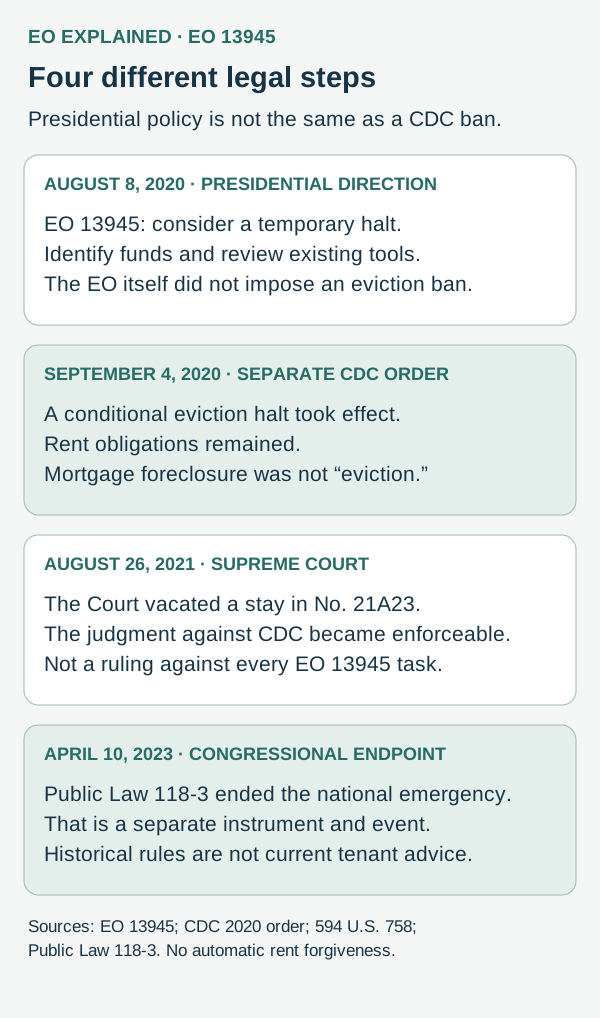
Later primary evidence reviewed September 24, 2026: CDC issued a temporary residential eviction halt effective September 4, 2020 after this order directed CDC to consider such a measure; the order itself did not impose the halt. Official source. The cited steps do not establish every downstream effect.
The distinction between the presidential direction and the later agency action is essential. EO 13945 asked HHS and CDC to consider a temporary halt; it did not itself establish a tenant declaration, cancel rent or order landlords to stop every eviction. The separate CDC order took effect September 4, 2020 and invoked Public Health Service Act section 361 and 42 C.F.R. § 70.2. Its historical terms required a qualifying declaration, preserved rent/payment obligations and expressly distinguished eviction from home-mortgage foreclosure. Those were agency-order conditions, not eligibility language hidden inside EO 13945. Signed section 3(a); CDC order, pages 55292–55293.
The Supreme Court’s August 26, 2021 action also needs its procedural label. In Alabama Association of Realtors v. Department of Health and Human Services, No. 21A23, the Court vacated a stay, allowing the District of Columbia district court’s judgment against CDC’s moratorium to be enforced. The majority concluded that the claimed section 361(a) authority did not support that moratorium and that Congress needed to authorize its continuation. This was not a judgment striking down every fund-identification or housing-agency review direction in EO 13945. The majority and the three-justice dissent disagreed over statutory authority and the stay analysis. Official decision, 594 U.S. 758, 759–766.
The pandemic national-emergency endpoint is another, separate instrument. Public Law 118-3, approved April 10, 2023, terminated the emergency declared in Proclamation 9994 under the National Emergencies Act. It did not say that every state housing law, rent obligation or assistance program disappeared. The completed/expired label here concerns this guide’s emergency-era measure; the historical CDC conditions above should not be used as a current defense to an eviction or a claim of automatic rent forgiveness. Public Law 118-3; Historical CDC applicability terms.
Before and after
Before the order
Tenants and homeowners faced housing disruption during the COVID-19 emergency under existing federal and state protections.
After the order
CDC issued a temporary residential eviction halt effective September 4, 2020 after this order directed CDC to consider such a measure; the order itself did not impose the halt.
Who had to do what
| Agency / office | Action | Timing / position |
|---|---|---|
| HHS Secretary | Jointly with CDC’s director, consider whether temporarily halting residential nonpayment evictions is reasonably necessary to prevent interstate COVID-19 spread. | Section 3(a): consideration direction, not an eviction halt imposed by this executive order; no numerical deadline. |
| CDC Director | Participate in that public-health assessment; any later agency order required its own legal basis and terms. | Section 3(a): no numerical deadline or automatic nationwide moratorium in EO 13945. |
| Treasury Secretary | Identify available federal assistance funds with HUD; consult on FHFA’s authority/resource review. | Sections 3(b), 3(d): available-funds identification and consultation; no numerical deadline or new appropriation. |
| HUD Secretary | Identify assistance funds with Treasury; take appropriate lawful steps to help renters/homeowners avoid eviction or foreclosure, potentially assisting housing authorities, owners, landlords and grant recipients. | Sections 3(b)–(c): no numerical deadline; actions limited by applicable law and available appropriations. |
| FHFA Director | Review existing authorities/resources to prevent COVID-hardship evictions and foreclosures, consulting Treasury. | Section 3(d): review of existing tools, not a separate new moratorium or numerical completion deadline. |
Section 3 names five principal officials, with joint tasks and consultation rather than five independent grant programs. It gives no 30-day, 60-day or 90-day deadline for these assignments. Section 4 preserves statutory agency authority and OMB functions, makes implementation subject to law and appropriations, and creates no privately enforceable right. EO 13945, sections 3–4.
What happened next
Executive Order 13945 signed.
The Federal Register published the presidential order, six days after signing. Section 3 directed consideration, fund identification and existing-authority review, not an immediate eviction ban. Official source.
CDC’s separate temporary residential eviction order became effective. Its terms retained rent obligations and used a qualifying declaration; its definition of eviction excluded home-mortgage foreclosure. Official source.
In Alabama Association of Realtors v. HHS, No. 21A23, the Supreme Court vacated the stay that had kept the district court’s judgment against CDC’s moratorium from taking effect. It did not strike down all of EO 13945. Official source.
Public Law 118-3 terminated the COVID-19 national emergency to which Executive Order 13945’s eviction and foreclosure policy was tied. Official source
Later primary evidence reviewed: CDC issued a temporary residential eviction halt effective September 4, 2020 after this order directed CDC to consider such a measure; the order itself did not impose the halt.
Legal and source detail
Sources by type
If a source is unavailable, first check the cited publisher or another official repository. The cited publisher remains the authority.
Primary and official sources
Orders, laws, court records and official implementation material.
How we checked this
Last checked against the sources above on September 24, 2026. How we research →