Executive Order 13948: Lowering Drug Prices by Putting America First
President: Donald J. Trump
Directed HHS to develop Medicare payment models tying selected Part B and Part D drug prices to lower comparable international prices, and revoked EO 13947.
Status: In effect. Sources: Federal Register: Executive Order 13948 · Federal Register 2020 executive order disposition table · CMS Most Favored Nation Model · CMS rescission final rule · Executive Order 14297, May 12, 2025.
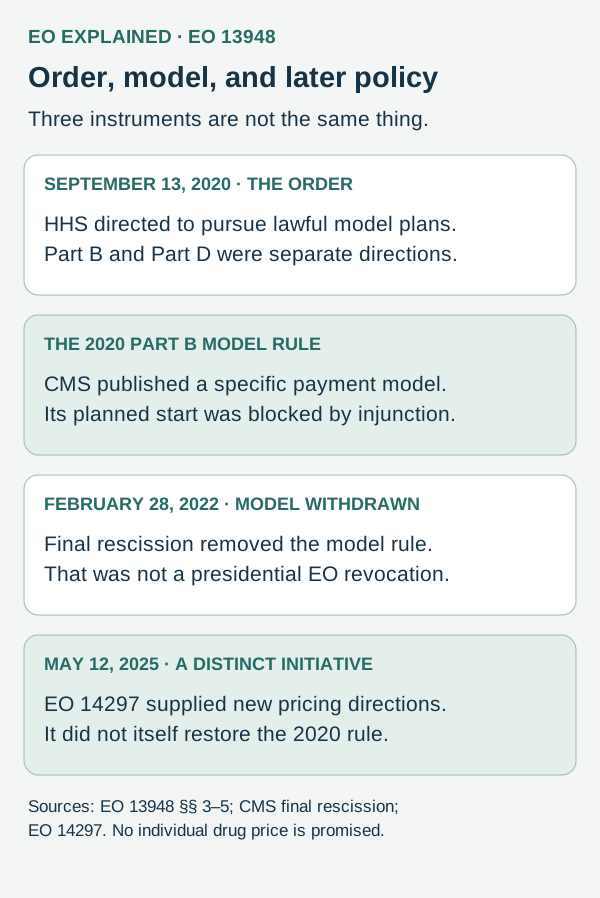
Is Executive Order 13948 still in effect? Yes. Executive Order 13948, signed September 13, 2020, remains unrevoked, but its 2020 Medicare most-favored-nation model is not operative: CMS rescinded the implementing rule effective February 28, 2022. Executive Order 14297 of May 12, 2025, established a separate most-favored-nation pricing initiative without expressly revoking this order.
What does Executive Order 13948 do?
EO 13948 directed HHS to pursue policies addressing drug-price differences and reference pricing, consistent with law.
Later primary evidence reviewed September 24, 2026: CMS published the Most Favored Nation Medicare Part B payment model and said it was implementing the model called for by this order. Official source. The cited steps do not establish every downstream effect.
The September 2020 text separated a pricing policy from two model-development directions. Its comparison price was the lowest manufacturer price in an OECD member country with comparable per-capita GDP, adjusted for volume and national GDP differences. It was not simply any foreign retail price. The Part B direction concerned certain high-cost drugs and biologicals; the Part D direction additionally focused on insufficient competition and the specified cross-country price gap. Both depended on lawful implementation. Sections 2–4.
CMS then published a Part B interim final rule on November 27, 2020, identifying it as a response to the September order. The rule’s executive summary described an initial cohort of 50 separately payable drugs/biologicals, with provider and supplier participation subject to exceptions. Its payment test was not an immediate universal reduction of every prescription price, and it did not implement every Part D direction in the EO. The rule’s expected savings were projections, not demonstrated savings from a model that had already operated.
The implementation stopped before the planned January 1, 2021 start. CMS’s December 29, 2021 final rescission rule records a December 28, 2020 nationwide preliminary injunction from the Northern District of California in California Life Sciences Ass’n v. CMS, No. 3:20-cv-08603. CMS said the injunction prevented implementation of the model as contemplated. This was litigation over the model/rule, not an express presidential revocation of the entire EO. The final rule withdrew the model and removed 42 CFR part 513 effective February 28, 2022.
Before and after
Before the order
Medicare drug payments followed existing federal statutes and payment rules.
After the order
CMS published the Most Favored Nation Medicare Part B payment model and said it was implementing the model called for by this order.
Who had to do what
| Agency / office | Action | Timing / position |
|---|---|---|
| HHS Secretary — Medicare Part B | Take appropriate steps to implement a rulemaking plan to test payments no higher than the defined most-favored-nation price for certain high-cost Part B drugs/biologicals, testing clinical outcomes and expenditure effects. | Section 3: immediately, to the extent consistent with law. The EO did not supply a fixed calendar launch date or say the model had already begun. |
| HHS Secretary — Medicare Part D | Develop and implement a rulemaking plan selecting a model under 42 U.S.C. 1315a(b)(2)(A), targeting insufficient competition and specified price differences; test the proposed pricing/outcome approach to the extent feasible. | Section 4: no numerical deadline; lawful model selection, feasibility and rulemaking qualified the direction. The later Part B rule did not establish completion of this separate Part D assignment. |
The operative model directions name the HHS Secretary. CMS later issued the Part B implementing rule within HHS, but the signed EO did not assign a separate numerical deadline to CMS, the Council of Economic Advisers or OMB. The Council appears in the administration’s background rationale, and OMB’s functions are preserved in the general provisions; those mentions should not be turned into invented reports or deadlines. Section 5 separately revoked the earlier EO 13947. Sections 1, 3–6.
What happened next
Executive Order 13948 signed.
The Federal Register published the September 13 order, including distinct Part B and Part D model directions and revocation of the July 24 predecessor. Official source.
CMS published the Part B MFN interim final rule. Its planned model performance start was January 1, 2021; publication was not proof of actual operation. Official source.
As later recorded in CMS’s final rescission rule, the Northern District of California preliminarily enjoined implementation nationwide in No. 3:20-cv-08603. The model did not start as contemplated. Official source.
CMS published a proposal to rescind the MFN model, a proposal distinct from the later final withdrawal; this history is recorded in the final rule. Official source.
CMS published the final rescission rule removing 42 CFR part 513, with withdrawal effective February 28, 2022 rather than immediately on publication. Official source.
CMS’s rescission of the 2020 Most Favored Nation Model rule took effect. The model was withdrawn; this agency rulemaking did not expressly revoke Executive Order 13948. Official source
EO 14297 established a distinct most-favored-nation pricing initiative. A later policy directive is not the same as reinstating the withdrawn 2020 regulation. Official source.
Later primary evidence reviewed: CMS published the Most Favored Nation Medicare Part B payment model and said it was implementing the model called for by this order.
Legal and source detail
Sources by type
If a source is unavailable, first check the cited publisher or another official repository. The cited publisher remains the authority.
Primary and official sources
Orders, laws, court records and official implementation material.
- Most Favored Nation (MFN) Model (opens in a new tab) Official record
- CMS — final MFN rescission, published December 29, 2021; effective February 28, 2022
- CMS — MFN model status and linked historical court records
- White House — separate EO 14297, May 12, 2025
- Federal Register — 2020 disposition entry for EO 13948
The December 2021 rescission text discusses procedural problems found by courts and stakeholder concerns about timing, access and provider effects. It also explains that the projected effects had not occurred because the model did not start as planned. These are reasons and findings stated in the agency’s rulemaking record, not a complete current docket or an assertion that the model’s legal merits were finally resolved in every case. The binding withdrawal date is the final rule’s February 28, 2022 effective date. Background, final decision and impact analysis.
A later policy must be read separately. EO 14297, May 12, 2025, directed price targets, lawful direct-to-consumer facilitation and conditional additional measures. Those provisions did not by themselves restore the withdrawn 2020 regulation. The EO 14297 guide covers that distinct instrument. The retained status answer above distinguishes an unrevoked directive from a model that no longer operates; it is not a promise of a particular beneficiary’s current drug price. EO 13948 disposition entry; CMS model status.
How we checked this
Last checked against the sources above on September 24, 2026. How we research →