Executive Order 13980: Protecting Americans From Overcriminalization Through Regulatory Reform
President: Donald J. Trump
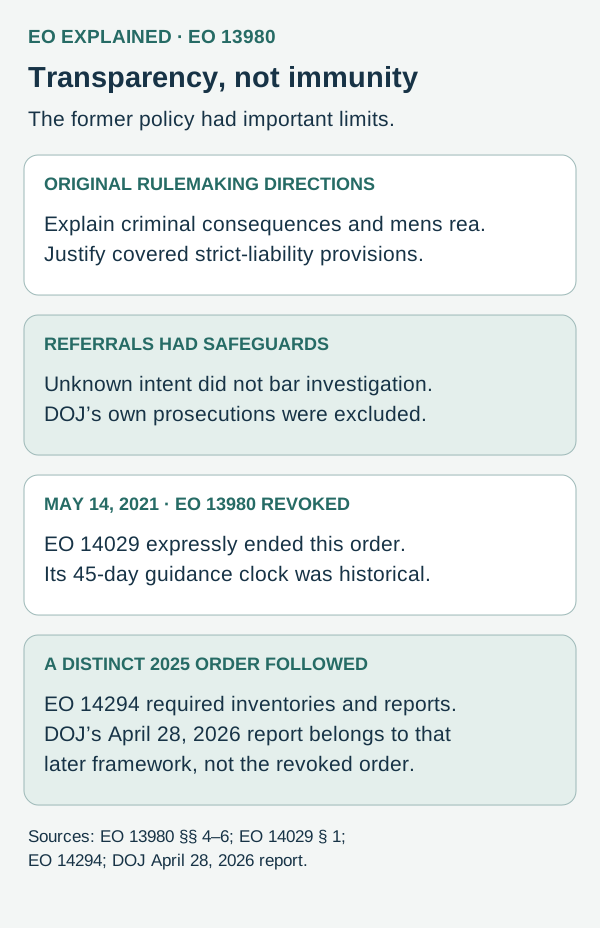
Directed agencies to identify and explain when violations of their regulations can bring criminal penalties, including any required mental state.
Status: Revoked. Is Executive Order 13980 still in effect? No. EO 14029, signed May 14, 2021, section 1, expressly revoked it, as recorded in the Federal Register disposition entry. EO 14294, signed May 9, 2025, later set a distinct regulatory-offense framework; its inventories and reporting clocks should not be attributed to EO 13980.
What does Executive Order 13980 do?
EO 13980 Directed agencies to disclose potential criminal penalties and mental-state requirements in regulations and explain certain strict-liability offenses.
Later primary evidence reviewed September 24, 2026: EO 14029 expressly revoked this order. Official source. The cited steps do not establish every downstream effect.
The order addressed notice of criminal consequences and how agencies approached referrals, not a wholesale repeal of regulatory offenses. A mental-state requirement, often called mens rea, concerns what the government must prove about a defendant’s state of mind. The order favored clarity about that requirement and justification of certain strict-liability provisions, but repeatedly preserved governing law. Its fairness rationale was the administration’s stated policy, not a finding that every existing regulatory prosecution was improper. Sections 1–4.
The exceptions were substantial. Section 6 excluded DOJ criminal investigations and prosecutions and specified civil enforcement activity; certain foreign, military, national-security and homeland-security actions; particular intellectual-property, adulterated/misbranded and unapproved goods cases; strict-liability misdemeanor plea agreements; and employee misconduct/personnel matters. The foreign/security exclusion itself preserved the stated procurement and nondefense import/export qualifications. Those details prevent the order from being read as a general promise that regulated conduct could not be prosecuted. Section 6(c).
Before and after
Before the order
Regulatory offenses and referrals depended on the underlying statutes and rules.
After the order
The order sought notices and referral guidance; EO 14029 revoked it in May 2021. The number of changed agency rules is not established.
Who had to do what
| Agency / office | Action | Timing / position |
|---|---|---|
| Agencies publishing proposed or final rules | Explain potential criminal penalties and, consistently with law, the mental-state requirement or strict-liability character; cite the authorizing statute and consult DOJ on the notice statement. | Sections 4(a)–(b): for notices/rules published after issuance; the text uses “should,” not a new statutory criminal defense. |
| Agencies proposing certain strict-liability regulatory offenses | Submit a brief justification and legal authority to OIRA for covered offenses/elements without a mental-state requirement; publish the justification after consultation. | Section 4(c): before publishing the proposed/final rule. The trigger excludes jurisdictional/venue elements and has the specified authorizing-statute qualification. |
| OIRA Administrator within OMB | Respond with implementation guidance, monitor relevant regulatory actions and advise agencies about inconsistencies with the order or other agencies’ policies/actions. | Section 4(c): in response to agency submissions; no separate numerical deadline. |
| Agencies considering criminal referrals | Consult DOJ and publish guidance for administrative handling rather than criminal referral, considering harm, potential gain, expertise/licensing and evidence of regulatory knowledge. | Section 5(a): the order said agencies “should” publish within 45 days of January 18, 2021. |
| Department of Justice | Serve as consultation partner for rule statements and agency referral guidance. DOJ’s own criminal investigations/prosecutions and specified enforcement actions were expressly excluded from the order. | Sections 4(a), 5(a), 6(c)(ii): relevant consultations; not an unconditional restriction on DOJ charging powers. |
| Designated agency investigation and law-enforcement offices | Could receive potential regulatory offenses for investigation where internal policy/practice required, subject to the stated referral guidance. | Section 5(c): permission linked to internal processes, not a new mandatory 45-day investigative deadline. |
| Agency heads applying the national-security safeguard | Determine whether applying the order in another circumstance would undermine national security. | Section 6(c)(vi): no numerical deadline; this safeguard was in addition to the express subject-matter exclusions. |
The referral guidance was not to deter, limit or delay a DOJ referral when further investigation was needed to establish the person’s state of mind, or when available evidence reasonably indicated a crime. An unknown mental state did not itself create immunity. These are the revoked order’s original directions and qualifications, not current individualized compliance advice. Sections 5(b)–(c), 6.
What happened next
Executive Order 13980 signed.
The Federal Register published the January 18 order. Its suggested 45-day agency-guidance period ran from signing, not publication. Official source.
EO 14029 section 1 expressly revoked EO 13980; implementation measures were separately subject to lawful rescission consideration under section 2. Official source.
The Federal Register published EO 14029, after the May 14 signing/revocation. Official source.
EO 14294 created a distinct offense-inventory and mental-state review framework. Its duties are not original EO 13980 requirements. Official source.
DOJ later reported that it circulated EO 14294 guidance and a model spreadsheet on this date. The April 2026 report is the source for that historical account. Official source.
DOJ issued its criminal-regulatory-offenses report under EO 14294, identifying 62 possible offenses in its own inventory; not a government-wide total. Official source.
Later primary evidence reviewed: EO 14029 expressly revoked this order.
Legal and source detail
Sources by type
If a source is unavailable, first check the cited publisher or another official repository. The cited publisher remains the authority.
Primary and official sources
Orders, laws, court records and official implementation material.
- EO 14029 — revoked by (opens in a new tab) Order text
- Federal Register — EO 14029, express May 14, 2021 revocation
- Federal Register — disposition entry for EO 13980
- White House — EO 14294, distinct May 9, 2025 framework
- DOJ — Criminal Regulatory Offenses report, April 28, 2026
- DOJ Office of Legal Policy — official reports page
EO 14294, May 9, 2025, returned to a similar policy subject but used different machinery. Among other provisions, it required a 365-day offense inventory, public posting and annual updates, followed by a separate assessment within 30 days of the inventory’s submission. Those were new instructions in the 2025 text, not the old order’s 45-day guidance deadline, and they did not erase the underlying criminal statutes. This relationship is explained in the existing EO 14294 guide.
There is concrete follow-up evidence for that later order. DOJ’s April 28, 2026 report says it circulated agency guidance and a model reporting spreadsheet on November 21, 2025. It identified 62 possible criminal regulatory offenses in its own inventory and attached an appendix with penalties and mental-state standards. That is DOJ’s reported inventory, not the total number of federal crimes or proof that every agency completed its obligations. The report is published on DOJ’s Office of Legal Policy reports page; it does not establish completion of the earlier revoked EO 13980.
How we checked this
Last checked against the sources above on September 24, 2026. How we research →