Executive Order 13979: Ensuring Democratic Accountability in Agency Rulemaking
President: Donald J. Trump
Directed agencies to have senior political appointees initiate and sign covered rules and review existing rulemaking delegations.
Status: Revoked. Is Executive Order 13979 still in effect? No. EO 14018, signed February 24, 2021, section 1, expressly revoked it. Its 90-day, 120-day and 180-day reviews were therefore directions of the former order, not continuing deadlines. The Federal Register disposition entry for EO 13979 records that revocation.
What does Executive Order 13979 do?
EO 13979 Directed agency heads, where law allowed, to have senior appointees initiate and sign covered rules and to review rulemaking delegations.
Later primary evidence reviewed September 24, 2026: EO 14018 expressly revoked this order. Official source. The cited steps do not establish every downstream effect.
The practical target was who could authorize a covered rulemaking, approve the agency’s regulatory agenda and sign the resulting rule. It did not say that career employees could never research, draft or administer regulations. The order’s stated accountability rationale was the administration’s policy argument; its operative mechanism was a restriction on specified decision points, subject to existing law. Sections 1–2 and 5.
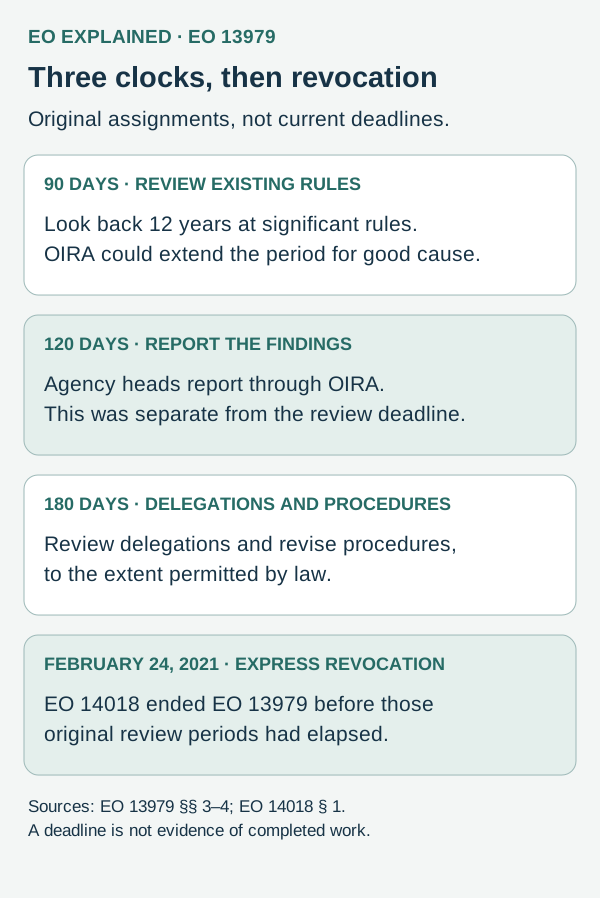
The separate retrospective review was not an automatic cancellation of every rule signed by a career official. Agencies were to identify significant rules from the previous 12 years, check who issued them and report their findings. That 90-day review, the 120-day report and the 180-day delegation/procedure work were different assignments. EO 14018 revoked the order before any of those original periods elapsed. The signed directions alone do not establish that each agency completed a review, submitted a report or changed a delegation before revocation. Sections 3–4; EO 14018, section 1.
Before and after
Before the order
Agency heads could delegate rulemaking functions under their governing authorities.
After the order
The order called for delegation reviews and allowed a documented safety exception; EO 14018 revoked it in February 2021. Completed revisions are not established.
Who had to do what
| Agency / office | Action | Timing / position |
|---|---|---|
| Heads of covered agencies | Require senior-appointee signatures on covered section 553 rules and reserve initiation of that rulemaking and approval of the regulatory agenda to senior appointees, to the extent permitted by law. | Sections 2(a), 2(d): continuing rulemaking directions while the order operated; no new numerical deadline. |
| Senior appointees at covered agencies | Act as the required initiators, agenda approvers and signers. The definition includes presidential appointees, people performing duties of presidentially appointed offices and non-career Senior Executive Service members or equivalents. | Sections 2(a), 5(b): when covered rulemaking is initiated, approved or signed, not a requirement that every appointee sign every rule. |
| Agency head personally | If compliance would impede public safety or security, determine that the exception applies, notify OIRA of the reasons and publish the notification consistently with safety, security and privacy interests. | Sections 2(b)–(c): no numerical deadline; the determination could not be delegated. |
| Heads of covered agencies — delegations and procedures | Review rulemaking delegations, make necessary lawful revisions and amend management/procedure regulations to incorporate the senior-appointee requirements. | Section 3: within 180 days of January 18, 2021. Revoked before that original period elapsed. |
| Heads of covered agencies — retrospective review and report | Check significant rules issued in the prior 12 years, plus other OIRA-identified rules, for senior-appointee issuance; report the findings to the President through OIRA. | Sections 4(a)–(b): review within 90 days and report within 120 days of signing; OIRA could extend either for good cause. Revoked before those periods elapsed. |
| OIRA Administrator within OMB | Identify additional rules for retrospective review; allow good-cause extensions of the section 4 review/report periods; provide implementation guidance and monitor compliance. | Sections 4, 6: 90-day/120-day periods were extendable; no separate numerical deadline for guidance or monitoring. |
These are the original order’s assignments, not current instructions. Section 5 expressly included the Consumer Financial Protection Bureau but excluded the Federal Bureau of Prisons. It also excluded internal organization, procedure or practice rules that did not substantially affect non-agency parties’ rights or obligations. Signed sections 2–6.
What happened next
Executive Order 13979 signed.
The Federal Register published the January 18 order. The 90-day, 120-day and 180-day periods ran from signing, not this publication date. Official source.
EO 14018 section 1 expressly revoked EO 13979, before its original review/report periods elapsed. Section 2 separately directed lawful consideration of rescinding implementing measures. Official source.
The Federal Register published EO 14018. Its signing date was February 24, not March 1. Official source.
EO 14148 revoked EO 14018. Its text did not expressly reinstate EO 13979’s original review clocks; the disposition entry continues to record EO 13979’s revocation. Official source.
Later primary evidence reviewed: EO 14018 expressly revoked this order.
Legal and source detail
Sources by type
If a source is unavailable, first check the cited publisher or another official repository. The cited publisher remains the authority.
Primary and official sources
Orders, laws, court records and official implementation material.
- EO 14018 — revoked by (opens in a new tab) Order text
- Federal Register — EO 14018 express revocation, February 24, 2021
- Federal Register — EO 13979 disposition entry
- U.S. Code — Administrative Procedure Act, 5 U.S.C. 553
- White House — EO 14148, January 20, 2025
The rulemaking reference was to 5 U.S.C. 553, not an exemption from the Administrative Procedure Act. The 2021 order’s requirements applied only to the extent permitted by law. Its public-safety/security exception required an agency-head determination that could not be delegated, an explanation to OIRA and Federal Register publication with the specified protections. EO 14018 separately told OMB and agency heads to consider lawful rescission of implementing measures, expressly including compliance with the APA; revocation did not establish that every separate agency rule had already been withdrawn. EO 13979, sections 2 and 7; EO 14018, section 2.
EO 14148, January 20, 2025, section 2, later revoked EO 14018. That provision names the revoking order, not an express reinstatement of EO 13979’s original review clocks. This guide retains the Revoked label recorded in the Federal Register disposition entry rather than treating the later rescission as proof that all former delegations, reports or deadlines returned. See the existing EO 14018 guide for the intervening revocation. Disposition table.
How we checked this
Last checked against the sources above on September 24, 2026. How we research →