Executive Order 14129: Providing for the Closing of Executive Departments and Agencies of the Federal Government on December 24, 2024
President: Joseph R. Biden Jr.
Closed most executive departments and agencies on December 24, 2024 while preserving agency authority to retain staff for national security, defense or other public need.
Status: Completed/expired.
Is Executive Order 14129 still in effect? No. Section 1 specified December 24, 2024, and that one-day closure is over. OPM issued its implementing memorandum on December 19, 2024. The order does not establish an annual Christmas Eve holiday or a closure in 2026. Official evidence checked October 17, 2026.
What does Executive Order 14129 do?
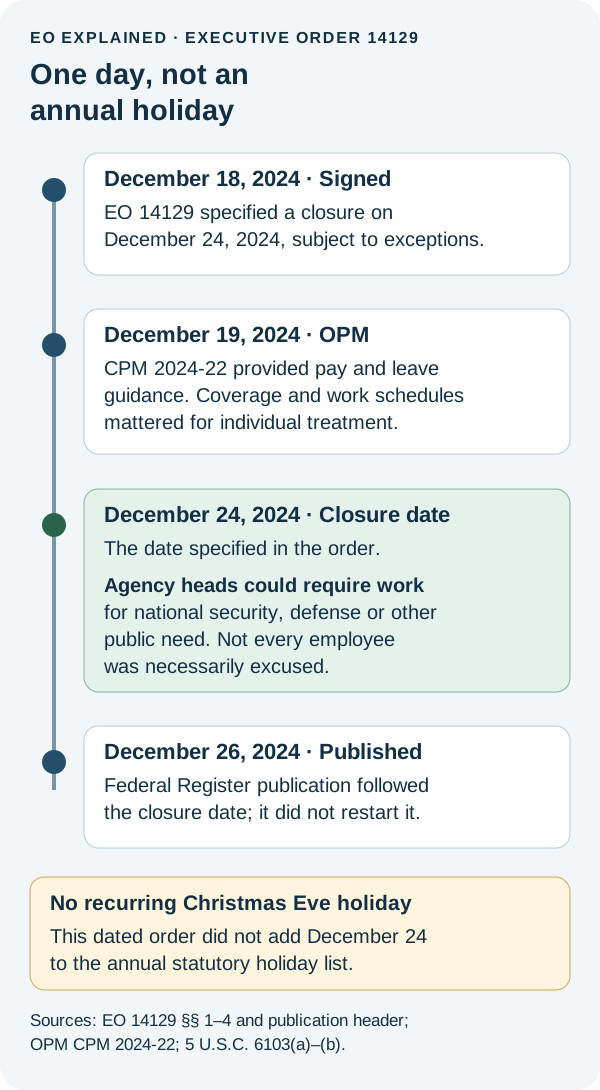
Agency heads could retain staff for national security, defense or public need, while OPM issued pay and operating guidance for the one-day closure.
This was an ad hoc executive-branch closure, not a permanent addition to the annual holiday calendar. Section 1 names one date; section 2 lets agency heads keep necessary offices open and require staff for national security, defense or other public need. Section 3 applies existing holiday pay and leave rules, while section 4 directs OPM implementation. Signed sections 1–4.
OPM’s December 19 memorandum is the actual implementation document. It says most excused employees receive normal basic pay and generally are not charged previously scheduled paid leave. Required nonovertime holiday work generally qualifies for premium pay; standby-duty and covered firefighter rules are exceptions. Part-time and intermittent schedules also have different rules, so the order should not be read as identical time off for every worker. CPM 2024-22, memorandum and questions 1, 4, 8–9.
OPM directed Postal Service and contract employees to their supervisor or contracting officer for their own pay and leave treatment. For a historical payroll question, the memorandum and agency HR/payroll office are more useful than assuming a private employer or every contractor was ordered to close. The document does not establish that every agency’s payroll transaction was correctly processed. Memorandum, page 2.
Before and after
Before the order
Christmas Eve was an ordinary federal workday unless employees used leave or agencies had separate authority.
After the order
OPM issued operating guidance and agencies implemented the closure. The order expired after the specified day and creates no continuing entitlement.
Who had to do what
| Agency / office | Action | Timing / position |
|---|---|---|
| Heads of executive departments and agencies | Close and excuse employees under section 1; decide which offices or employees must remain on duty for national security, defense or other public need under section 2. | December 24, 2024; the stated date, not a recurring annual instruction. |
| Director of the Office of Personnel Management | Take necessary implementation action under section 4. OPM subsequently issued CPM 2024-22. | No separate numerical deadline in the order; the actual memorandum is dated December 19, 2024. |
Original sections 1–5; Dated implementation memorandum. OMB’s preserved functions are not a new task. The agency-head exception is a decision power, not proof that every office closed.
What happened next
EO 14129 signed.
Order signed.
OPM issued CPM 2024-22 with pay and leave guidance and attached questions and answers. Original dated memorandum.
Closure implemented and completed.
The order appeared in the Federal Register after the one-day closure date. This publication did not create a second closure or restart the instruction. Authenticated publication header and sections 1–4.
Legal and source detail
How it works legally
Federal pay, leave, collective-bargaining and essential-operations rules controlled individual treatment. Agency heads retained discretion to require work.
The statutory distinction is between the recurring public-holiday list in 5 U.S.C. 6103(a) and the pay/leave treatment of a day declared a holiday by executive order under subsection (b). Section 3 of EO 14129 also expressly invokes EO 11582. It does not amend the annual statutory list to add every Christmas Eve. Section 6103(a)–(b) and EO 11582 reproduced below it; Section 3.
Under 5 U.S.C. 5546(b)–(d), covered nonovertime holiday work generally receives basic pay plus an equal premium, with a two-hour minimum for required holiday work; overtime is treated separately. Those statutory rules and OPM’s schedule-specific exceptions matter more than a blanket promise of double pay to everyone. These are historical rules for the specified closure, not individualized payroll advice or a current 2026 closure announcement. Section 5546(b)–(d), printed page 678; Questions 8–9 and special categories.
Sources by type
If a source is unavailable, first check the cited publisher or another official repository. The cited publisher remains the authority.
Primary and official sources
Orders, laws, court records and official implementation material.
How we checked this
Last checked against the sources above on September 9, 2026. How we research →
Additional evidence review: October 17, 2026. Read the complete signed order, the full eight-page OPM memorandum and attachment, the holiday statute and the cited premium-pay provisions. Corrected the source-list link that had pointed to a general Washington, DC dismissal handbook instead of this order’s actual implementation memorandum. The dated instruction is completed; no new 2026 closure, universal individual entitlement or audit of every agency’s historical payroll is inferred.