Executive Order 14114: Taking Additional Steps With Respect to the Russian Federation's Harmful Activities
President: Joseph R. Biden Jr.
Amended Russia sanctions orders to expose foreign financial institutions supporting Russia’s military-industrial base to blocking or correspondent-account sanctions and to broaden import restrictions.
Status: In effect.
Is Executive Order 14114 still in effect? Yes. Its amendments remain part of the Russia-sanctions framework. The March 24, 2026 notice expressly includes EO 14114 and continues the underlying emergency for one year beyond April 15, 2026. Particular sanctions, product determinations and licenses must still be checked separately. Continuation notice; disposition checked October 17, 2026.
What does Executive Order 14114 do?
Treasury could identify covered foreign financial institutions; sanction decisions and import controls required subsequent determinations under the amended framework.
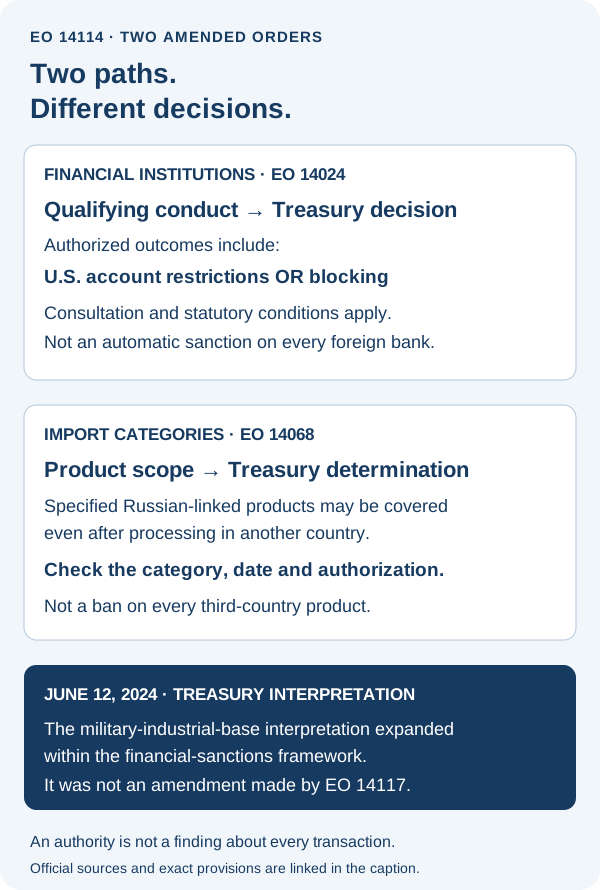
There are two distinct mechanisms. Sections 1–2 amend EO 14024, adding a foreign-financial-institution sanctions route and changing its prior-notice provision. Section 3 amends EO 14068, expanding the types of imports that can be restricted through determinations. An affected bank and an affected shipment therefore require different factual and legal checks. OFAC’s explanation of the two amended orders.
For a qualifying foreign financial institution, Treasury may restrict access to U.S. correspondent or payable-through accounts, or impose property-blocking sanctions. Those are alternative authorized measures following the relevant determination, not an automatic penalty on every foreign bank. OFAC explains the resulting U.S. financial-institution obligations and the separate role of authorizations such as general licenses. Sanctions choices, account closure and blocking.
The covered institution definition is broader than deposit-taking banks, extending to listed financial businesses such as insurers, securities dealers and certain affiliates. It also expressly excludes specified international financial institutions. OFAC’s significance analysis considers the circumstances, including transaction size, frequency, management awareness, sanctioned-party connections and deceptive practices; the FAQ does not supply a universal dollar threshold. Definition, exclusions and significance factors.
Currency alone does not remove the risk. OFAC’s updated guidance says the section 11 targeting authorities apply to transactions in any currency, including qualifying activity denominated in a local currency. Separately, Treasury’s June 12, 2024 interpretation included all persons blocked under EO 14024 in Russia’s military-industrial base. That was Treasury’s implementation of the amended framework, not a change made by EO 14117. Non-dollar transactions; the dated Treasury interpretation.
The import provisions also require attention to product origin and the relevant determination. They authorize restrictions on specified Russian-linked categories even after incorporation or substantial transformation outside Russia; they do not automatically prohibit every third-country product. OFAC distinguishes the existing Russian-origin restrictions from the additional categories that require determinations. Categories and determination requirements.
A concrete example is the December 22, 2023 seafood determination. It covered salmon, cod, pollock and crab meeting the stated Russian production, harvesting-water or vessel conditions, even after processing into another product outside Russia. The text retains exceptions provided by law and OFAC licenses or other authorization. Its effective date was December 22, 2023; that historical instrument is not a substitute for checking the authorizations applicable to a present shipment. Actual seafood determination and exceptions.
Before and after
Before the order
Existing sanctions targeted Russian actors and trade but provided narrower leverage over foreign banks facilitating the military-industrial base and transformed Russian goods.
After the order
OFAC issued implementing determinations, including the December 22, 2023 critical-items and seafood instruments. On June 12, 2024, Treasury broadened its interpretation of Russia’s military-industrial base under the amended framework. The change was not made by EO 14117. Critical-items determination; seafood determination; June 2024 interpretation.
Who had to do what
| Agency / office | Action | Timing / position |
|---|---|---|
| Secretary of the Treasury | Authorized to determine qualifying foreign-institution conduct and choose account restrictions or blocking, with State consultation; consult Commerce for the specified critical-items route. Determine covered import categories with the required agency consultations and concur in DHS documentation rules. | EO 14114 sections 1 and 3; actions depend on determinations. No numerical deadline for imposing sanctions. |
| Secretary of State | Consult on Treasury’s sanctions, sector, critical-item and import determinations, and on the three departments’ import-implementation actions. | Sections 1 and 3; linked to the relevant action, with no standalone numerical deadline. |
| Secretary of Commerce | Consult on critical items and import categories; authorized to implement the amended import order through appropriate actions, rules and lawful redelegation. | Sections 1 and 3; no fixed number of days. |
| Secretary of Homeland Security | Consult on specified import categories. With Treasury’s concurrence, prescribe rules to collect documentation or information needed to enforce the expanded categories; also authorized to implement the amended import order. | Section 3: documentation rules as expeditiously as possible; covered imports follow determination-specific dates. |
| All executive departments and agencies | Take appropriate measures within their authority to implement the amended EO 14068. | Section 3(d), replacing EO 14068 section 5; no numerical deadline. |
Original sections 1–3 and their cross-references. The table distinguishes authorized sanctions and consultation roles from DHS’s documentation-rule direction. OMB’s preserved functions are not a new deliverable. A direction or authorization does not demonstrate completion by every agency.
What happened next
EO 14114 signed.
OFAC’s critical-items determination took effect, identifying classes such as specified machine tools and semiconductor-manufacturing equipment for the new financial-institution route. A separate seafood determination took effect the same day. Critical-items instrument and annex; seafood instrument.
The Federal Register published EO 14114 at 88 FR 89271–89274, four days after signing. Publication and determination-specific import dates are separate questions. Authenticated publication.
Treasury expanded its interpretation of Russia’s military-industrial base to include all persons blocked under EO 14024. This was agency implementation of EO 14024 as amended by EO 14114. Dated OFAC explanation.
The President signed a notice continuing the underlying EO 14024 emergency for one year beyond April 15, 2026. It expressly identifies EO 14114 among the additional steps taken under that emergency. Continuation notice.
The continuation notice was published at 91 FR 15515–15516. It continues the emergency; it is not a new designation of every foreign institution or a replacement list of licensed transactions. Publication record and operative paragraph.
Legal and source detail
How it works legally
Section 1 inserts section 11 into EO 14024; section 2 revises that order’s prior-notice provision. For covered blocking decisions, the President found that advance notice could allow assets to move and make the measures ineffective. That finding concerns notice before listing; it should not be described as a court judgment eliminating every procedural protection. Exact amendments in sections 1–2.
The financial sanctions remain subject to statutory provisions and applicable regulations, directives and licenses. OFAC distinguishes correspondent-account restrictions from full blocking, with different resulting duties for U.S. financial institutions. A transaction’s currency, a financial institution’s nationality and its relevant conduct are distinct questions. Operational distinction and authorizations; currency guidance.
The import amendment similarly separates Treasury’s category determinations from enforcement documentation. Homeland Security must act with Treasury’s concurrence on the documentation rules, while the statute-based implementation powers may be redelegated within the specified departments. The order preserves applicable law and appropriations limits and creates no private enforceable benefit. Sections 3–4.
For practical research, use OFAC’s official program page for the governing orders, determinations, sanctions lists, regulations and licenses, then match the instrument to the institution or product and its date. The March 2026 continuation supports the continuing emergency framework; it does not establish that an individual transaction is authorized or that every designation or related court proceeding has the same outcome. Official program resources; scope of the continuation.
IEEPA and the National Emergencies Act govern the sanctions. OFAC regulations, due process, licenses and judicial review constrain designations; no court located invalidated EO 14114 or its amendments.
Sources by type
If a source is unavailable, first check the cited publisher or another official repository. The cited publisher remains the authority.
Primary and official sources
Orders, laws, court records and official implementation material.
- OFAC — Russia sanctions program (opens in a new tab) Official record
- Federal Register — EO 14114 disposition entry
- March 24, 2026 national-emergency continuation notice
- OFAC FAQ 1149 — sanctions choices and U.S. bank obligations
- OFAC FAQ 1151 — institution exclusions and significance factors
- OFAC FAQ 1152 — non-dollar transactions
- OFAC FAQ 1181 — June 12, 2024 interpretation
- OFAC FAQ 1154 — import categories and determinations
- December 22, 2023 seafood determination
- December 22, 2023 critical-items determination
How we checked this
Additional primary-source review on October 17, 2026: complete signed order, Treasury’s determinations and FAQs, the disposition entry, and the March 2026 continuation notice. The cited instruments establish the described scope and dates, not every current transaction, designation challenge or agency completion.
Last checked against the sources above on September 9, 2026. How we research →