Executive Order 14419: Ending Birth Tourism
President: Donald J. Trump
Delegated travel-control authority to State and Homeland Security for nonimmigrant-visa birth tourism and facilitation, with lawful implementation and discretionary exemptions.
Status: In effect.
Is Executive Order 14419 still in effect? Yes. The August 6, 2026 order contains continuing State and Homeland Security directions with no fixed sunset. Its October 17 disposition entry lists no later revocation. That does not establish every implementation step or resolve an individual visa or admission case. Disposition checked October 17, 2026.
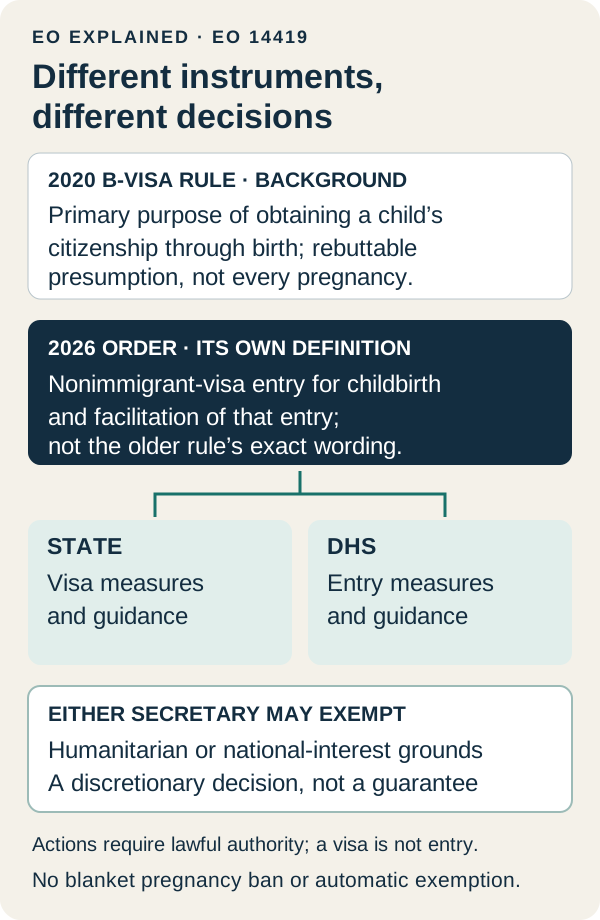
What does Executive Order 14419 do?
EO 14419 delegates travel-control authority to State and Homeland Security and directs action concerning entry on a nonimmigrant visa for the purpose of giving birth in the United States, including facilitation of that entry. Its section 3 definition does not repeat the older B-visa rule’s primary-purpose and citizenship-motive language. It concerns visa and entry measures, not a new statutory citizenship rule. Signed sections 2–6.
Reading the operative provisions of Executive Order 14419
The order is broader in wording than the preexisting visitor-visa restriction. It covers nonimmigrant-visa entry and facilitation, and section 4 lists possible visa, travel-authorization, admission, removal and facilitator measures within the Secretaries’ discretion and legal authority. It does not direct automatic denial to every pregnant traveler. Original definition and implementation clauses.
Consular officers assess visitor-visa eligibility under the Immigration and Nationality Act and State Department regulations. Border officials make separate admissibility decisions at entry. A stated purpose of travel, finances, medical plans and other facts may be relevant, but each decision must follow the governing law and procedural rules. The order’s direction does not eliminate an officer’s obligation to assess the individual applicant.
EO 14419 also must be read separately from EO 14418’s citizenship interpretation. The visa order concerns entry and purpose of travel; it does not determine the citizenship status of a child after birth. The Supreme Court’s decision in Trump v. Barbara governs the Citizenship Clause question for children of unlawfully or temporarily present parents. Agencies must apply that holding along with immigration law, while distinguishing lawful medical travel from a case where officials find an impermissible primary purpose.
The older rule remains important background, but it is a different instrument. State’s January 24, 2020 final rule changed the B-visa definition of pleasure and introduced a rebuttable presumption when an officer has reason to believe an applicant will give birth during the stay. Its preamble explains legitimate medical or other primary purposes that can rebut the presumption. Those details cannot simply be substituted for EO 14419’s differently worded definition. 2020 rule, operative paragraph (b)(2) and explanation.
Section 5 supplies a distinct discretion: either Secretary may exempt a foreign national on humanitarian grounds or because entry is in the national interest. This is not an automatic exemption for every medical trip, nor evidence that a particular exemption has been granted. The order sets no numerical deadline for the guidance updates, information sharing or exemption decisions. Sections 4–5.
For practical visitor-visa questions, State’s current public guidance separates consular eligibility from admission at a port of entry. It still identifies medical treatment as a visitor activity and describes documents an officer may request: a local diagnosis, a U.S. provider’s treatment/cost statement and evidence that travel, medical and living expenses can be paid. These are general resources, not a guarantee that a particular trip qualifies under this order or other immigration restrictions. Official visitor-visa and medical-treatment guidance.
A visa permits travel to request admission; it does not guarantee entry. State directs case-specific questions to the embassy or consulate handling the application, while CBP makes the admission decision at the border. Do not confuse an available visitor-visa category, a humanitarian exemption decision, permission to enter, and a child’s citizenship determination. They are separate questions with separate legal conditions. Admission and case-specific contact information.
Before and after
Before the order
Consular and border officers already applied visitor-visa and admissibility law, including rules concerning travel for the primary purpose of giving birth.
Existing statutes, regulations and constitutional limits continued to govern the subject.
After the order
State and DHS were directed to reinforce visa and admission screening and issue consistent guidance within their delegated authority.
The official order, White House explanation, current visitor-visa regulation and agency guidance were searched through September 15. No amendment, revocation, public order-wide implementation report or material order-specific injunction was found; individual decisions remain fact-specific and reviewable only through the channels Congress provides.
Who had to do what
| Agency / office | Action | Timing / position |
|---|---|---|
| Secretary of State | Use delegated section 215(a) authority as necessary; take appropriate action and update rules, policies or guidance; may grant humanitarian or national-interest exemptions. | Sections 2, 4(a), 5: no numerical deadline; measures remain within discretion and lawful authority. |
| Secretary of Homeland Security / Department of Homeland Security | Exercise the parallel delegated travel-control and implementation functions; may grant the same exemptions; DHS pays Federal Register publication costs. | Sections 2, 4(a), 5, 6(e): no numerical deadline. |
| Other relevant executive departments and agencies | Provide records and information needed by State and Homeland Security to implement the order and implementing measures, subject to applicable law. | Section 4(b): when necessary for implementation; no fixed number of days. |
Original sections 2–6. OMB’s preserved functions are not a new assignment. The listed possible enforcement measures are discretionary and law-limited, not proof that every listed measure has been taken against every person.
What happened next
State’s earlier B-visa rule took effect, using a primary-purpose test and rebuttable presumption. It predates EO 14419 and is not implementation of the 2026 order. Background rule’s dates and operative text.
EO 14419 signed alongside the distinct citizenship order EO 14418.
EO 14419 was published at 91 FR 51993, five days after signing. Publication establishes the text of the delegation and directions, not completion of all later agency work. Authenticated three-page publication.
Legal and source detail
How it works legally
The INA authorizes visa and admission decisions, but the executive order cannot amend the Citizenship Clause. Pregnancy alone is not the legal test stated by the current visitor-visa rule; the relevant inquiry is travel purpose and statutory eligibility. Constitutional, statutory and procedural limits remain.
Section 2 uses two linked provisions rather than an unrestricted new power. Under 3 U.S.C. 301, the President may delegate qualifying statutory functions through a written, published designation with specified conditions and revocation authority. The function delegated here is INA section 215(a), codified at 8 U.S.C. 1185(a), to the extent necessary to implement the order. Written-delegation statute; Order’s section 2.
Section 1185(a) addresses entry and departure under presidentially prescribed rules, limitations and exceptions, as well as specified knowing misuse of travel documentation. Subsection (d) also makes clear that a permit does not entitle an otherwise inadmissible person to enter. The EO does not eliminate these statutory conditions or turn every factual allegation into a completed finding of inadmissibility. Actual statutory text, subsections (a) and (d).
The order’s references to revocation, permanent bars, removal and facilitators are possibilities within legal authority, not a self-executing individual judgment. Section 6 retains applicable law, appropriations limits and severability, and creates no privately enforceable benefit. A statement that the directive remains in effect therefore does not establish the outcome of a visa, removal or exemption case. Sections 4–6 and their limits.
Sources by type
If a source is unavailable, first check the cited publisher or another official repository. The cited publisher remains the authority.
Primary and official sources
Orders, laws, court records and official implementation material.
- eCFR — 22 C.F.R. §41.31 visitor visas (opens in a new tab) Official record
- State Department — Visitor Visa (opens in a new tab) Official record
- Signed EO — complete operative text
- State — January 24, 2020 B-visa rule and explanation
- 8 U.S.C. 1185(a), (d) — travel controls and admission limits
- 3 U.S.C. 301 — written presidential delegations
- Federal Register — disposition entry
How we checked this
Last checked against the sources above on September 15, 2026. How we research →
Additional evidence review: October 17, 2026. Read the full signed order in the White House and Federal Register versions and its authenticated three-page publication; checked its disposition entry, the separate 2020 B-visa rule, current public visitor-visa guidance and the cited statutory provisions. Corrected the conflation of the order’s definition with the older rule. The disposition entry has no later revocation annotation, but is not a substitute for a complete implementation or current court-record review. Earlier September 15 caveats remain dated and unchanged; no individual eligibility, exemption, removal or citizenship outcome is certified.