Executive Order 14290: Ending Taxpayer Subsidization of Biased Media
President: Donald J. Trump
Directed the Corporation for Public Broadcasting board and agencies to end direct and indirect federal funding for NPR and PBS where lawful.
Status: Blocked by courts. Is Executive Order 14290 still in effect? Executive Order 14290 is blocked by court rulings. See Federal Register record.
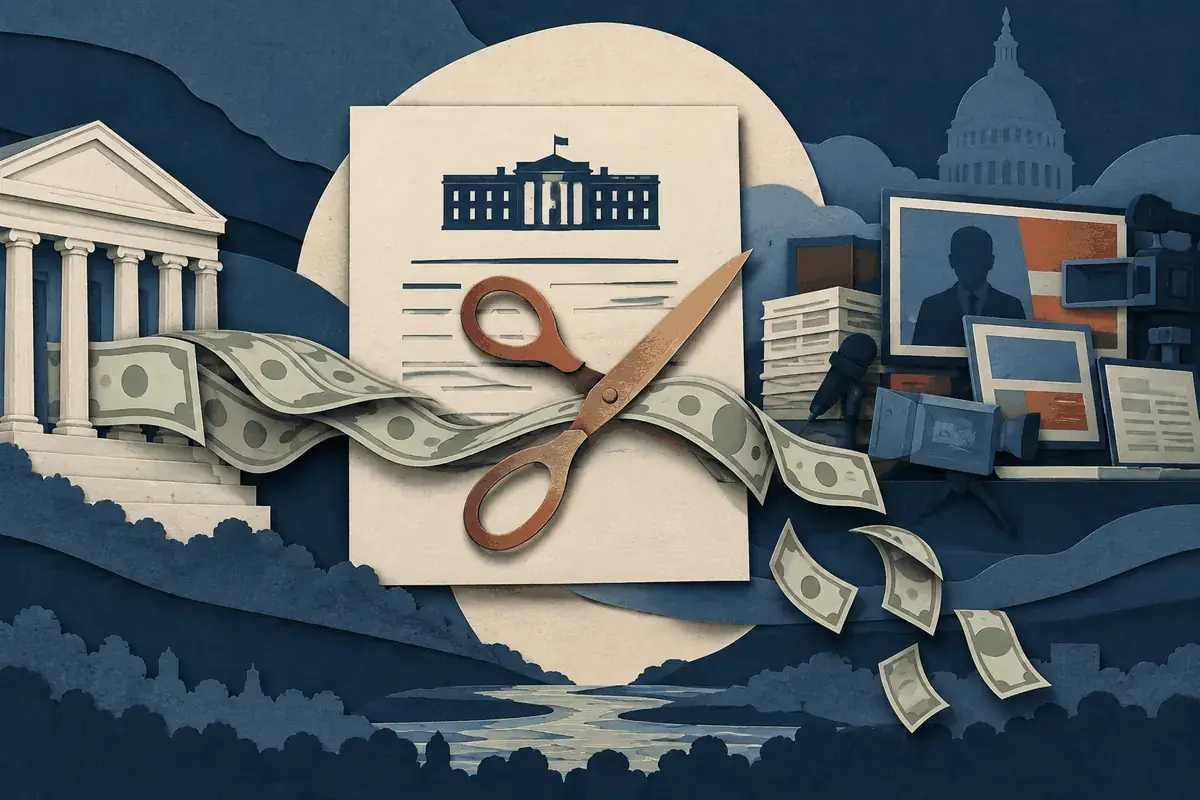
What does Executive Order 14290 do?
The order directed CPB and agencies to end funding where lawful; the funding cutoff was subsequently challenged in court.
Later primary evidence reviewed September 24, 2026: A March 2026 district court opinion held section 3(a)’s funding cutoff unconstitutional and enjoined federal agencies from implementing that provision. The ruling does not settle the order’s other provisions or any later appeal. Official source. The cited steps do not establish every downstream effect.
Reading the operative provisions of Executive Order 14290
EO 14290 directs the Corporation for Public Broadcasting board and federal agencies to end direct and indirect federal support for NPR and PBS to the extent permitted by law. It also addresses funding passed through public-media intermediaries. The stated rationale appears in the Federal Register text of EO 14290. The order does not automatically dissolve either broadcaster or prevent them from receiving donations, state support or other lawful revenue.
CPB is a congressionally created nonprofit corporation with statutory responsibilities for public broadcasting. Its board and the agencies that administer grants have to follow the Public Broadcasting Act, appropriations and the terms of existing awards. A presidential instruction to stop a funding stream cannot override a statute that directs how appropriated money must be used. Nor does an executive order itself determine whether a broadcaster’s coverage is biased; those characterizations are the administration’s stated rationale, not a judicial finding.
The order was challenged and courts blocked its operative funding restrictions. The injunction’s scope matters for CPB, agencies, NPR, PBS and local stations because funds may move through several separate grant and distribution mechanisms. A court block prevents implementation of the enjoined provisions while it remains in force; it does not decide how Congress may appropriate future funds. To assess current support, examine the applicable court order, CPB’s grant records and the specific source of funding rather than treating the executive order as a completed defunding.
Before and after
Before the order
Congress appropriated public-broadcasting funds through CPB, a federally chartered private nonprofit with statutory independence.
After the order
The administration pursued funding restrictions, while CPB and broadcasters litigated; appropriations and CPB’s organic statute govern the disposition of funds.
A March 2026 district court opinion held section 3(a)’s funding cutoff unconstitutional and enjoined federal agencies from implementing that provision. The ruling does not settle the order’s other provisions or any later appeal.
Who had to do what
| Agency / office | Action | Timing / position |
|---|---|---|
| CPB board | Cease covered direct funding where lawful | Subject to statute and litigation |
| Agencies | Identify and end indirect support where authorized | Ongoing |
| OMB | Coordinate implementation | Ongoing |
What happened next
EO 14290 signed.
Later primary evidence reviewed: A March 2026 district court opinion held section 3(a)’s funding cutoff unconstitutional and enjoined federal agencies from implementing that provision. The ruling does not settle the order’s other provisions or any later appeal.
Court status
See the court documents in Sources by type.
Legal and source detail
How it works legally
47 U.S.C. §§396–398, appropriations, contract rights and the First Amendment limit implementation. The President cannot rescind enacted spending solely by order.
Sources by type
If a source is unavailable, first check the cited publisher or another official repository. The cited publisher remains the authority.
Primary and official sources
Orders, laws, court records and official implementation material.
How we checked this
Last checked against the sources above on September 24, 2026. How we research →