Executive Order 14256: Further Amendment to Duties Addressing the Synthetic Opioid Supply Chain in the People's Republic of China as Applied to Low-Value Imports
President: Donald J. Trump
Ended duty-free de minimis treatment for covered products of China and Hong Kong and established collection methods.
Status: Superseded. The section 2 entry-and-collection framework.
Is Executive Order 14256 still in effect? No. Its section 2 entry-and-collection framework was expressly superseded by EO 14324 section 4(b) for covered entries from August 29, 2025, at 12:01 a.m. eastern daylight time. The Superseded label concerns that operational framework, not an assertion that every recital or the original one-time reporting direction was revoked. Later de minimis suspension and CBP customs rules are separate from the ended IEEPA tariffs. Signed replacement and amendment scope; EO 14389, section 2(c); Later postal rule and dates.
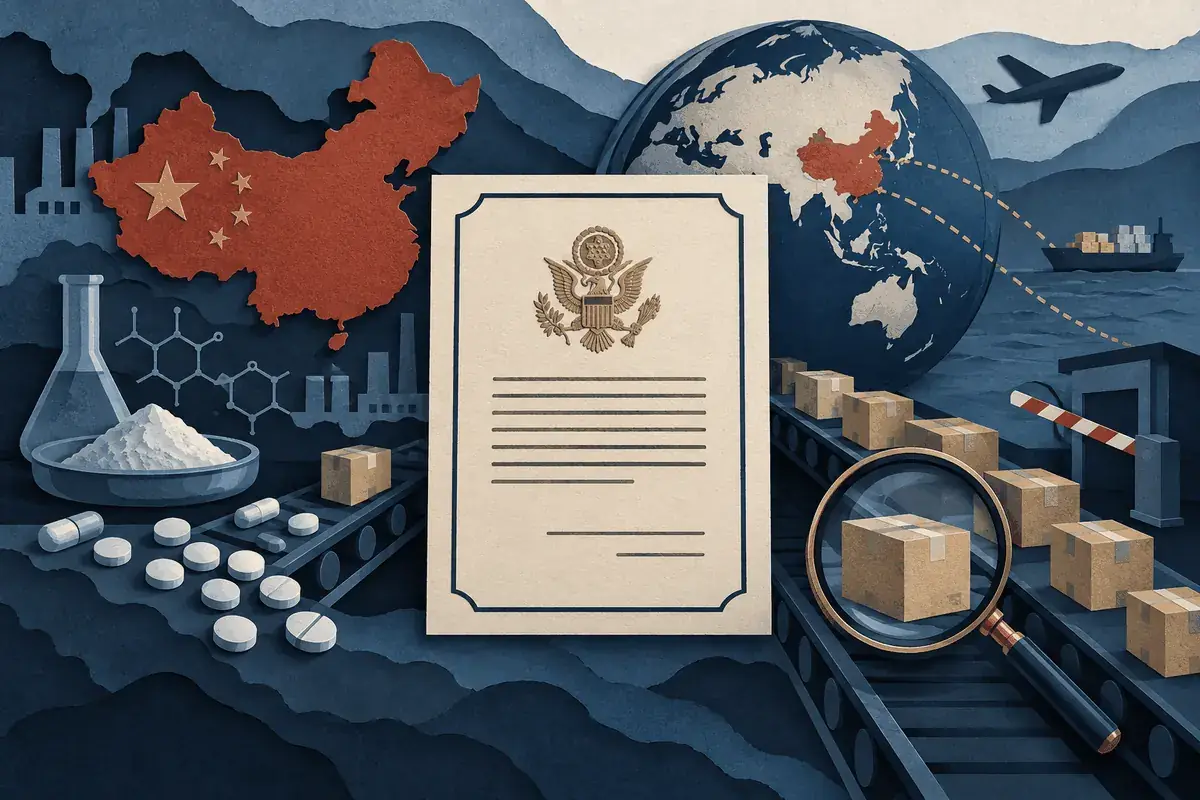
What does Executive Order 14256 do?
EO 14256 ended the temporary restoration of duty-free de minimis treatment for covered products of China and Hong Kong from May 2, 2025, at 12:01 a.m. eastern daylight time. Section 1 records Commerce’s systems-readiness notification; it is affirmative evidence of that notification, not a newly imposed deadline to supply one. The order separated nonpostal ACE entries, with applicable duties, from a special carrier-collected postal regime. Signed sections 1–2.
The original postal terms were 30% of value or a per-item amount of $25, rising to $50 on June 1. These were not the rates that ultimately began on May 2: intervening amendments changed them before collection started. CBP’s April 28 notice implemented the amended framework, including the 120% or $100 postal alternatives; EO 14298 later reduced the percentage to 54% from May 14 and retained $100 instead of the contemplated June increase. These are historical rates, not current quotations. CBP amended implementation notice; EO 14298, section 4.
Formal entry remained a distinct possibility: CBP could require it under existing regulations, in which case the special postal duty was replaced by all applicable duties, taxes and fees under the ordinary rules. Carriers also had reporting and bond responsibilities. Commerce’s impact report was due within 90 days, consulting USTR; the cited records do not establish that this particular report was submitted. Sections 2(b)–(e) and 5.
EO 14324 section 4(b) expressly superseded this order’s section 2 for covered entries from August 29, 2025. That explains the status label without claiming that every original provision was revoked. The subsequent global suspension, its 2026 amendments and CBP’s independent regulations need to be read separately from the original China postal rates. Express supersession and effective clause.
Before and after
Before the order
Tariff treatment was set by the Harmonized Tariff Schedule and measures issued under specific trade statutes.
IEEPA had not previously been used to impose the broad tariffs at issue in the 2026 Supreme Court cases.
After the order
EO 14259 changed the related postal rate; later all-country de minimis actions and the 2026 replacement framework were separate instruments.
The Supreme Court held that IEEPA does not authorize tariffs. The administration then used other statutes for separate measures, including a temporary section 122 surcharge that ran from February 24 to July 24, 2026.
Who had to do what
| Agency / actor | Original direction or role | Timing and limits |
|---|---|---|
| Homeland Security Secretary | Lead implementation under sections 2(a), 3 and 4, including lawful rules/notices; consult Treasury, the Attorney General and Commerce under section 3. | Covered entry change: May 2, 2025, at 12:01 a.m. eastern daylight time. No separate fixed rulemaking deadline. |
| U.S. Customs and Border Protection | Administer ACE entries; may require periodic postal duty remittance, carrier data, adequate bonds or formal entry; sections 2(a), 2(b)(ii)–(iii), 2(d)–(e). | Monthly remittance or another CBP-set period; data timing set by CBP. Formal entry is discretionary under the stated existing regulations. |
| U.S. International Trade Commission | Ministerially modify the HTSUS as needed to reflect the order; section 2(a). | As needed; no independent numerical deadline. |
| Treasury Secretary | Consult with DHS on implementation under section 3. | As implementation arises; not the lead for a new tariff schedule. |
| Attorney General | Consult with DHS on implementation under section 3. | As implementation arises; no separate report deadline. |
| Commerce Secretary | Consult on implementation; submit an impact report and recommendations, including whether Macau coverage is needed to prevent circumvention; sections 3 and 5. Section 1 records an earlier readiness notification. | Report within 90 days of April 2, 2025. The recital is not a fresh notification deadline; submission is not established by the examined records. |
| United States Trade Representative | Consult with Commerce on the section 5 impact report. | Within the report’s 90-day clock; not the lead author or an independent deadline. |
| All executive departments and agencies | Take necessary lawful implementation action; section 2(a). | As required; this direction does not establish that every implementing action occurred. |
| Carriers transporting covered international postal packages | Report item counts and required values; collect/remit duties using one permitted method; maintain an international carrier bond; sections 2(b)–(d). | CBP-prescribed reporting/remittance periods; method changes once a month or another CBP-approved interval, with 24-hour notice. The original rates were subsequently amended. |
| Parties qualified to make entry for covered nonpostal shipments | Use another appropriate ACE entry type and pay applicable duties under the relevant entry/payment procedures; section 2(a). | For covered entries from May 2, 2025; not a new duty imposed on every small parcel worldwide. |
Full original signed assignments. This table separates original leads, consultation partners, private filing/collection duties and discretionary powers. Later rules and amendments, not the original table alone, govern a current entry. General OMB savings language is not a new substantive assignment.
What happened next
EO 14256 signed.
The original order was published, before its entry and collection start. Official publication.
EO 14259 changed the planned original postal rates before May 2; the originally signed 30%/$25/$50 figures were not the opening collection schedule. Section 3 rate changes.
CBP published an amended implementation notice reflecting EOs 14259 and 14266, including the 120%/$100 opening postal alternatives. Official customs implementation.
The amended China/Hong Kong entry-and-collection framework began for covered entries at 12:01 a.m. eastern daylight time. Operational entry date.
EO 14298 directed a reduction to 54% and retention of $100 instead of the planned June increase, with the stated May 14 entry changes. Section 4.
EO 14324 expressly superseded EO 14256 section 2 for covered entries at 12:01 a.m. eastern daylight time. Section 4(b).
The Supreme Court rejected IEEPA tariff authority. EO 14388 separately amended the de minimis framework, and EO 14389 expressly left that action unaffected. Separate amendment and preserved framework.
EO 14388’s modifications applied to covered entries from 12:01 a.m. eastern standard time. Section 5(a).
EO 14388 was published in the Federal Register after its signing and specified entry date. Official publication.
A separate temporary 10% surcharge operated under section 122 of the Trade Act.
Current position checked against the Court judgment and official USTR tariff record.
Court status
See the court documents in Sources by type.
Legal and source detail
How it works legally
The Superseded label identifies the section 2 framework expressly replaced by EO 14324, not a judicial annulment of every original direction. The later order’s background recalls the Commerce reporting requirement, but does not establish its fulfillment. The Supreme Court’s February 20, 2026 holding concerns presidential tariff power under IEEPA, not a judicial decision restoring the de minimis exemption. EO 14389 preserved the separate de minimis action and non-tariff measures. Controlling tariff holding; Preserved measures, sections 1–2; Later scope and authority.
Sources by type
If a source is unavailable, first check the cited publisher or another official repository. The cited publisher remains the authority.
Primary and official sources
Orders, laws, court records and official implementation material.
- EO 14324 — global framework and express supersession
- EO 14388 — textual amendments and distinct entry date
- EO 14389 — preserved de minimis and non-tariff actions
- CBP — June 24, 2026 postal interim final rule
- CBP — June 24, 2026 nonpostal interim final rule
- CBP — October 8, 2026 proposed low-value entry rule
- CBP — October 14, 2026 postal compliance-date extension
- CBP — April 28, 2025 amended implementation notice
- EO 14259 — April 8, 2025 planned postal-rate amendment
- EO 14298 — May 12, 2025 postal-rate reduction
How we checked this
Last checked against the sources above on September 9, 2026. How we research →
Additional evidence review: October 17, 2026. Compared original actor assignments and timing, later textual replacements, dated customs rules and implementation notices. The reviewed records do not establish every original report’s fulfillment or resolve individual entry eligibility, refunds or every later court challenge.