Executive Order 14389: Ending Certain Tariff Actions
President: Donald J. Trump
Ended collection of additional ad valorem duties imposed under the listed IEEPA tariff orders after the Supreme Court decision.
Status: In effect.
Is Executive Order 14389 still in effect? Yes. The February 20, 2026 termination remains the operative direction for the listed IEEPA additional duties. CBP’s February 22 guidance specified no collection for covered entries from February 24, 2026. Section 1 preserves the emergencies and non-tariff actions, while section 2(c)–(d) preserves the separate de minimis action and duties under other statutes. Signed scope and implementation clauses; CBP CSMS 67834313.
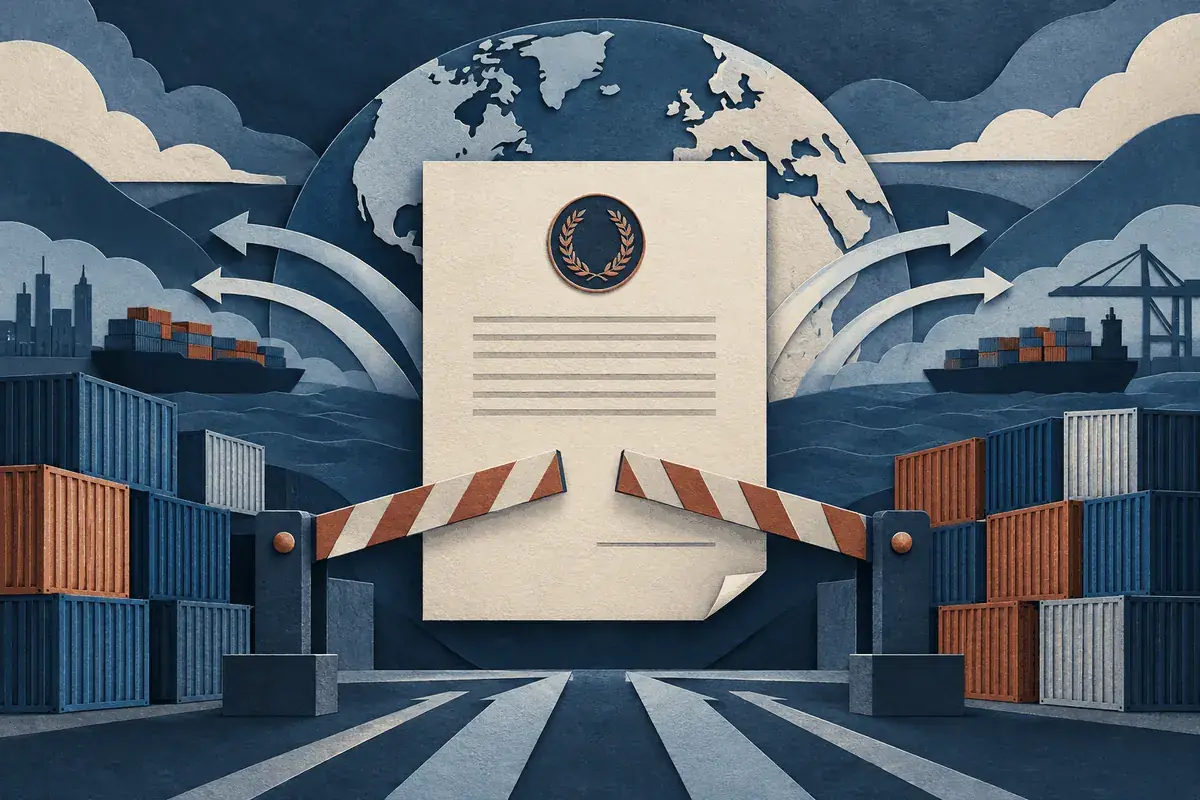
What does Executive Order 14389 do?
This action formed part of the 2025–2026 tariff framework. On February 20, 2026, the Supreme Court held that IEEPA does not authorize presidential tariffs; EO 14389 then ended the additional ad valorem duties imposed under the listed IEEPA orders. Measures based on other statutes and the all-country de minimis suspension require separate analysis.
Reading the operative provisions of Executive Order 14389
EO 14389 ends collection of specified additional ad valorem duties imposed under the listed IEEPA tariff orders after the Supreme Court ruled that IEEPA did not authorize those tariffs. The Federal Register text lists the affected actions and directs agencies to stop collecting those duties. It does not end every U.S. tariff or trade measure.
The order distinguishes tariff duties from the underlying emergency declarations and non-tariff measures. It directs the relevant agencies to cease collection of the listed additional rates and address customs administration. Other duties imposed under different statutes, including section 232 measures and ordinary customs rates, remain separate. EO 14388 also continues the suspension of de minimis treatment under customs law, so low-value imports may still owe applicable duties.
A separate section 122 proclamation imposed a temporary import surcharge with its own rate, duration and exceptions. That measure is not a continuation of the IEEPA tariffs terminated by EO 14389. Importers should identify the legal authority and effective date attached to each duty. The Supreme Court decision, EO 14389 and later replacement actions each answer different questions about why collection stopped, what remains and whether a new tariff applies.
CBP supplied the operational cutoff after signing: its February 22 bulletin says the listed IEEPA duties would not be collected for consumption entries or warehouse withdrawals for consumption from 12:00 a.m. eastern time on February 24, 2026, and that the related HTSUS numbers would be inactive in ACE. This is a later customs instruction, not the signing date or the Federal Register publication date. CBP’s dated implementation bulletin.
Before and after
Before the order
The Harmonized Tariff Schedule reflected the then-current reciprocal, country-specific and product-specific treatment.
Earlier orders in the same lineage supplied the baseline that this order amended.
After the order
The underlying emergency declarations and non-tariff actions remained in effect; de minimis and non-IEEPA duties were expressly preserved.
EO 14389 ended the listed IEEPA additional ad valorem duties after the Supreme Court decision. It expressly preserved non-IEEPA duties and the separate all-country de minimis suspension.
Who had to do what
| Agency / official | Original direction | Timing and limits |
|---|---|---|
| All executive department and agency heads | Immediately begin appropriate steps to end the listed IEEPA additional duties; lawful redelegation permitted; section 2(a). | Begin immediately; terminate collection as soon as practicable, not a new fixed number of days. |
| Commerce Secretary | Determine necessary tariff-schedule modifications, with DHS and USTR as appropriate, consulting CBP and USITC; may modify through Federal Register notice; section 2(b). | As needed to implement termination; no separate numerical deadline. |
| Homeland Security Secretary | Participate in the section 2(b) schedule determinations and notices; bear the publication costs under section 3(d). | Termination work begins immediately; collection ends as soon as practicable. No numerical publication-cost deadline. |
| United States Trade Representative | Participate as appropriate in the section 2(b) schedule determinations and notices. | Implementation as needed; no separate numerical deadline. |
| Commissioner of U.S. Customs and Border Protection | Consultation partner for the schedule determinations; section 2(b). CBP later issued the entry-system guidance described below. | Original order supplies no independent numeric deadline; later CBP cutoff is February 24, 2026. |
| Chair of the U.S. International Trade Commission | Consultation partner for tariff-schedule modifications; section 2(b), alongside any other senior official the lead officials deem appropriate. | As part of implementation; no independent report or numerical deadline. |
Full original signed assignments. The table distinguishes lead officials from consultation partners. OMB’s general savings clause is not a separate substantive assignment.
What happened next
EO 14389 signed.
The Supreme Court rejected IEEPA tariff authority, affirmed the Federal Circuit judgment in V.O.S. Selections and vacated the separate district-court judgment for lack of jurisdiction. Controlling decision.
CBP issued CSMS 67834313 with the operational collection cutoff and ACE tariff-number changes. Dated CBP bulletin.
CBP’s bulletin specified no IEEPA duty collection for covered consumption entries or warehouse withdrawals from 12:00 a.m. eastern time. Entry cutoff.
EO 14389 was published at 91 FR 9437, after its signing and the CBP collection cutoff. Official publication.
A separate temporary section 122 surcharge operated under the Trade Act.
Current position checked against the judgment and later presidential action.
Court status
See the court documents in Sources by type.
Legal and source detail
How it works legally
Learning Resources v. Trump held that IEEPA does not authorize the President to impose tariffs. EO 14389 ended the identified IEEPA duties but preserved the underlying emergencies and non-tariff actions. Section 232, section 301, section 122 and customs-law measures stand or fall on their own authority.
Sources by type
If a source is unavailable, first check the cited publisher or another official repository. The cited publisher remains the authority.
Primary and official sources
Orders, laws, court records and official implementation material.
How we checked this
Last checked against the sources above on September 9, 2026. How we research →
Additional evidence review: October 16, 2026. Compared the original assignments, Supreme Court holding and judgments, EO 14389’s preserved-action clauses and CBP’s dated entry cutoff. This does not determine an individual entry’s refund or certify every later customs dispute.