Executive Order 14388: Continuing the Suspension of Duty-Free De Minimis Treatment for All Countries
President: Donald J. Trump
Continued the separate de minimis suspension and revised postal collection; later CBP rules independently relied on customs law.
Status: In effect. The continuing suspension framework, not unchanged historical postal rates.
Is Executive Order 14388 still in effect? Yes. Its continuing suspension and implementation directions remain distinct from its time-limited interim postal rate. EO 14389 section 2(c), signed February 20, 2026, expressly left this order unaffected. CBP’s June 24 rules subsequently imposed an independent customs-law suspension and a new postal process. The order’s interim postal-rate clause lasts only until the earlier of the temporary surcharge’s expiration or the new process’s effective date; it is not a permanent uniform charge. Signed replacement and amendment scope; EO 14389, section 2(c); Later postal rule and dates.
What does Executive Order 14388 do?
This action formed part of the 2025–2026 tariff framework. On February 20, 2026, the Supreme Court held that IEEPA does not authorize presidential tariffs; EO 14389 then ended the additional ad valorem duties imposed under the listed IEEPA orders. Measures based on other statutes and the all-country de minimis suspension require separate analysis.
Reading the operative provisions of Executive Order 14388
EO 14388 continued the separate de minimis suspension and revised the postal collection framework after the Supreme Court’s IEEPA tariff ruling. The Federal Register text provides the legal basis and collection procedures. The presidential order invoked IEEPA, the National Emergencies Act, section 604 of the Trade Act and the delegation statute. CBP’s later independent customs-law regulations must not be mistaken for the order’s own asserted authority.
De minimis treatment allowed qualifying low-value goods to enter with reduced customs processing and duties. Continuing its suspension means packages may require more complete entry information and payment of applicable charges. The amount due still depends on product classification, origin and any other tariff program. Carriers, marketplaces and importers need accurate data to avoid delays and miscalculated duties.
The order’s collection rules do not mean every package is subject to an identical flat tax, and exemptions or special procedures may apply under the statute. CBP guidance and the tariff schedule determine how the rule works for specific shipments. The earlier IEEPA decision changed the legal basis for certain tariffs; EO 14388 addresses the distinct suspension and postal framework; CBP’s later rules independently exercise customs-law authority. Readers should not conflate the two measures.
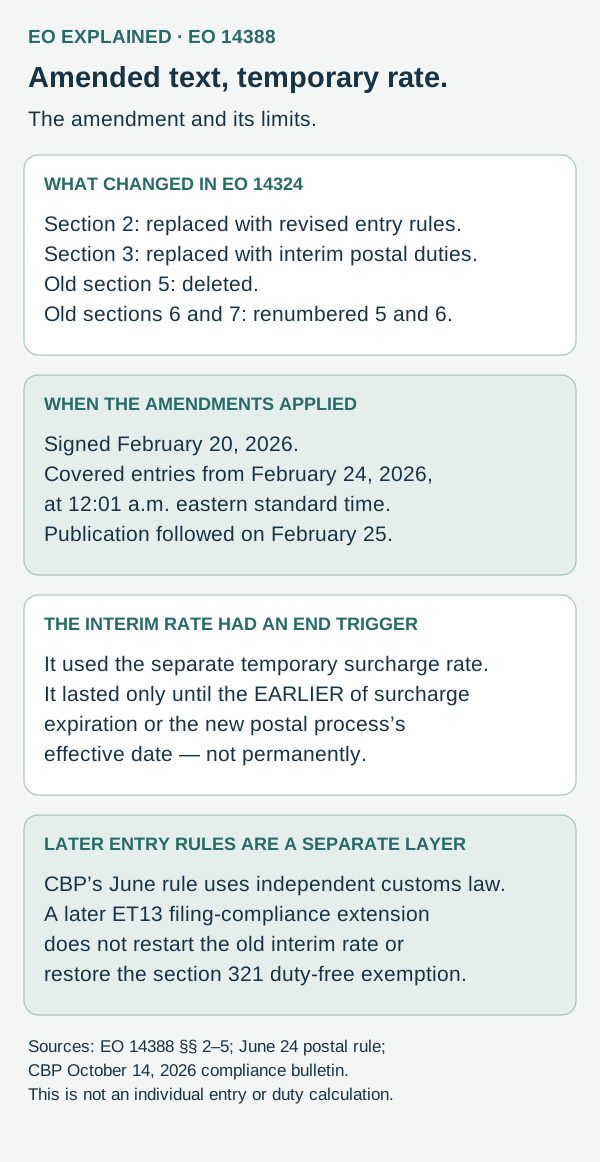
The amendment applied to covered entries from February 24, 2026, at 12:01 a.m. eastern standard time, not immediately on the February 20 signing date. Its revised section 3 temporarily used the rate in the separate import-surcharge proclamation, but only until the surcharge expired or CBP’s new postal entry process took effect, whichever came first. The continued suspension therefore does not establish a permanent uniform postal tax. Sections 3 and 5(a).
Postal origin and value still had to be declared, and goods subject to antidumping/countervailing duties or quotas retained appropriate ACE entry requirements. Nonpostal entry responsibilities were separate from the carrier-collected postal mechanism. DHS could continue the implementation powers authorized in EO 14324; this was not a fresh assignment making Commerce, Treasury and USPS joint leads. Sections 1–3 and 5(b).
CBP’s June 24, 2026 interim final rules independently suspended the administrative exemption under 19 U.S.C. 1321. Both suspension provisions took effect June 24, while the postal rule’s remaining provisions took effect July 24. These rules preserve the separate gift and traveler exemptions and distinguish the postal process from nonpostal formal/informal entry. Postal rule, dates and background; Nonpostal rule, dates and authority.
CBP’s October 14 announcement extended the specified international-mail informal-entry compliance date from October 22, 2026 to January 20, 2027. It concerns postal shipments subject to section 201, 232 or 301 duties or partner-agency requirements: Entry Type 13 is the electronic informal-entry route, with formal entry remaining an alternative. It is not a restoration of duty-free treatment or an immediate mandate for every postal package. CBP described its October 8 broader filing proposal separately as proposed, with comments due December 7. Official dated extension and covered shipments; Separate notice of proposed rulemaking.
Before and after
Before the order
The Harmonized Tariff Schedule reflected the then-current reciprocal, country-specific and product-specific treatment.
Earlier orders in the same lineage supplied the baseline that this order amended.
After the order
EO 14389 expressly preserved this order; CBP continues to state that duty-free treatment for covered low-value shipments is suspended.
EO 14389 ended the listed IEEPA additional ad valorem duties after the Supreme Court decision. It expressly preserved non-IEEPA duties and the separate all-country de minimis suspension.
Who had to do what
| Agency / actor | Original direction or role | Timing and limits |
|---|---|---|
| Homeland Security Secretary | Implement through lawful regulations, notices or guidance; may continue powers previously authorized by EO 14324; section 5(b). Bear publication costs under section 7(d). | Modifications apply to covered entries from February 24, 2026, at 12:01 a.m. eastern standard time; not the February 20 signing date. |
| U.S. Customs and Border Protection | Collect applicable postal and nonpostal charges; approve qualified substitute collectors; establish and publish the new postal entry process; sections 1–3. | Remittance follows CBP guidance. The new-process effective date is an event trigger; the original order sets no fixed date for publishing that process. |
| Postal transportation carriers or CBP-approved qualified substitute parties | Collect/remit the interim duty under the revised section 3; follow CBP guidance on payment. | Only during the interim rate’s stated life: until surcharge expiration or the new process’s effective date, whichever comes first; not permanently. |
| Parties making covered entry/declarations | File appropriate nonpostal ACE entries; declare postal origin and value; maintain ACE entry for postal goods subject to AD/CVD or quota; revised sections 2 and 3(c)–(d). | For covered entries under the amended framework; later CBP rules and instructions govern the operational filing process. |
Full original signed assignments. This table separates original leads, consultation partners, private filing/collection duties and discretionary powers. Later rules and amendments, not the original table alone, govern a current entry. General OMB savings language is not a new substantive assignment.
What happened next
EO 14388 signed.
The Supreme Court rejected IEEPA tariff authority. EO 14388 separately amended the de minimis framework, and EO 14389 expressly left that action unaffected. Separate amendment and preserved framework.
EO 14388’s modifications applied to covered entries from 12:01 a.m. eastern standard time. Section 5(a).
EO 14388 was published in the Federal Register after its signing and specified entry date. Official publication.
CBP’s postal/nonpostal interim final rules independently suspended the administrative exemption; suspension provisions took effect that day. Dates and independent customs basis.
A separate temporary section 122 surcharge operated under the Trade Act.
The postal rule’s remaining provisions took effect, distinct from its June 24 suspension provision and later specified compliance window. Distinct effective dates.
Current position checked against the judgment and later presidential action.
CBP proposed broader low-value filing and bonding changes, with comments due December 7; the proposal itself did not adopt those changes. NPRM action and dates.
CBP announced the extension of the specified postal informal-entry compliance date to January 20, 2027, with formal entry remaining an alternative. Dated official extension.
Court status
See the court documents in Sources by type.
Legal and source detail
How it works legally
The presidential orders invoked IEEPA and the stated emergency, tariff-schedule and delegation authorities. CBP’s June 2026 regulations independently relied on customs authority under 19 U.S.C. 1321; an executive order and an agency regulation are distinct legal acts. The Supreme Court’s February 20, 2026 holding concerns presidential tariff power under IEEPA, not a judicial decision restoring the de minimis exemption. EO 14389 preserved the separate de minimis action and non-tariff measures. Controlling tariff holding; Preserved measures, sections 1–2; Later scope and authority.
Sources by type
If a source is unavailable, first check the cited publisher or another official repository. The cited publisher remains the authority.
Primary and official sources
Orders, laws, court records and official implementation material.
- EO 14256 — original China/Hong Kong framework
- EO 14324 — global framework and express supersession
- EO 14389 — preserved de minimis and non-tariff actions
- CBP — June 24, 2026 postal interim final rule
- CBP — June 24, 2026 nonpostal interim final rule
- CBP — October 8, 2026 proposed low-value entry rule
- CBP — October 14, 2026 postal compliance-date extension
How we checked this
Last checked against the sources above on September 9, 2026. How we research →
Additional evidence review: October 17, 2026. Compared original actor assignments and timing, later textual replacements, dated customs rules and implementation notices. The reviewed records do not establish every original report’s fulfillment or resolve individual entry eligibility, refunds or every later court challenge.