Executive Order 14384: Modifying Duties To Address Threats to the United States by the Government of the Russian Federation
President: Donald J. Trump
EO 14384 is partly revoked. See the India duty cutoff, conditional refunds, State-led implementation and monitoring after the IEEPA tariff ruling.
Status: Partly revoked. Sources: Learning Resources, Inc. v. Trump, Supreme Court opinion, February 20, 2026 · Executive Order 14389, February 20, 2026, sections 1–2 · Executive Order 14384, signed text.
Is Executive Order 14384 still in effect? Partly. It removed India’s 25% additional duty effective February 7, 2026, and section 4’s Russian-oil monitoring remains operative. Learning Resources, Inc. v. Trump on February 20, 2026 rejected IEEPA tariff authority; EO 14389 on the same date ended the EO 14329 duties, so its IEEPA tariff-reimposition route no longer operates.
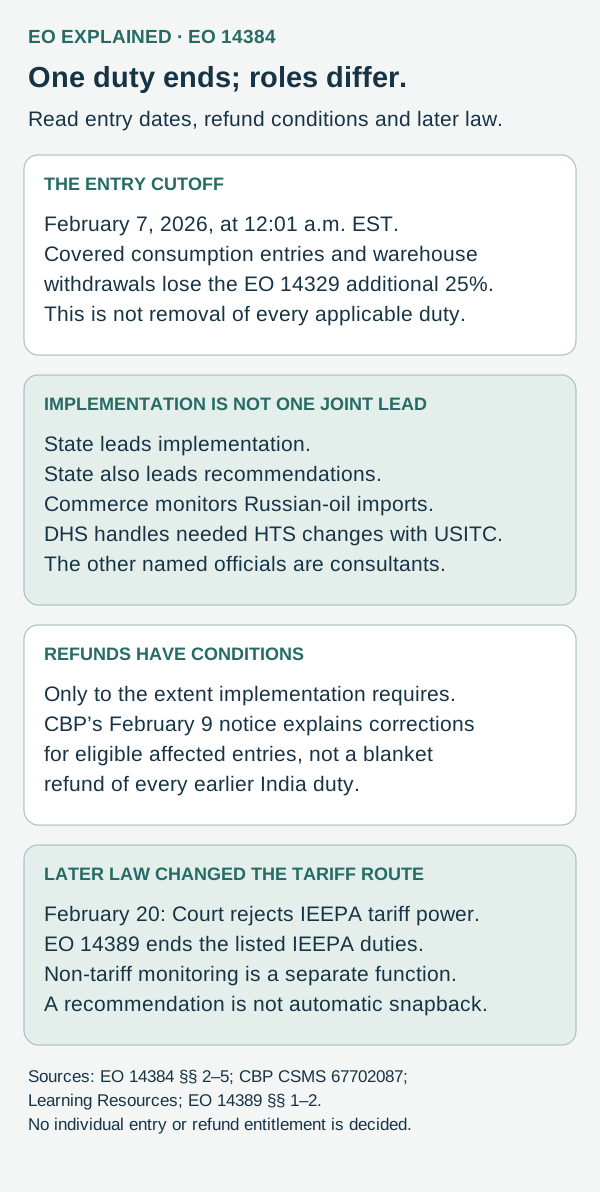
What does Executive Order 14384 do?
This action formed part of the 2025–2026 tariff framework. On February 20, 2026, the Supreme Court held that IEEPA does not authorize presidential tariffs; EO 14389 then ended the additional ad valorem duties imposed under the listed IEEPA orders. Measures based on other statutes and the all-country de minimis suspension require separate analysis.
Reading the operative provisions of Executive Order 14384
EO 14384 ended the additional 25 percent duty on certain Indian imports after the administration found that India had committed to stop importing Russian oil. The Federal Register text modifies the earlier India tariff order and specifies the effective date. It is a completed tariff change, not a general repeal of all trade measures related to Russia.
The duty had applied to covered Indian-origin goods, not directly to the oil itself. Removing it changes the customs rate for entries after the effective date, while other tariffs and ordinary duties may still apply. Importers need to distinguish this additional rate from sanctions, export controls and other trade remedies concerning Russian energy.
EO 14389 later ended other specified IEEPA tariff actions after the Supreme Court decision. EO 14384’s own change should still be read on its effective date and alongside that later measure. Customs entries made before and after the changes can be treated differently. A company assessing a shipment should use the tariff schedule and CBP instructions for the entry date rather than rely on a broad summary of the policy.
The exact cutoff matters. Section 2 removed the EO 14329 additional 25 percent duty for covered Indian products entered for consumption, or withdrawn from warehouse for consumption, on or after February 7, 2026, at 12:01 a.m. eastern standard time. It terminated HTSUS headings 9903.01.84–9903.01.89 and the corresponding note subdivision. Signing on February 6, publication on February 11 and the February 7 entry cutoff are three distinct events. Signed section 2.
CBP’s February 9 implementation bulletin confirms that cutoff and explains correction of affected entries. For eligible post-cutoff entries under the terminated headings, it described post-summary corrections for unliquidated entries and protests within 180 days after liquidation for liquidated entries. The order itself only requires refunds to the extent implementation requires them, under applicable law and standard procedures. Neither statement is a blanket promise to refund every India tariff paid before February 7. CSMS 67702087, correcting previously filed entries; Conditional refund clause.
The same February 9 bulletin said reciprocal tariffs then remained. That sentence describes the position on that date, not today’s tariff authority. The February 20 Supreme Court decision held that IEEPA does not authorize presidential tariffs, and EO 14389 then ended listed IEEPA additional duties, including the EO 14329 lineage. Other statutory duties were expressly preserved. A historical implementation notice therefore cannot establish a current all-in rate. Learning Resources holding; EO 14389, sections 1–2.
The order also contains a decision chain rather than an automatic snapback. Commerce monitors whether India resumes Russian-oil imports; a finding triggers State-led consultation and recommendations to the President. The background describes the administration’s assessment of India’s commitments, not independently verified proof of future compliance. Non-tariff monitoring must be distinguished from the original IEEPA tariff route that later legal events foreclosed. Background and section 4; Preservation of non-tariff actions.
Broader IEEPA refund litigation is a separate issue from this order’s February entry correction. On October 8, 2026, Judge Richard K. Eaton of the U.S. Court of International Trade certified a class in Freestyle World, Inc. v. U.S. Customs and Border Protection, No. 26-01088. The order defines a class by its challenged tariff orders and entry period, excluding entities that filed their own recovery actions; it is not an individualized determination that a particular India entry qualifies for payment. Its procedural history also describes an appeal over earlier liquidation/reliquidation relief. This guide does not establish the complete later appeal or stay position. October 8 opinion, opening history and conclusion/order.
Before and after
Before the order
The Harmonized Tariff Schedule reflected the then-current reciprocal, country-specific and product-specific treatment.
Earlier orders in the same lineage supplied the baseline that this order amended.
After the order
The order terminated the relevant tariff headings and authorized refunds; Commerce was to monitor whether India resumed Russian-oil imports.
EO 14389 ended the listed IEEPA additional ad valorem duties after the Supreme Court decision. It expressly preserved non-IEEPA duties and the separate all-country de minimis suspension.
Who had to do what
| Agency / office | Action | Timing / position |
|---|---|---|
| Secretary of State | Lead authorized implementation, consulting the named officials; may lawfully redelegate within State. After a Commerce finding that India resumed Russian-oil imports, lead recommendations to the President on possible further action. State bears publication costs. | Sections 3(a), 4 and 5(d). No numerical report deadline. A recommendation is not automatic tariff reimposition; later law limits the original IEEPA tariff route. |
| Secretary of Commerce | Monitor whether India resumes directly or indirectly importing Russian oil, coordinating with State, Treasury and other appropriate senior officials. Consult on State’s implementation and any triggered recommendations. | Section 4 monitoring is ongoing; a Commerce finding triggers the recommendation process. No fixed number of days. |
| Secretary of the Treasury | Consult on State’s implementation and triggered recommendations; coordinate with Commerce’s monitoring. | Sections 3(a) and 4; no separate numerical deadline or automatic tariff determination. |
| Secretary of Homeland Security | Consult on implementation/recommendations; with USITC, determine whether HTSUS modifications are needed and may publish them by notice. | Sections 3(a)–(b) and 4. Section 2’s entry cutoff is February 7, 2026, at 12:01 a.m. EST; no separate fixed notice deadline. |
| U.S. Customs and Border Protection | Process any refunds required by implementation under applicable law and standard procedures. | Section 2 is conditional; it does not order a refund of every earlier India duty or set a universal refund-payment date. |
| United States International Trade Commission | Consult with DHS on necessary HTSUS modifications. | Section 3(b); consultation role, not the lead implementation official. |
| United States Trade Representative | Consult with State on implementation and on recommendations following a Commerce monitoring finding. | Sections 3(a) and 4; no separate reporting clock. |
| Assistant to the President for National Security Affairs | Consult with State on implementation and triggered recommendations. | Sections 3(a) and 4; no independent tariff power or numerical deadline. |
| Assistant to the President for Economic Policy | Consult with State on implementation and triggered recommendations. | Sections 3(a) and 4; no independent reporting deadline. |
| Assistant to the President and Senior Counselor for Trade and Manufacturing | Consult with State on implementation and triggered recommendations. | Sections 3(a) and 4; no separate numerical deadline. |
| Each executive department and agency | Take appropriate measures within its own authority to carry out the order. | Section 3(a); existing law and appropriations still limit action. No blanket exemption from other legal requirements. |
This table identifies the original leads, consultation partners and conditional duties. It does not treat State, Treasury, Commerce and DHS as interchangeable joint leads. OMB appears in a savings clause, not a newly assigned monitoring or refund task. The original delegation cannot supply IEEPA tariff power rejected by the Supreme Court. Signed sections 2–5; Controlling IEEPA holding.
What happened next
EO 14384 signed.
At 12:01 a.m. EST, section 2’s removal of the EO 14329 additional duty applied to covered consumption entries and warehouse withdrawals. Official source.
CBP issued CSMS 67702087 with the cutoff, retired headings and correction procedures for eligible affected entries. Official source.
The order was published in the Federal Register, after its signing and specified entry cutoff. Official source.
Supreme Court held that IEEPA does not authorize presidential tariffs; EO 14389 ended the listed IEEPA duties.
A separate temporary section 122 surcharge operated under the Trade Act.
Current position checked against the judgment and later presidential action.
The Court of International Trade certified a defined class in Freestyle World, a broader IEEPA refund case. The order is not a finding of refund eligibility for every India entry. Class-certification order.
Court status
See the court documents in Sources by type.
Legal and source detail
How it works legally
Learning Resources v. Trump held that IEEPA does not authorize the President to impose tariffs. EO 14389 ended the identified IEEPA duties but preserved the underlying emergencies and non-tariff actions. Section 232, section 301, section 122 and customs-law measures stand or fall on their own authority.
Sources by type
If a source is unavailable, first check the cited publisher or another official repository. The cited publisher remains the authority.
Primary and official sources
Orders, laws, court records and official implementation material.
How we checked this
Last checked against the sources above on September 9, 2026. How we research →
Additional evidence review: October 17, 2026. The complete original assignments, dated CBP correction guidance, later tariff termination and selected October 8 court provisions were reviewed. Monitoring findings, individual refunds and the full later appeal/stay record are not established here.