Executive Order 14195: Imposing Duties To Address the Synthetic Opioid Supply Chain in the People's Republic of China
President: Donald J. Trump
Imposed an additional duty on products of China in response to the administration’s findings about the synthetic-opioid supply chain.
Status: Struck down. The IEEPA tariff mechanism, not every underlying emergency action.
Is Executive Order 14195 still in effect? No. The China-related IEEPA tariff program was invalidated by the Supreme Court’s February 20, 2026 ruling in Learning Resources, Inc. v. Trump, and EO 14389 ended the duties. CBP stopped collection on covered entries from February 24, 2026. That does not remove separate section 301 duties or terminate the emergency and non-tariff actions expressly preserved by EO 14389. Supreme Court opinion, February 20, 2026; EO 14389, sections 1–2; CBP collection cutoff.
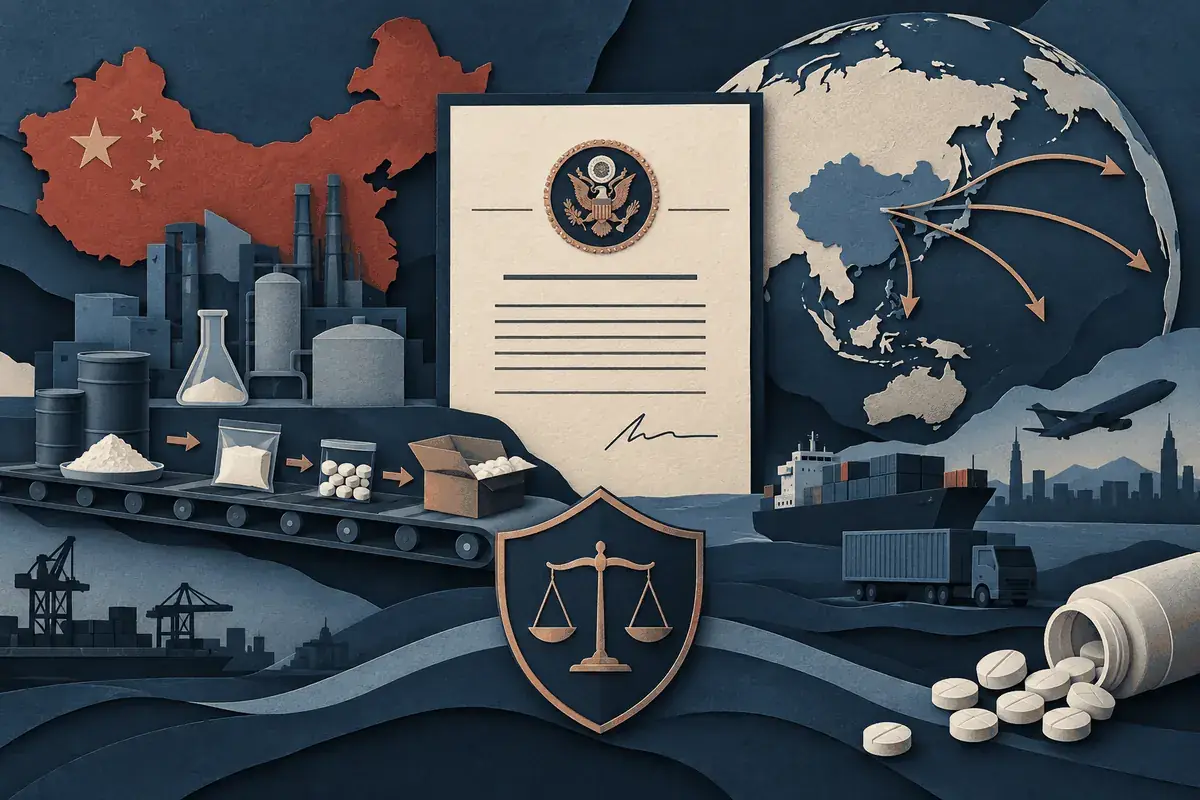
What does Executive Order 14195 do?
The measure relied on the International Emergency Economic Powers Act (IEEPA). On February 20, 2026, the Supreme Court held that IEEPA does not authorize the President to impose tariffs. The order remains part of the historical presidential record, but its IEEPA duty direction cannot supply current tariff authority.
Reading the operative provisions of Executive Order 14195
EO 14195 directed additional duties on covered imports from China under IEEPA, linking the measure to the declared emergency involving synthetic opioids. The order’s stated purpose and its customs mechanism are separate questions: the President described the emergency, while the Homeland Security Secretary was assigned tariff-schedule notice work, consulting Treasury, Justice and Commerce on implementation. Later amendments changed the duty’s operation, so the original text alone does not establish what an importer owed on a later shipment.
Learning Resources, Inc. v. Trump held that IEEPA did not authorize the challenged tariffs. The Court’s interpretation applies to the statutory authority asserted for these duties; it does not decide the underlying public-health problem or prevent Congress from legislating under a different trade authority. A separate section 122 surcharge had a limited effective window and should not be conflated with EO 14195.
The opinion also does not itself tell each importer whether a particular customs payment will be refunded. Entry records, liquidation status, and follow-on Customs or court procedures matter. For current tariff liability, check the official schedule and notices in force on the date of entry, together with the Supreme Court’s opinion. Read Executive Order 14195 in the Federal Register; read the Supreme Court opinion.
The original PRC measure specified a 10% additional duty, an in-transit certification exception, foreign-trade-zone treatment, no drawback and loss of de minimis treatment. Later changes altered the framework. Ending its IEEPA additional duty does not establish that a low-value shipment is now duty-free. Original section 2; Later termination and preserved measures.
CBP’s February 22, 2026 bulletin distinguished the termination direction from its entry-system implementation: collection ceased for covered consumption entries and warehouse withdrawals from 12:00 a.m. eastern time on February 24. That cutoff does not decide the refund treatment of every earlier entry. Official collection guidance.
Before and after
Before the order
Tariff treatment was set by the Harmonized Tariff Schedule and measures issued under specific trade statutes.
IEEPA had not previously been used to impose the broad tariffs at issue in the 2026 Supreme Court cases.
After the order
EOs 14200, 14228, 14256 and 14259 repeatedly changed the rate and low-value-shipment treatment.
The Supreme Court held that IEEPA does not authorize tariffs. The administration then used other statutes for separate measures, including a temporary section 122 surcharge that ran from February 24 to July 24, 2026.
Who had to do what
| Agency / official | Original direction | Timing and limits |
|---|---|---|
| Homeland Security Secretary | Determine tariff-schedule changes and publish the notice; regularly consult on conditions, notify the President of adequate foreign action and recommend additional action if needed; sections 2(d) and 3. Implement under section 4; coordinate emergency reports under section 5. | Original tariff date: 12:01 a.m. eastern time on February 4, 2025, subject to the text’s transit exception and later amendments. Consultation: regularly; recommendations conditional. No new numeric reporting deadline. |
| Secretary of State | Consult on situation regarding the PRC conditions and coordinate potential further-action recommendations; sections 3(a)–(b). | Regular consultation; additional recommendations if needed. Not an independent tariff-schedule assignment. |
| Attorney General | Consult/coordinate on conditions, further action, implementation and congressional reporting; sections 3–5. | Regular or action-dependent consultation; reporting follows the cited statutes, not a new fixed order deadline. |
| Treasury Secretary | Consult with DHS on implementation and coordinate national-emergency reporting; sections 4–5. | As implementation/reporting arises; not the original lead for setting the tariff schedule. |
| Commerce Secretary | Consult on implementation and coordinate national-emergency reporting; sections 4–5. | As implementation/reporting arises; no separate numeric deadline. |
| Assistant to the President for National Security Affairs | Consult/coordinate with DHS on conditions, further action and emergency reports; sections 3 and 5. | Regular consultation; additional recommendations conditional; statutory reporting framework. |
| Assistant to the President for Homeland Security | Consult/coordinate with DHS on conditions, further action and emergency reports; sections 3 and 5. | Regular consultation and action-dependent coordination; no separate fixed report. |
| U.S. Customs and Border Protection | Receive the importer’s certification for the original in-transit exception specified by the Federal Register notice; section 2(a). | Applies only if the original transit and entry conditions are met; later amendments and termination must be checked. |
| All executive departments and agencies | Take appropriate implementation measures within their own authority; section 4. | As required for implementation, consistent with law; not a power to impose duties after their statutory basis was rejected. |
| President | May expand duties in response to retaliation and determines sufficient foreign action for removal; sections 2 and 3. | Conditional powers in the original text, not fixed deadlines or evidence that a determination occurred; later limited by the Court’s IEEPA ruling. |
Full original signed assignments. The original authority and deadlines must be distinguished from the later end of tariff collection. USTR is not named in this original order’s assignments.
What happened next
EO 14195 signed.
The signed order was published in the Federal Register. The original February 4 entry date was a separate provision, subject to subsequent changes. Original publication.
The Supreme Court rejected IEEPA tariff authority, affirmed the Federal Circuit judgment in V.O.S. Selections and vacated the separate district-court judgment for lack of jurisdiction. Controlling decision.
EO 14389 ended this order’s IEEPA additional duties, preserving the emergencies and non-tariff actions. Termination scope.
CBP issued CSMS 67834313 with the operational collection cutoff and ACE tariff-number changes. Dated CBP bulletin.
CBP’s bulletin specified no IEEPA duty collection for covered consumption entries or warehouse withdrawals from 12:00 a.m. eastern time. Entry cutoff.
EO 14389 was published at 91 FR 9437, after its signing and the CBP collection cutoff. Official publication.
A separate temporary 10% surcharge operated under section 122 of the Trade Act.
Current position checked against the Court judgment and official USTR tariff record.
Court status
See the court documents in Sources by type.
Legal and source detail
How it works legally
The Supreme Court’s February 20, 2026 decision held that IEEPA does not authorize presidential tariffs. It affirmed the Federal Circuit judgment in No. 25–250, Trump v. V.O.S. Selections, while vacating the District of Columbia judgment in No. 24–1287, Learning Resources, with instructions to dismiss for lack of jurisdiction. This is not simply a still-pending preliminary injunction, nor a holding that Congress can never authorize tariffs. Opinion, 607 U.S. 229, 254–255.
EO 14389 then ended these IEEPA additional duties while expressly preserving the emergencies and non-tariff actions. Separate duties under sections 232 and 301 were not ended by that order. The Struck down label here identifies the invalid tariff mechanism, not a claim that every emergency declaration or customs measure was annulled. Sections 1 and 2(c)–(d).
Sources by type
If a source is unavailable, first check the cited publisher or another official repository. The cited publisher remains the authority.
Primary and official sources
Orders, laws, court records and official implementation material.
How we checked this
Last checked against the sources above on September 9, 2026. How we research →
Additional evidence review: October 16, 2026. Compared the original assignments, Supreme Court holding and judgments, EO 14389’s preserved-action clauses and CBP’s dated entry cutoff. This does not determine an individual entry’s refund or certify every later customs dispute.