Executive Order 14245: Imposing Tariffs on Countries Importing Venezuelan Oil
President: Donald J. Trump
Authorized a country-specific additional duty on goods from nations importing Venezuelan oil, at the Secretary of State’s discretion.
Status: Struck down. The conditional IEEPA tariff mechanism, not all Venezuela measures. EO 14389, sections 1–2.
Is Executive Order 14245 still in effect? No. Its IEEPA tariff mechanism cannot operate after the Supreme Court held in Learning Resources, Inc. v. Trump on February 20, 2026 that IEEPA does not authorize presidential tariffs. EO 14389 expressly ended the additional IEEPA duties under EO 14245 that day. The label concerns that tariff mechanism, not a claim that all Venezuela sanctions, the underlying emergency or every non-tariff direction ended. Supreme Court holding, pages 254–255; Dated emergency continuation.
What does Executive Order 14245 do?
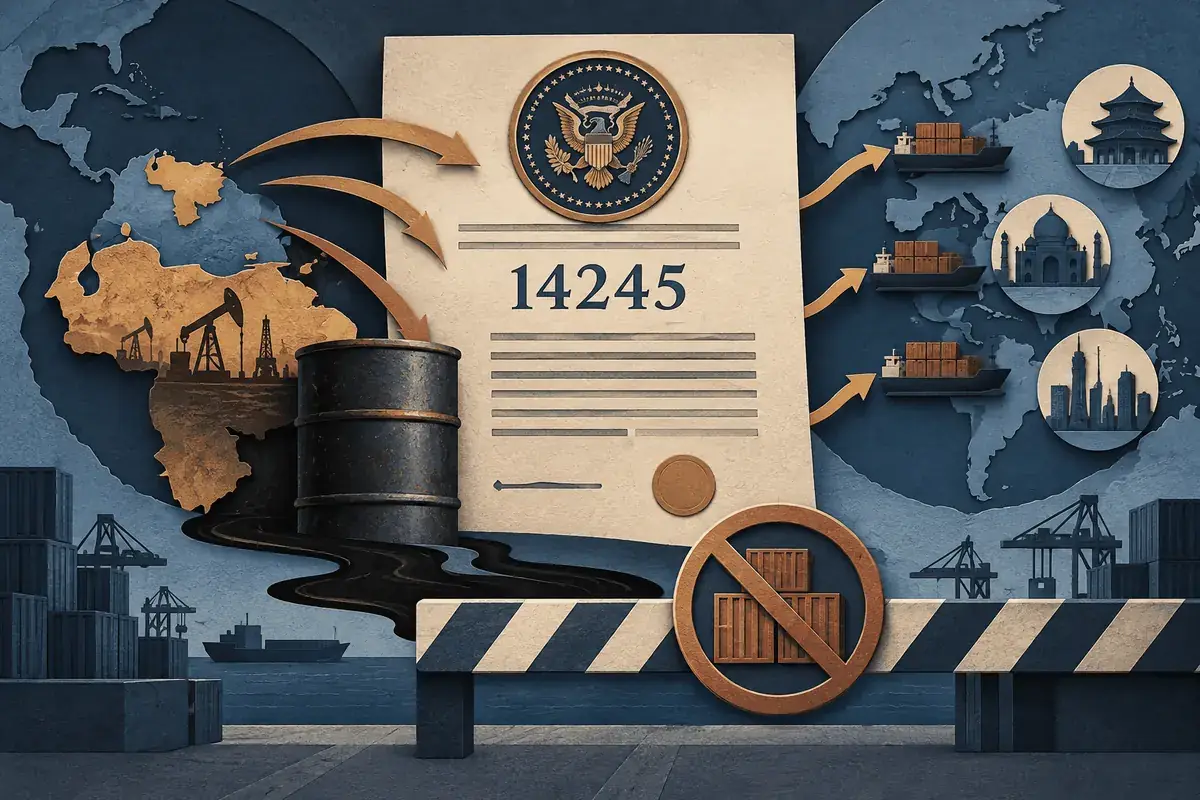
EO 14245 established a conditional secondary-tariff mechanism directed at countries importing Venezuelan oil, directly or through intermediaries. Section 2 authorized a 25% additional tariff on goods from a country selected by the Secretary of State; it did not automatically impose that rate on every oil-buying country when the President signed. The order was signed March 24, 2025, published March 27 and effective April 2 at 12:01 a.m. eastern daylight time. Original sections 2 and 6.
State’s discretionary imposition decision required consultation with Treasury, Commerce, Homeland Security and USTR. Commerce had a different role: determining whether oil purchases could be traced to Venezuela, including indirect purchases, and issuing implementation measures in coordination with State and the Attorney General. A definition of eligible conduct and an authorization to impose a tariff are not evidence that a particular country was selected. The official records cited here do not establish every country-specific decision or actual collection under this mechanism. Sections 2(b), 3(a)–(b) and 5.
The original duration was also conditional. Once State imposed the tariff, it would expire one year after the country’s last Venezuelan-oil import, unless Commerce made an earlier termination determination after the specified consultations. It was not a fixed one-year period beginning on March 24. If State selected China, section 3(e) would extend the same action to Hong Kong and Macau; that clause was not itself a finding that China had been selected. Sections 2(c) and 3(e).
The order defined Venezuelan oil by where crude or petroleum products were extracted, refined or exported, not the nationality of the producer or seller. Treasury’s OFAC later reused this definition in its Venezuela licensing FAQ. That is a separate licensing context, not evidence of a revived tariff or permission to disregard other sanctions. The February 18, 2026 notice continued the underlying Venezuela emergency; EO 14389 subsequently ended the listed IEEPA duties while preserving other actions and emergencies. Dated OFAC definition and licensing context; Emergency continuation; Termination limited to IEEPA duties.
State and Commerce also had a joint reporting assignment: within 180 days of signing and at least every 180 days thereafter, assess the tariffs’ effectiveness and the Maduro regime’s ongoing conduct. The examined public records do not establish the submission of each original periodic report. An elapsed deadline is not proof of completion, and ending the tariff mechanism does not by itself establish that every independent assessment obligation was canceled. Section 4; Preserved non-tariff scope.
Before and after
Before the order
The original order expressly preserved the listed earlier Venezuela sanctions. It added a conditional country-level tariff tool, with duties supplemental to other applicable measures, rather than replacing every sanctions program. Sections 1(b), 2(a) and 3(c)–(d).
After the order
After the Supreme Court’s IEEPA ruling, EO 14389 expressly included EO 14245 in the duties it ended. CBP’s February 22, 2026 bulletin set February 24 at 12:00 a.m. eastern time as the operational collection cutoff for the listed IEEPA actions. That implementation date is distinct from the February 20 decision and termination order. Statutory holding; Express inclusion; Dated customs implementation.
The continuing Venezuela emergency and other sanctions are not a current 25% tariff under this order. A transaction still needs the separate official sanctions and customs rules that actually apply; this guide does not determine individual trade eligibility. Emergency notice; Separate licensing context.
Who had to do what
| Agency / office | Action | Timing / position |
|---|---|---|
| Secretary of State | Decide whether to impose the conditional 25% tariff, consulting Treasury, Commerce, DHS and USTR; coordinate imposition. Jointly report with Commerce; sections 2(b), 3(a) and 4. | Imposition authorized on or after April 2, 2025; original joint report within 180 days of March 24, then at least every 180 days. |
| Commerce Secretary | Determine direct/indirect Venezuelan-oil imports; issue implementation measures and coordinate compliance with other agency heads, working with State and the Attorney General. May determine earlier tariff termination after listed consultations; jointly report; sections 2(c), 3(b), 4 and 5(b). | Country determinations as necessary, without a separate fixed deadline. Earlier termination discretionary; same original 180-day reporting clock. |
| Treasury Secretary | Consult on State’s imposition decision, coordinate administration, and consult on Commerce’s potential early termination; sections 2(b)–(c) and 3(a). | At those decisions; not assigned a separate original report or all country-tracing determinations. |
| Homeland Security Secretary | Consult on tariff imposition and early termination; coordinate administration with State and the other listed officials; sections 2(b)–(c) and 3(a). | As decisions and implementation arise; no independent fixed reporting deadline. |
| United States Trade Representative | Consult on State’s decision and Commerce’s early termination determination; coordinate administration; sections 2(b)–(c) and 3(a). | Decision-triggered; not a coauthor of the section 4 report. |
| Attorney General | Coordinate with Commerce and State on Commerce’s authorized determinations, guidance and lawful implementation actions; section 3(b). | As implementation requires; not named as a required State imposition-consultation partner in section 2(b). |
| Heads of other executive departments and agencies | Participate in Commerce-led compliance coordination under section 3(b)(iii), within applicable authority. | As necessary; not a new universal tariff determination or a separate 180-day report assignment. |
Full original signed assignments. This table separates original leads, named consultation partners, discretionary powers and timing; it does not establish that every directed action occurred. General OMB savings language is not an additional substantive assignment. Later termination and independent customs measures must be read separately.
What happened next
EO 14245 signed.
The original conditional tariff order was published in the Federal Register. Official publication.
The order became effective at 12:01 a.m. eastern daylight time; country-specific imposition still required State’s discretionary decision. Sections 2 and 6.
The President continued the underlying Venezuela national emergency for one year; this was not a new country-specific tariff determination. Signed continuation notice.
Supreme Court held that IEEPA does not authorize presidential tariffs.
EO 14389 expressly ended the additional IEEPA duties under EO 14245 while preserving other actions and the underlying emergency. Sections 1–2.
CBP announced the operational end of listed IEEPA collection for covered entries from February 24 at 12:00 a.m. eastern time. Official agency bulletin.
OFAC updated its licensing FAQ, retaining the EO 14245 oil definition in that separate licensing context; this did not revive the ended IEEPA tariff. FAQ update date and scope.
A separate temporary 10% surcharge operated under section 122 of the Trade Act.
Current position checked against the Court judgment and official USTR tariff record.
Court status
See the court documents in Sources by type.
Legal and source detail
How it works legally
The signed preamble relied on IEEPA, the National Emergencies Act and 3 U.S.C. 301, in the existing Venezuela emergency. Section 3(c)’s inconsistency clause did not indiscriminately revoke every earlier Venezuela measure: section 3(d) preserved others except to the specified extent. Section 7 required lawful implementation subject to appropriations and created no privately enforceable right. Preamble and sections 3 and 7.
The Supreme Court’s February 20, 2026 holding that IEEPA does not authorize tariffs supplies the legal limit on this mechanism; EO 14389 expressly names EO 14245 in its termination. Struck down is therefore a tariff-mechanism classification, not a statement that the Court adjudicated or invalidated every Venezuela sanctions provision or that all non-tariff reporting ceased. Majority holding and dispositions; Termination and preserved actions.
Sources by type
If a source is unavailable, first check the cited publisher or another official repository. The cited publisher remains the authority.
Primary and official sources
Orders, laws, court records and official implementation material.
How we checked this
Last checked against the sources above on September 9, 2026. How we research →
Additional evidence review: October 17, 2026. Compared the original actor assignments, conditional scope and timing with signed later actions, court holdings and dated agency implementation. The reviewed records do not establish every original report or consultation, a current individual import/refund outcome, or an exhaustive later litigation history.