Executive Order 14363: Launching the Genesis Mission
President: Donald J. Trump
Launched the Genesis Mission to coordinate federal AI capabilities and scientific research infrastructure.
Status: In effect.
Is Executive Order 14363 still in effect? Yes. The Federal Register disposition entry lists no revocation, and DOE continued to announce Genesis project awards and a fellowship pilot on October 8, 2026. Those implementation steps do not establish completion of every milestone; the order remains limited by existing law and available appropriations. Current disposition entry; Dated project announcement.
What does Executive Order 14363 do?
The Energy Department was assigned a leading role in connecting national laboratories, data and computing resources for research, with participating agencies acting under existing authority.
Later official evidence reviewed October 4, 2026: DOE announced 26 science and technology challenges in February 2026, spanning discovery science, energy, and national security. In July, it reported more than $800 million in consortium partner commitments, including computing resources, AI models, cloud infrastructure, research expertise, partnerships, and direct funding.
Reading the operative provisions of Executive Order 14363
EO 14363 launches the Genesis Mission to coordinate federal artificial-intelligence and scientific-research resources. It assigns the Energy Department a leading role in connecting national laboratories, computing capacity, scientific data and research programs. The Federal Register text frames the mission as a national research effort; it does not automatically make every federal dataset public or merge agency systems without limits.
AI-assisted research may help analyze large datasets, simulate physical systems and identify promising experimental directions. Those tools are only as reliable as the data, assumptions and validation methods behind them. Scientific teams still need to test model outputs, document uncertainty and preserve the ability to reproduce results. Research that affects health, safety or regulated products also remains subject to the relevant agency review.
Connecting national laboratories and federal datasets raises privacy, cybersecurity, intellectual-property and classified-information concerns. Agencies must apply the rules governing each dataset and protect sensitive information. A mission announcement is not the same as a functioning platform or a verified scientific breakthrough. To track progress, look for funded projects, access protocols, evaluation metrics and peer-reviewed results from the research conducted through the mission.
The central change is organizational and technical: DOE must connect computing, models, protected datasets and experimental tools in an American Science and Security Platform, while APST coordinates participating agencies through NSTC. The order does not authorize every agency to hand over every record without restriction. Section 3 expressly preserves classification, privacy, intellectual-property and federal data-management requirements, and section 5 adds export-control compliance and collaborator vetting. Sections 2–3 and 5(c).
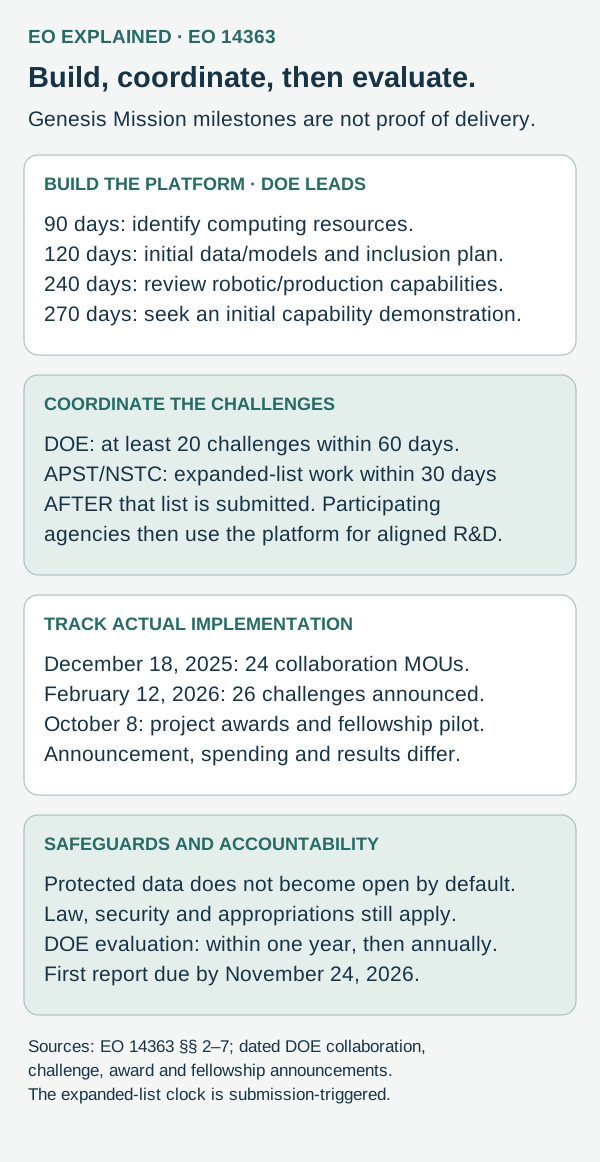
The rollout has several different tests. Identifying available computing resources is a 90-day task; choosing initial data/model assets and planning incorporation is a 120-day task; reviewing robotic and production capabilities is a 240-day task. At 270 days DOE must seek to demonstrate initial operating capability for at least one challenge, subject to law and available appropriations. A capabilities review, a funding award and a demonstrated scientific result are not interchangeable evidence. Sections 3(c)–(f).
DOE’s December 18, 2025 announcement described memorandums of understanding with 24 organizations whose positions ranged from expressions of interest to active projects. It did not say that every MOU was a completed procurement or that every organization had received unrestricted data access. The February 12, 2026 announcement then published 26 scientific challenges, including grid planning, historical nuclear data and autonomous laboratories. Publication of that list does not establish when DOE submitted its internal initial list to APST. Collaboration announcement; 26-challenge announcement.
On October 8, 2026, DOE announced 12 new Phase II project awards totaling $159 million and six additional Phase I awards. Examples included a proposed fusion-device digital twin, rare-earth extraction work and accelerator operations. These are agency-reported awards and proposed research aims, not evidence that all funds have been spent or that the promised capabilities have been independently validated. The same announcement described the total Phase II portfolio as 14 projects, including two earlier awards; that is not 14 newly announced awards that day. Award counts, amounts and project descriptions.
The graduate fellowship announcement on the same date was a new pilot funding opportunity, with an initial cohort of approximately 100 fellows planned. DOE described up to $100 million in planned funding, including $20 million in fiscal year 2027, with later-year funding contingent on congressional appropriations. A reader should not convert that plan into a claim that Congress had appropriated the entire amount or that fellows had already been selected. Fellowship pilot and funding conditions.
For practical participation information, use DOE’s current mission and collaboration pages rather than assuming the executive order creates an application entitlement. DOE identifies collaboration teams for data, infrastructure, models, challenges and public-private partnerships, and provides an official partnership inquiry route. Section 5 requires security and authorization processes for nonfederal users; section 7 creates no privately enforceable right to an award or platform access. Official collaboration route; Access safeguards and general provisions.
What happened after
Verified actions after the order
The challenge list includes AI-assisted grid planning, digitizing historical nuclear research, adaptive particle accelerators, materials design, and autonomous laboratories. DOE said the consortium included all 17 national laboratories, five National Nuclear Security Administration plants and sites, and 41 industry, nonprofit, and philanthropic organizations, while it was expanding academic participation. These announcements document resources and selected problem areas; they do not establish that the mission has already doubled research productivity or produced validated scientific breakthroughs. See DOE’s 26-challenge announcement and July consortium update.
Who had to do what
| Agency / office | Action | Timing / position |
|---|---|---|
| Secretary of Energy / DOE | Implement the mission and establish the secure American Science and Security Platform. Identify computing resources, initial data/model assets and a dataset-incorporation plan; review robotic/production capabilities; seek an initial operating-capability demonstration. Submit at least 20 challenges, update them annually, establish secure partner/IP/data-use frameworks, and submit the annual evaluation report. DOE bears publication costs. | Sections 3(c)–(f): 90, 120, 240 and 270 days from signing. Section 4(a): 60 days for the initial challenge list. Section 6: report within one year, then annually. The demonstration is an instruction to seek a result, subject to law and appropriations; other framework/cost tasks have no separate numerical deadline. |
| Assistant to the President for Science and Technology (APST) | Provide general leadership through NSTC; review and coordinate an expanded challenge list; convene interagency alignment, data/resource plans, funding/prize mechanisms and workforce programs; coordinate external and appropriate international collaboration; route the evaluation report. | Expanded-list review within 30 days after DOE submits its initial list, not 30 days from signing; sections 2(c), 4(b) and 5–6. Other coordination is ongoing without a numerical completion date. |
| National Science and Technology Council (NSTC) / participating agency members | Serve as the interagency coordination forum; work with APST on the expanded list and mission activities; consult on annual challenge updates. | Initial expanded-list work follows submission of DOE’s list; annual challenge review thereafter. Sections 2(c), 4(b), 4(d) and 5. |
| Federal Chief Data Officer Council | Support APST/NSTC in convening agencies and aligning appropriate data, infrastructure and resource plans. | Section 5(a); no independent report or numerical deadline. |
| Chief AI Officer Council | Support APST/NSTC interagency convening and alignment of mission-relevant AI activities. | Section 5(a); no separate numerical deadline. |
| Participating executive departments and agencies | Propose challenges, use the platform for aligned research after development of the expanded list, and coordinate appropriate data, infrastructure, funding and experimental resources within their own missions. | Sections 4(b)–(c) and 5(a)–(b); sequence depends on the expanded list. Existing law and available appropriations still govern participation. |
| Special Advisor for AI and Crypto | Coordinate with Energy and APST on mechanisms for collaboration with qualified external partners. | Section 5(c); no independent award or platform-delivery deadline. |
| Director of the Office of Management and Budget | Receive DOE’s annual evaluation report as a route to the President, together with APST. | Section 6(a): first report within one year of signing, then annually. This is distinct from section 7’s general OMB savings clause. |
Counting calendar days from November 24, 2025 gives January 23, 2026 for 60 days; February 22 for 90; March 24 for 120; July 22 for 240; and August 21 for 270. The first annual report is due by November 24, 2026. These are calculated milestones, not findings that each task was completed. The expanded-list clock cannot be fixed without knowing the initial list’s actual submission date. Original sections 3–6.
What happened next
Executive Order 14363 signed.
Order published in the Federal Register.
DOE announced collaboration MOUs with 24 organizations, distinguishing expressions of interest from active projects. DOE source.
DOE announced 26 science and technology challenges. The publication date does not establish the initial list’s internal submission date. DOE source.
DOE announced 12 new Phase II awards totaling $159 million and six additional Phase I awards; awards are distinct from outlays or validated research results. DOE source.
DOE announced a graduate fellowship pilot funding opportunity, with planned funding and later-year appropriations conditions. DOE source.
Legal and source detail
How it works legally
The order organizes executive research responsibilities; its opening cites presidential authority generally rather than a new standalone Genesis spending statute. Sections 3–5 limit action by existing law, protected-data rules and available appropriations. Section 7 preserves agencies’ lawful authority and creates no enforceable private right or benefit. Therefore a mission goal is neither a congressional appropriation nor an exemption from classification, privacy, intellectual-property or export-control law. Signed authority and limitations.
Sources by type
If a source is unavailable, first check the cited publisher or another official repository. The cited publisher remains the authority.
Primary and official sources
Orders, laws, court records and official implementation material.
- NNSA — Aires Tide demonstration (June 2026) (opens in a new tab) Official record
- DOE — December 18, 2025 collaboration MOUs
- DOE — February 12, 2026 challenge list announcement
- DOE — October 8, 2026 Phase I/II award announcement
- DOE — October 8, 2026 graduate fellowship pilot
- DOE — current platform description
- DOE — current collaboration and inquiry route
- Federal Register — current EO 14363 disposition
How we checked this
Last checked against the sources above on October 4, 2026. How we research →
Additional evidence review: October 17, 2026. The full signed order and selected dated DOE implementation records were checked. The reviewed records do not independently establish every milestone’s completion, the internal list-submission date, actual outlays, a complete current court position or the not-yet-due annual report.