Executive Order 14364: Addressing Security Risks From Price Fixing and Anti-Competitive Behavior in the Food Supply Chain
President: Donald J. Trump
Directed DOJ and FTC to investigate competition and foreign control in food supply chains.
Status: In effect.
Is Executive Order 14364 still in effect? Yes. Active competition-enforcement direction.
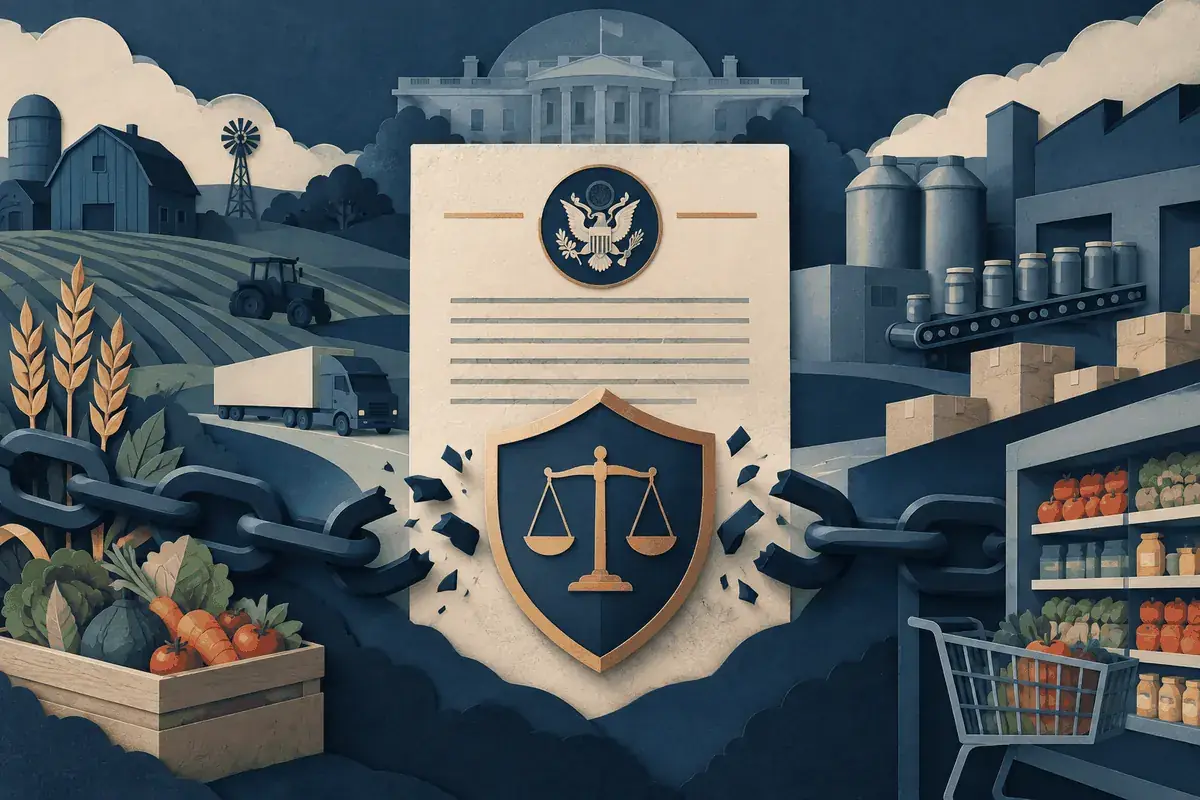
What does Executive Order 14364 do?
The Attorney General and FTC chair were each to create a Food Supply Chain Security Task Force, investigate possible anticompetitive conduct and brief congressional leaders within 180 and 365 days. Any enforcement action depends on investigative findings and applicable law.
Later official evidence reviewed September 26, 2026: DOJ reported establishing an Antitrust Division Food Supply Chain Security Task Force in May 2026; FTC’s FY 2027 budget justification also reports its corresponding task force. Neither report establishes liability or lower food prices.
Reading the operative provisions of Executive Order 14364
EO 14364 directs the Justice Department and Federal Trade Commission to investigate competition concerns and potential foreign control in food supply chains. It calls for task forces and review of conduct such as price fixing, market concentration or practices that may raise costs for farmers, processors and consumers. The Federal Register text sets agency assignments; it does not establish that any named company fixed prices or committed an antitrust violation.
Antitrust enforcement requires evidence of conduct covered by the Sherman Act, Clayton Act or other applicable law. Market concentration alone is not automatically unlawful, and price changes can have many causes, including supply, weather, transportation and demand. DOJ and FTC investigations may examine documents, market structure and communications before deciding whether to file a case.
The order also treats food supply as a national-security concern. That policy framing can guide review but does not substitute for the legal elements of an antitrust offense. Agencies must use lawful investigative powers and protect confidential business information. Consumers and producers can assess results through public complaints, settlements, judgments and market data—not by assuming that a task force’s creation proves misconduct.
What happened after
Verified actions after the order
DOJ reported establishing an Antitrust Division Food Supply Chain Security Task Force in May 2026; FTC’s FY 2027 budget justification also reports its corresponding task force. Neither report establishes liability or lower food prices.
Who had to do what
| Agency / office | Action | Timing / position |
|---|---|---|
| President | Issued the executive order and stated the administration policy | December 6, 2025 |
| Named departments and officials | Carry out the directions, reviews and reports specified in the order | According to the deadlines in the primary text |
| Office of the Federal Register | Assigned the EO number and published the signed document | December 10, 2025 |
What happened next
Executive Order 14364 signed.
Order published in the Federal Register.
Legal and source detail
Sources by type
If a source is unavailable, first check the cited publisher or another official repository. The cited publisher remains the authority.
Primary and official sources
Orders, laws, court records and official implementation material.
How we checked this
Last checked against the sources above on September 26, 2026. How we research →