Executive Order 14235: Restoring Public Service Loan Forgiveness
President: Donald J. Trump
EO 14235 directs PSLF rulemaking. Its implementing rule was vacated in June 2026; this guide explains the duties, court decision and later agency response.
Status: In effect. Is Executive Order 14235 still in effect? Yes. The Federal Register disposition entry does not record a revocation of this rulemaking directive. But its October 31, 2025 implementing rule was vacated on June 30, 2026, in the District of Massachusetts, and Education subsequently reported removing the related form attestation. The directive’s continued existence does not make that vacated rule an operative employer exclusion. Disposition entry; National Council of Nonprofits v. McMahon and Commonwealth of Massachusetts v. U.S. Department of Education, June 30, 2026; Education’s September 22, 2026 notice.
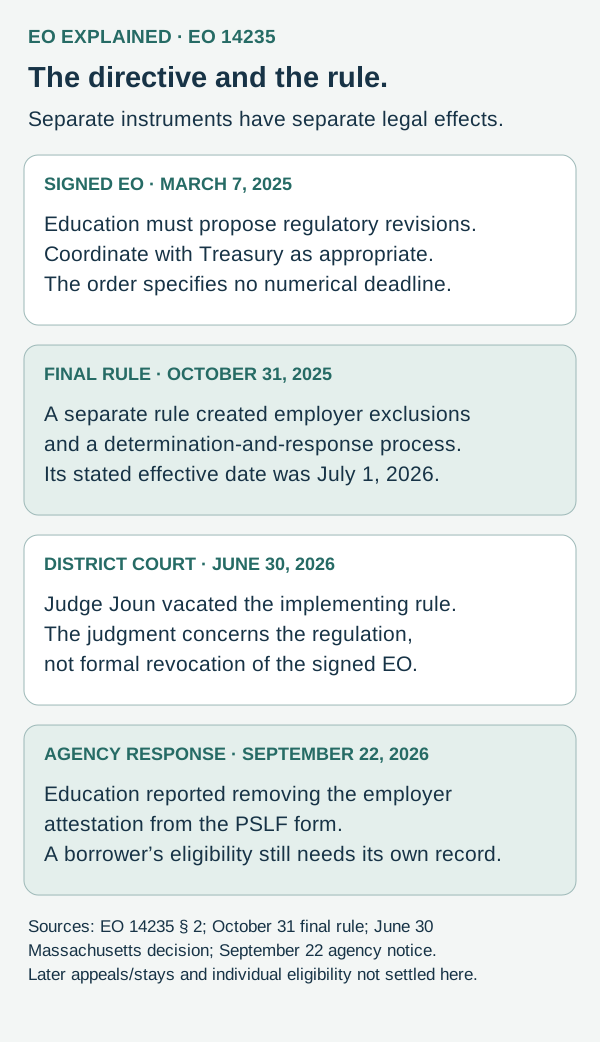
What does Executive Order 14235 do?
Education was told to propose public-service-loan regulations; any exclusion required the separate rulemaking and applicable law.
Later primary evidence reviewed September 24, 2026: Education published a Public Service Loan Forgiveness eligibility rule and expressly linked the revision to this order. Official source. The cited steps do not establish every downstream effect.
Reading the operative provisions of Executive Order 14235
Public Service Loan Forgiveness is created by statute, and qualifying borrowers receive cancellation after meeting statutory and program requirements. EO 14235 directed the Education Department to propose a regulatory change concerning employers the administration characterized as having a substantial illegal purpose. It does not itself cancel an individual’s forgiveness, recalculate a borrower’s payment count or remove an employer from eligibility without a separate rule and application of that rule. The order is published in the Federal Register.
The difference between proposing and finalizing a regulation is important. A proposed rule invites public comment and signals a possible policy; it ordinarily does not change existing eligibility on its own. A final rule must identify its statutory authority, respond to significant comments and provide an effective date. Borrowers and employers may have reliance interests, and any new employer exclusion must be consistent with the Higher Education Act and constitutional protections. The order’s instruction therefore begins an administrative process rather than functioning as an immediate borrower-level decision.
The later Federal Register rulemaking cited on this page provides evidence of a formal regulatory step, but readers should check its final text, effective date and any litigation before concluding how it affects a specific nonprofit or borrower. PSLF determinations depend on qualifying employment, eligible loans, repayment history and program rules. An employer’s mission or public controversy alone does not automatically establish that a borrower is ineligible. Borrowers should rely on the current Education Department rules and their account-specific records, not infer an individual result from the executive order’s broad language.
Education published its final eligibility rule on October 31, 2025, with a stated July 1, 2026 effective date. It proposed an employer-determination process, notice and an opportunity to respond, and protection for earlier qualifying work until an employer’s disqualification became effective. Those were features of the later regulation, not immediate consequences of signing EO 14235. Final rule, summary and major provisions.
On June 30, 2026, Judge Myong J. Joun of the U.S. District Court for the District of Massachusetts vacated the final rule in National Council of Nonprofits v. McMahon, No. 25-13242, and the related Commonwealth of Massachusetts v. U.S. Department of Education, No. 25-13244. The decision found the rule beyond statutory authority, arbitrary and capricious, and contrary to the First Amendment. It set aside the regulation; it did not purport to revoke the executive order as a presidential instrument. Memorandum of decision, conclusion at page 68.
Education’s September 22, 2026 notice says it was removing the attestation about substantial illegal purpose from the PSLF form to comply with the court order. That is documented agency action after the judgment, not proof of every individual borrower’s eligibility or the ultimate result of later appellate proceedings. Official form-revision notice. Borrowers can use the official PSLF Help Tool for employer and employment certification; this guide does not determine an individual payment count.
Before and after
Before the order
PSLF eligibility followed 20 U.S.C. §1087e(m) and Education regulations based chiefly on employer type and qualifying service.
After the order
Any eligibility change requires a valid regulation and cannot cancel statutory forgiveness rights merely through the order.
Education published a Public Service Loan Forgiveness eligibility rule and expressly linked the revision to this order.
Who had to do what
| Agency / office | Action | Timing / position |
|---|---|---|
| Secretary of Education | Propose revisions to 34 CFR 685.219 excluding organizations with the substantial illegal purposes specified in section 2 from the definition of public service; coordinate with Treasury as appropriate. | No numerical deadline in the signed order; separate lawful rulemaking required. |
| Secretary of the Treasury | Coordinate with Education as appropriate on the proposed revisions. | As appropriate during proposal development; no separate numerical deadline. |
The signed order assigns no Attorney General identification task. Treasury is a coordination partner, not a separate borrower-eligibility decision maker under this order. Signed section 2.
What happened next
EO 14235 signed.
Education published a final rule with a stated July 1, 2026 effective date. Official record.
Judge Joun vacated the implementing rule in the related Massachusetts cases; this was a judgment about the regulation. Official record.
Education reported removing the PSLF form attestation in compliance with the June 30 vacatur. Official record.
Later primary evidence reviewed: Education published a Public Service Loan Forgiveness eligibility rule and expressly linked the revision to this order.
Legal and source detail
How it works legally
Congress created PSLF. Definitions must remain within the statute, provide fair notice and comply with the APA, due process and First Amendment protections.
The June 30 decision treated Congress’s definition of public-service jobs in 20 U.S.C. 1087e(m) as a limit on Education’s power to add employer exclusions. The APA and First Amendment findings concerned the final rule’s statutory basis, reasoning and effect on protected expression. An executive policy preference does not itself amend the statute. The cited judgment and later agency notice establish those events; a complete current appeal or stay record was not recovered in this review. Decision, pages 45–49 and 68.
Sources by type
If a source is unavailable, first check the cited publisher or another official repository. The cited publisher remains the authority.
Primary and official sources
Orders, laws, court records and official implementation material.
How we checked this
Last checked against the sources above on September 24, 2026. How we research →
Additional evidence review: October 17, 2026. Read the signed order, selected final-rule provisions, the cited court analysis and conclusion, and the later agency notice. The current appeal or stay position and individual employer determinations are not exhaustively established.