Executive Order 14240: Eliminating Waste and Saving Taxpayer Dollars by Consolidating Procurement
President: Donald J. Trump
Directed GSA to become the executive branch’s primary buyer of common goods and services and required agencies to propose procurement consolidation.
Status: In effect. Is Executive Order 14240 still in effect? Yes. Executive Order 14240 remains in effect. See Federal Register record.
What does Executive Order 14240 do?
Agencies had to propose common-purchase consolidation, after which GSA and OMB would develop an implementation plan.
Reading the operative provisions of Executive Order 14240
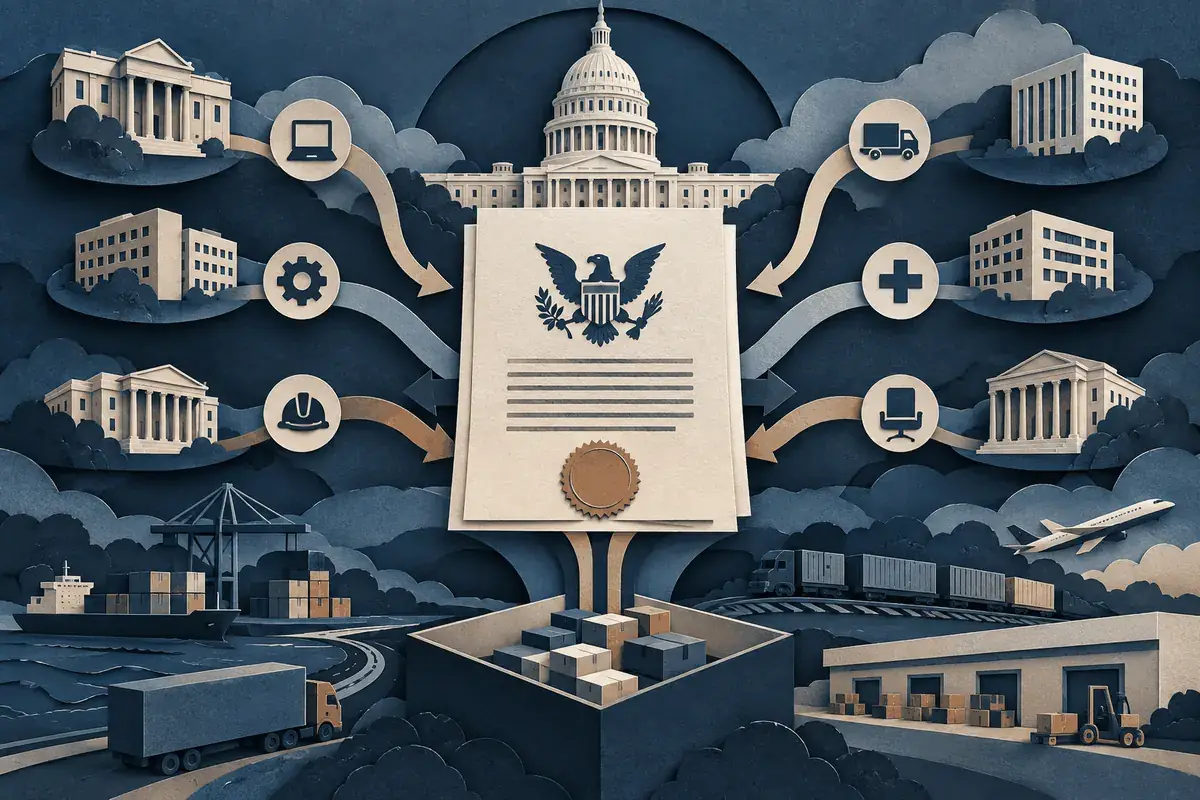
EO 14240 seeks to combine commonly purchased goods and services under a more centralized federal buying model. It makes the General Services Administration the primary purchasing agent for common items and requires agencies to identify procurements that could be consolidated. The goal is to reduce duplicative contracts and improve purchasing terms, while leaving mission-specific acquisitions with the agencies that need them. The order’s text is in the Federal Register publication of EO 14240.
Central purchasing can change who runs a solicitation without changing what an agency is legally allowed to buy. GSA and agency officials still need to follow the Federal Acquisition Regulation, appropriations restrictions, competition requirements and any small-business rules that apply. A consolidated vehicle may set common prices or terms, but the ordering agency remains responsible for determining that a purchase meets its needs and is properly funded. The order therefore concerns administrative structure and coordination, not a blanket waiver of procurement law.
The required agency plans are an early deliverable. A plan can identify categories, timelines and proposed transfers, but it does not prove a contract has been moved or savings achieved. To evaluate results, compare solicitations and awards before and after consolidation, including total price, delivery, competition and administrative costs. Consolidation may create scale efficiencies, but it can also concentrate vendor dependence or reduce flexibility if the requirements differ across agencies. The order’s promise of taxpayer savings is an objective to test against procurement data, not an automatic result of changing the lead buyer.
The planned transfer of buying work can also affect supplier access and contract administration. Agencies should document how requirements were grouped, whether the chosen vehicle permits adequate competition and how performance will be measured. A lower unit price is not by itself proof of lower total cost if transition expenses, delivery delays or agency-specific modifications offset the savings. These details make the order’s consolidation goal measurable while preserving the need for each purchase to meet its mission.
Before and after
Before the order
Agencies used decentralized contracts alongside GSA schedules and government-wide vehicles.
After the order
GSA created an Office of Centralized Acquisition Services and began transitioning contract vehicles, including NIH government-wide acquisition contracts.
Who had to do what
| Agency / office | Action | Timing / position |
|---|---|---|
| Agency heads | Submit proposals to consolidate common purchasing at GSA | 60 days |
| GSA and OMB | Approve an implementation plan | 90 days |
| GSA | Execute centralized acquisitions | Ongoing |
What happened next
EO 14240 signed.
Legal and source detail
How it works legally
Consolidation remains subject to the Federal Acquisition Regulation, competition statutes, small-business requirements, appropriations and existing contract rights.
Sources by type
If a source is unavailable, first check the cited publisher or another official repository. The cited publisher remains the authority.
Primary and official sources
Orders, laws, court records and official implementation material.
- GSA procurement consolidation (opens in a new tab) Official record
- GSA NIH GWAC transition (opens in a new tab) Official record
How we checked this
Last checked against the sources above on September 9, 2026. How we research →